Tuning Up: Sensory Awareness to Help Kids Learn

Last week, I got to attend a workshop at Parents Place in Palo Alto called Getting Ready to Learn: a Sensorimotor Approach, led by Lisa Kaplan Shaanan.  The class was intended primarily for preschool teachers and parents, but several children’s librarians from our library system also attended in the hopes of learning how to make our storytimes and children’s events more inclusive for kids with special needs.

I’m still thinking through the different ways I might incorporate what I learned from the class into my library programs, but as a parent, I found it fascinating.  The instructor began by talking about Sensory Processing Disorders, which are estimated to affect anywhere from 5 to 16 percent of school-aged children.  The disorders affect each child in different ways, but all of them can inhibit their ability to concentrate and learn.

Some kids are overly sensitive to touch, and can be distracted by tags in clothing, dislike being touched, or frequently walk on their tiptoes.  Others can be bothered by bright lights or strong smells, have trouble processing sounds, be picky eaters, or seem clumsy or careless.  The sensory processing disorder can affect any of eight basic senses: sight, hearing, smell, taste, touch, proprioceptive input (your internal map of your body), interoception (the sense of what’s happening inside your body: hunger, thirst, etc.), and vestibular input (the sense of balance).  And any of these senses can be overly responsive, or not responsive enough (leading to kids who are unaware of being dirty, or touching other children too roughly).

Although I know kids who have been diagnosed with sensory processing disorder, it was good to realize that it can take a lot of different forms.  For example, the boy who is holding his ears during circle time is not doing it to be rude, and the girl who is sprawled across the floor instead of sitting “criss-cross applesauce” may not have the muscle tone she needs to sit up straight (kids with sensory processing disorders often have low muscle tone and underdeveloped motor skills).

But the part of the workshop I found most interesting was about how to help kids recognize when they are feeling too alert (in fight or flight mode) or not alert enough to learn.  This is useful for adults too.  The instructor passed out a checklist of sensory activities, like chewing gum, chewing on a pencil, stretching, rocking, twisting your hair, listening to classical music, etc., and asked us to mark whether each one made us calmer or more alert.  The list even included my favorite alertness regulator, coffee, although not my favorite calmness one: red wine.  She talked about how there is an ideal state of alertness, and how we all instinctively do things throughout the day to regulate our nervous system.  After the class, I found myself more aware of small triggers that made me temporarily stressed, like when both my kids were talking to me at once, or when my husband turned on the fan over the kitchen stove (a sound that for some reason makes me feel like I have bees in my brain).

For kids, Shaanan offered an analogy of an engine to help them understand the idea of finding the right level of alertness (this is based on The Alert Program by Therapy Works).  She asked what happens when an engine runs too fast: it gets out of control, it crashes, you get a speeding ticket.  But if the engine is running too slow, other people around you can get frustrated, and you might still get a ticket.  The idea is to help kids get their engines running just right.  They may need to move around to wake themselves up, or do some activities to calm down.  One easy technique Shaanan demonstrated was having us all stand up and hum together, while bouncing lightly on our feet.  She also had us pair up and try matching our breath with our partner.  This was a calming exercise that reminded me of a game I sometimes play with my kids, where we try to sing the same note.  The kids love to change the pitch up and down, but something magical happens when we all find the same pitch again.

A lot of the class focused on visual cues, and Shaanan had us make this cute speedometer to help kids indicate how calm or alert they were feeling:

20160207_182944

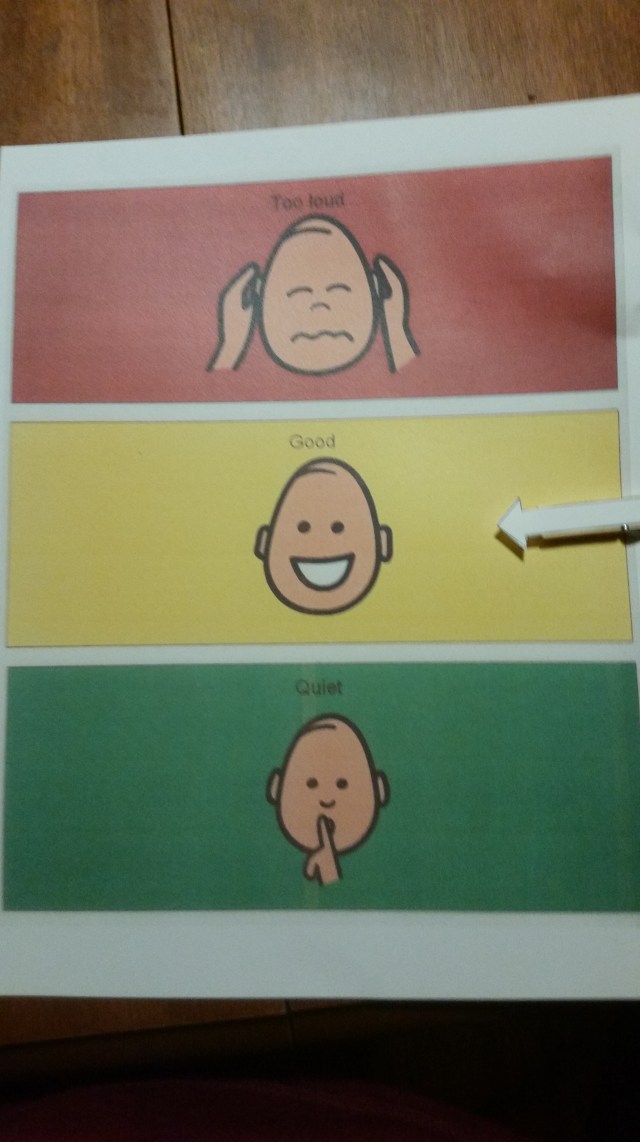
Another useful visual cue tool she provided was this handy noise indicator, which I can imagine using at storytime (mostly for the chatty adults in the audience!).  The arrow is attached to a clothespin to make it easy to move:
20160207_220428

I’ve gone to a lot of trainings over the course of my career, but this was one of the best, partly because the instructor and the Parents Place staff had taken pains to equip us each with everything we needed to keep ourselves at the right level of alertness.  There was a range of snacks at both a main table in the back, and on each of the tables where we were sitting.  There were “fidgets” (small toys like wind-ups and things that were fun to touch or move) in baskets at each table too.  She also made of point of telling us to feel free to stand up, move around, or go to the bathroom whenever we needed to.

I realized midway through the class that I was actually very hungry, something I would ordinarily just have lived with, but it really did make it easier to concentrate when I dove into the snacks.  Shaanan also cited the statistic that 26% of California children live in food-insecure households, pointing out that hunger and thirst are fundamental needs that have to be met before kids have any hope of learning.

As a librarian, the class was mostly validating. As a parent whose own two kids often preferred to roam the library like wildebeests during storytime, I tend to give other people’s kids a lot of flexibility to move around, as long as they don’t interfere with the other kids’ ability to hear the story or see the pictures.  I like to incorporate a range of activities, including movement activities and songs in between stories, instrument play with a variety of shakers and maracas after all the stories, and a craft at the very end that gives them a chance to work with a range of art tools, and make something in their own way.

What I could definitely use more of are visual cues: flannel boards, puppets, and props.  I may also explore the possibility of getting small cushions or mats (the instructor showed us several types of “wiggle” cushions designed to give kids the sense of moving, even when they were sitting still.  These are pretty pricey, but she said you could improvise with an inflatable beach ball that is only very slightly inflated).  And I definitely plan to raid my friend Ashley Waring’s wonderful blog, Libraries Serving Children with Autism, for other ideas to make my story times better for kids with a range of special needs.

My biggest takeaway from the class was that I’d like to be more aware in general, both as a librarian and a parent, of how every one has their own unique stressors and challenges, and maybe the next time my daughter and I are having a huge argument about something mundane like homework, we may just need to stop and have a snack, play some ’80s music on Pandora, or just take a moment to breathe.

*      *      *     *      *

Some other fun activities, tools, and ideas Lisa Shaanen presented were:

1.Controlled Wrestling: two people sit on the floor (or stand, if they are older and more coordinated) facing each other.  Each person asks the other, “Are you ready?” They both agree to stop as soon as the other person says “STOP!”  Then they try to push each others’ hands to knock them over.  I’ve tried this with both of my kids, and they loved it.

2. This fun “fidget” for kids who struggle with waiting.  You hand it to them, and say, “We’re waiting,” and they can play with the little koosh ball until it’s their turn:20160208_171752 (1).jpg

3. A bubble blower made out of a cup with a straw stuck through a hole punched in the side.  You put a small amount of dish detergent and water in the cup, and blow into the straw to make a mountain of bubbles.  Shaanen said for younger kids you can poke a small hole in the straw to keep them from accidentally drinking the soap.  Activities that involve blowing air can be calming and help built breath control.

4. Another simple game with a straw and a pompom, where you make a croquet wicket (hoop) out of masking tape that you attach to the table.  Then you try to blow the pompom through the hoop.

5. A collection of small pictures showing different ways kids might use to calm down when they are feeling angry out of control: going to the bathroom, reading, sitting in a comfy chair, having a drink of water, etc.  Shaanen suggested that for kids who struggle with self control, you can ask them to identify three ideas they might try during the day if they need to calm down.  The pictures have Velcro on the back, allowing the child to move them onto a chart which shows a picture of an angry child at the top and a happy one at the bottom: a visual cue you can use to remind them of their choices later.

RECOMMENDED RESOURCES:

Lisa Shaanen gave us an extensive list of recommended resources.  Here are a few that she highlighted:

No Longer a Secret: Unique Common Sense Strategies for Children with Sensory or Motor Challenges by Doreit Bialer and Lucy Jane Miller.

Sensory Parenting: From Newborns to Toddlers by Britt Collins and Jackie Linder Olson.

The Out of Sync Child by Carol Kranowitz.

Understanding Your Child’s Sensory Signals by Angie Voss.

Take Five: Staying Alert at Home and School by Mary Sue Williams and Sherry Shellenberger.

FOR KIDS:

Ellie Bean the Drama Queen: A Children’s Book about Sensory Processing Disorder by Jennie Harding; illustrated by Dave Padgett.

You are My I Love You by Maryann Cusimano Love; illustrated by Satomi Ichikawa.

Calm Down Time by Elizabeth Verdick; illustrated by Marieka Heinlen.

For parents and teachers in the Bay Area who are interested in learning more about working with kids with sensory processing disorders, or just about any other child-related topic, I highly recommend the workshops and programs offered by Parents Place.

Also, if anyone has any suggestions of ideas and strategies for working with special needs kids in a library setting, please write them in the comments.  I would love to learn more!


Get Wet! Water Science at the Library

I’ve been continuing to do monthly science programs for grades 4-6 at the Burlingame Library.  It’s a challenge finding activities that are interesting enough for that age group, but easy and inexpensive enough to coordinate with a class of 25 kids.  I’m always a little bit nervous to see how the projects will work, but I am loving the interactions with the kids, who are always enthusiastic and full of ideas.  This month’s topic was Water.  I had three projects planned: a paper clip challenge, to introduce surface tension; a clay boat challenge, to introduce buoyancy; and an electrolysis project, to demonstrate the composition of water.

I started out with a conversation about what the kids already knew about water: that it’s made up of two hydrogen atoms and one oxygen; that it makes up most of our bodies and the earth’s surface; and all of the different ways we use it, from growing food to generating energy.

Then I had the kids go to the tables, and gave them each a paper clip and a paper bowl half full of water.  I told them that their challenge was to get the paper clip to float on the surface.  The tools they could use were a tissue or another paper clip.  Some of the kids were able to get the paper clip to float by very carefully setting it on the surface of the water with their fingertips.  Others lowered the paper clip onto the water with a tissue, which would sink, leaving the paper clip floating.  A few kids actually took pieces of cardboard from the tissue box and made little rafts for the paper clip.  None of them used the second paper clip idea (you can partially straighten the second paper clip and use it to lower the first one onto the surface), but they all found a solution.  I gave a brief explanation about how this was another demonstration of surface tension: the water molecules clinging together create a kind of a “skin” on the top of the water.

20160207_093234

Paper clip floating on the water due to surface tension


Their second challenge was to get a ball of Sculpey clay to float on the water.  This was by far the thing that excited them the most.  It took them a minute or two to come up with the idea of shaping the clay into boats.  After that they were all eagerly making Sculpey boats and asking if they could add different components, like paper clip sails.  They could have happily spent the whole rest of the class doing that.  We discussed the idea of buoyancy, the upward force that the water exerts on objects.  I demonstrated buoyancy by pushing a ping pong ball to the bottom of a cup of water, and showing how it shot up to the surface when I let it go.  I didn’t get to go into the details of Archimedes’ principle, so I’d like to come back to that in a future class.

20160207_093746

Boat made out of Sculpey clay to demonstrate buoyancy

The last part of the class was the electrolysis activity.  First, I had to show them the acid/base indicator we were going to use: the juice of a red cabbage (I used a juicer, but you can also just boil the leaves).   I demonstrated that when you add vinegar (an acid) to the red cabbage juice, it turns pink, and when you add baking soda (a base) to the juice, it turns green.  I explained that we were going to use electricity to split water into hydrogen gas (H+) and hydroxide (OH-).

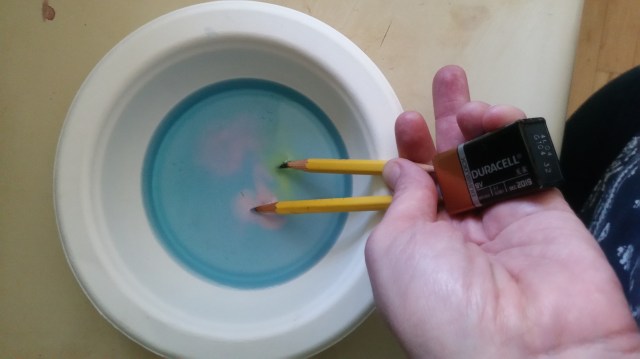
I gave each student a 9 volt battery, two short pencils that had been sharpened at both ends, and some poster tack.  They still had their bowls of water from the previous activities, and I added a small amount of red cabbage juice to each bowl (we found the experiment worked better if the water was only slightly bluish).  I also added a spoonful of Epson salt to each bowl, and explained that it make the electrolysis work more effectively.

The biggest challenge the kids found was getting the pencils to adhere to the battery terminals with the poster tack without breaking the pencil tip or preventing the tip from touching the metal of the battery.  In some cases, I had the kids remove the poster tack altogether, and just hold the pencils in place while they lowered the other ends into the bowls of water.  Once they did that, the water would bubble around the pencil tips.  Hydrogen ions (H+) collect at the positive terminal of the battery, making the water more acidic, and turning the cabbage juice pink.  Hydroxide (OH-) ions collect at the negative terminal, forming a base, and turning the cabbage juice green.

20160208_110623

Electrolysis of water with a red cabbage juice pH indicator.  The pink color indicates the formation of Hydrogen (H+) ions, while the greenish color indicates Hydroxide (OH-).

It was a fun class overall, although I think it has inspired to do more construction based challenges in the future, since they had so much fun making the boats.  I would love any ideas for future classes, so please share them in the comments.


Birds on Ice: a Storytime for Penguin Awareness Day

Today is Penguin Awareness Day, in case you were unaware.  I’m always happy to find obscure celebrations that actually lead to good storytime themes, and I was especially happy about this one, because there are LOTS of picture books about penguins.

Here’s what we read:

penguins everywhere

Penguins, Penguins Everywhere by Bob Barner

This is a cute and colorful, simple introduction to penguins.  It includes basic facts, like penguins live in hot places as well as cold ones, the penguin dads carry their eggs on their feet, etc.  It has a nice display of different types of penguins at the end.  It was an ideal length for a nonfiction opener to the storytime, and the kids seemed to enjoy it.  It was snatched up at the end.

one cool friend

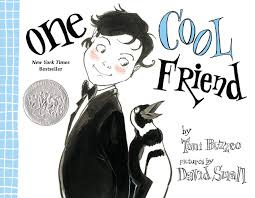
One Cool Friend by Tony Buzzeo; illustrated by David Small

I’ve been getting a lot more school-aged kids at Family Storytime, and this was a fun, lengthier story for them.  When Elliot, a very proper boy, visits the aquarium with his father, he takes home a penguin in his backpack and names it Magellan.  To make Magellan feel at home, he builds an ice skating rink in his bedroom, lets him sleep in the freezer, takes him to the library to do research, and draws him a bath to swim in.  The kids loved the funny twist at the end when Elliot’s father asks him where the penguin came from, and reveals a surprise of his own.  There was a very brief, quiet skirmish after I read it between two kids who both wanted to check it out.

tacky

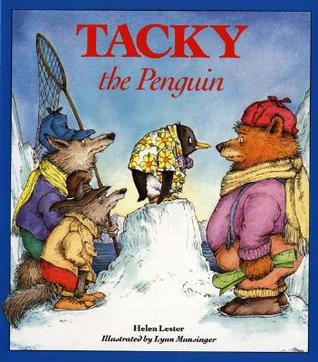
Tacky the Penguin by Helen Lester; illustrated by Lynn Munsinger

Tacky is a very odd bird.  Unlike all of the other penguins, who march neatly, dive gracefully, and sing beautifully, Tacky has his own unique, boisterous way of doing things.  But when a band of hunters comes looking for penguins, Tacky’s odd ways save the day.  This one got big laughs from the kids, especially in the parts where Tacky marches, and his counting is all out of order.

lost and found

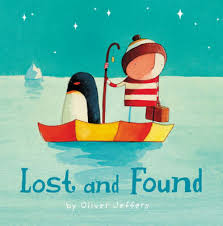
Lost and Found by Oliver Jeffers

When a boy finds a sad-looking penguin at his door, he decides that it is lost and sets out in a row boat to return it to the North Pole.  But, once he does, he realizes that the penguin was not lost after all, but merely lonely.  A simple, sweet fantasy that worked well with the group, especially because they could relate to the huge waves portrayed in several of the illustrations (we’ve had enormous waves here on the California coast this past week, and the kids were all buzzing about it).

SONG:

I didn’t know of any good kids songs about penguins, so I wrote this one.  I played it on the dulcimer, a Christmas present from my in-laws that I am enjoying. Click on the triangle for the tune:

I Am A Penguin

I am a penguin,
My wings cannot fly.
Not like the petrols
And gulls in the sky.

CHORUS:
But put me in the water
And then you will see.
There’s no bird in the ocean,
Who flies as fast as me.

On land I may waddle,
And look quite absurd.
A flightless and clumsy,
Black-and-white bird.

CHORUS

My home is the ice
Where we huddle for heat.
I carry my egg
On the top of my feet.

CHORUS

I am a penguin,
My wings cannot fly.
But my home is the ice,
And the sea is my sky.

CHORUS

CRAFT: Fingerprint Penguins

20160120_194322 (1)

Fingerprint Penguins and Handprints by Paxton

20160120_194740

Fingerprint Penguin, Butterfly and Tree by Olivia

There are lots of versions of this craft online, but I wanted to keep mine simple, and just use markers and ink pads.  I also put out Ed Emberley’s Fingerprint Drawing Book, so the kids could explore other things to make with fingerprints.  They had a great time, and all of their drawings came out completely different.

OTHER BOOKS ABOUT PENGUINS:

And Tango Makes Three by Justin Richardson and Peter Parnell; illustrated by Henry Cole

This book is controversial because of its portrayal of two male penguins who raise a chick together (based on real penguins at the Central Park Zoo).  But it’s a wonderful book with adorable illustrations, and while it does do an excellent job of portraying a nontraditional family in a very natural way, most kids will enjoy it simply as a sweet animal story, made even more compelling because it is true.

Turtle’s Penguin Day by Valeri Gorbachev

After Turtle hears a bedtime story about penguins, he decides to dress himself up as a penguin for school the next day.  His teacher embraces the idea, allowing his whole class to spend the day doing penguin activities: passing a ball with their feet, sliding on their bellies, etc.  This book does a nice job of seamlessly blending facts into a fictional story.

A Penguin Story by Antoinette Portis

Edna the penguin knows there must be something else besides the white of the snow, the black of the night, and the blue of the sea.  She sets out to find it, finally discovering the brilliant orange of a research base.  I didn’t get to share this one at storytime, but I wish I had, because I think the kids would have been intrigued by the idea of never having seen more than three colors.

What are your favorite books about penguins?


Finding Winnie: My Favorite Picture Books of 2015

Somehow it’s already mid-December, the time of year when I start thinking about the upcoming Caldecott Award announcement.  Every year, in January, I like to do Mock Caldecott storytimes, where I share several picture books and ask the kids to guess which one they think will win.  Here’s my list of favorite picture books published in 2015.  I’m basing it mostly on the reactions I’ve gotten from reading these aloud, either at storytimes, or with my 6 year-old daughter.

frog

I Don’t Want to Be a Frog by Dev Petty; illustrated by Mike Boldt

When a young frog complains that he’d like to be some other animal, because frogs are too slimy, and wet, and eat too many bugs, an older frog tries to counter all of his arguments.  The young frog isn’t convinced though, until a wolf tells him that he likes to eat every other animal, except slimy, wet, bug-eating frogs.  My daughter asked for this book several times, and it got laughs from both kids and parents at storytime.

stick

Stick and Stone by Beth Ferry; illustrated by Tom Lichtenheld

A stick and a stone are both lonely, until they meet and become friends.  When Pinecone picks on Stone, Stick sticks up for him because “that’s just what sticks do.” And when Stick gets stuck in a puddle, Stone rescues him.  This book reminds me of Kathryn Otoshi’s One, although it is a much simpler, lighter story that nicely summarizes what it means to be a good friend.  I haven’t shared this one at storytime yet, but my daughter loved it.

bear.jpg

How to Share with a Bear by Eric Pinder; illustrated by Stephanie Graegin

A boy builds a cozy fort out of blankets, only to find it constantly being taken over by a small bear.  He tries everything he can think of to lure the bear away from the fort– blueberries, honey, and a sink full of water and toys– and finally gets the fort to himself.  But then the bear is revealed to be his tearful little brother in a bear suit, and the boy rebuilds the fort so they can share.  A super sweet sibling story that was a hit at storytime.

tree

Little Tree by Loren Long

A little tree is afraid to let go of his leaves, even as all the trees around him shed theirs and grow new ones.  Over time, he is overshadowed by all of trees around him, until he can no longer see the sky, and is finally convinced to let go and grow.  I haven’t read this one at storytime yet, but when I brought home a stack of picture books to read to my daughter, she said it was her favorite.  It would work well for a theme about the seasons, but on a deeper level it’s a wonderful story about the pains of growing up.

princess

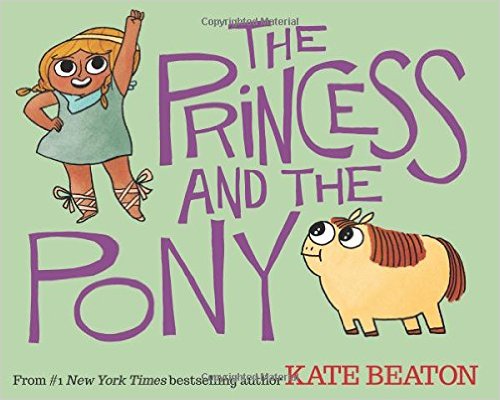
The Princess and the Pony by Kate Beaton

Princess Pinecone wants a big, strong, fast, warrior horse befitting a warrior princess.  Instead she gets a small, chubby, gassy pony.  But her disappointing pony ends up turning the battle around in a surprising way.  This one was a big hit both with my daughter, and with the kids at storytime.

cinderella

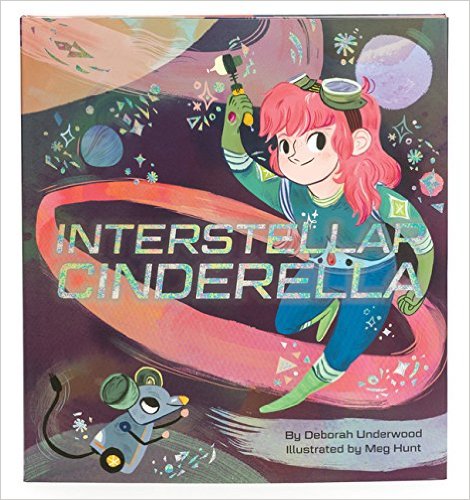
Interstellar Cinderella by Deborah Underwood; illustrated by Meg Hunt

Although there are lots of picture book variations on the Cinderella story, this one stands out because of its plucky, mechanically-inclined heroine.  In this story, Cinderella not only has to devise her own transportation to get to the Royal Space Parade, she also rescues the Prince when his ship breaks down.  I love the ending, where Cinderella declines to marry the Prince, and instead becomes his chief mechanic.  My daughter and I had fun reading this one together.

small

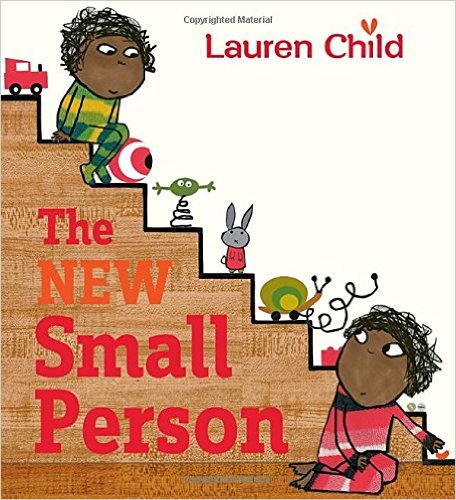
The New Small Person by Lauren Child

Elmore Green enjoys being an only child, and having his own room, where no one ever moves his things or eats his favorite jelly beans.  But then a new small person arrives, and Elmore worries that people seem to like him more than they do Elmore.  Plus the new small person moves his things, cries during his favorite television shows, and even licks his jelly beans.  But over time, Elmore learns that younger brothers can be fun, helpful, and even comforting.  My boss read this one at a storytime recently, and it was met with lots of laughs and “Aww’s.”

wolfie

Wolfie the Bunny by Ame Dyckman; illustrated by Zachariah OHora

One of my daughter’s favorite books of the year, this one’s about a family of bunnies who adopt an abandoned wolf pup.  Although her parents think that Wolfie is absolutely wonderful, little Dot is convinced he is going to eat them all up, until one day she and Wolfie have a run in with a hungry bear, and have to save each other.  Funny and adorable.

red.jpg

Red: A Crayon’s Story by Michael Hall

Red has a big problem.  Even though his label clearly says he is a red crayon, he only seems to be able to color things blue.  Everyone says he just needs to try harder, until one day a new friend asks him to color a blue ocean, and he finally discovers what he is meant to be.  This is wonderful allegory for anyone who’s ever felt forced to try and be something they’re not, but beyond that, my daughter was so taken with the story that she went on to write her own versions with different colors of crayons.

winnie

Finding Winnie: The True Story of the World’s Most Famous Bear by Lindsay Mattick; illustrated by Sophie Blackall

Before there was Winnie the Pooh, there was a man named Harry Colebourn, a veterinarian who bought a bear cub from a hunter at a train station in Canada.  He took the cub along with him to England, and named her Winnie, after his hometown of Winnipeg.  Winnie became the mascot of his military unit, but when Harry learned that he would have to go to France to help on the front lines, he brought her to the London Zoo, where she became a favorite among the visitors, especially a small boy named Christopher Robin.  When I was reading this book with my daughter, at first I found it jarring that it begins with a mother telling the story to her son.  But in end, the son is revealed to be the great-great-great-grandson of Harry Colebourn, and the woman telling the story is his great-great-granddaughter, the author of the book.  A lovely story, both for animal lovers and fans of Winnie the Pooh.  Funnily enough, there’s another new picture book out about this same story called Winnie: The True Story of the Bear Who Inspired Winnie-the-Pooh by Sally M. Walker, illustrated by Jonathan D. Voss.  I enjoyed that one too–it has a lot more details about the antics of the bear, and the illustrations are darling– but it didn’t give me the chills the way Finding Winnie did on discovering the connections between the book’s subject and its author.  I’m looking forward to sharing this book with the second graders I read to in the New Year.

What are your favorite picture books of the year?

Read Local: A Storytime about Bay Area Authors

Sorry, I haven’t had a chance to post my storytimes for quite a while.  But Monday (November 2) was National Author’s Day, so this week I decided to focus on some of my favorite authors from the San Francisco Bay Area.  Here is what we read:

extra

Extra Yarn by Mac Barnett; illustrated by Jon Klassen (Amazon.com link)

When Annabelle finds a box of yarn, she knits a sweater for herself, and her dog, Mars, her entire class, her parents, and all the people, animals, and buildings in town.  But still, she has extra yarn.  Until one day a greedy archduke sails across the sea to steal Annabelle’s box of yarn.  This is a wordier picture book than the others, but it still held the kids mesmerized (I read it to two second grade classes this week too, and several of them said it was their favorite).  The illustrations by Jon Klassen add color and whimsical humor to the story.  Mac Barnett, who lives in Oakland, has written a number of my favorite picture books, including Guess Again! and Count the Monkeys.

paint

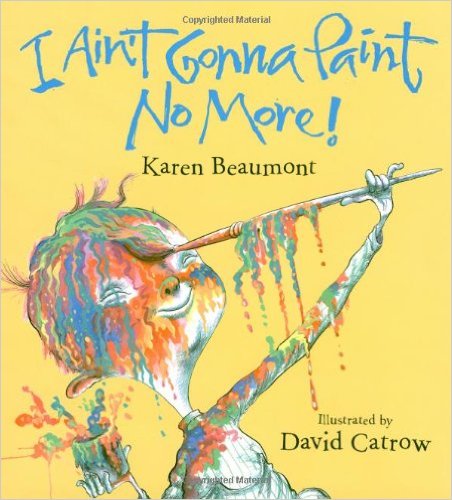
I Ain’t Gonna Paint No More by Karen Beaumont; illustrated by David Catrow (Amazon.com link)

This is one of those rare books that works for almost any age group.  A parody of the old song “It Ain’t Gonna Rain No More,” it tells the story of a naughty little boy who can’t resist painting himself all over.  I enjoy trotting out my Southern accent (I come by it honest, since I grew up in Georgia, although most people can’t tell).  Older kids enjoy trying to guess what body part the boy will paint next, based on the rhyme: “Still, I just can’t rest, ’till I paint my…Chest!”  “But I ain’t complete, ’till I paint my…Feet!”  The big punchline is the last line, when the boy’s horrified mother walks in, “But I’m such a nut, gonna paint my…WHAT?!”  This one is always a hit, and would make a fun addition to a lesson on rhyme.  Author Karen Beaumont, who lives in San Martin, has written lots of other fun rhyming books, including Who Ate All the Cookie Dough? and Baby Danced the Polka.

one

One by Kathryn Otoshi (Amazon.com link)

This book is powerful and ingenious, and works on so many different levels.  Blue is a happy color, except when he’s being picked on by Red.  All of the other colors like Blue, but they never tell Red to stop being mean to him, so Red becomes bigger and scarier and starts to bully all of them.  Until 1 comes along, and simply says, “No!” to Red’s threats, and all of the other colors realize that they can count too.  One by one, they turn into numbers.  The lovely thing about this anti-bullying message is that in the end, Red is welcomed back into the group because “everyone counts.”  I’ve used this book for lots of different themes, including numbers, colors, friendship, bullying, and even for Martin Luther King Jr.’s Birthday.  When I got to last line, “Sometimes it just takes 1,” one Dad audibly gasped, “Wow.”  Kathryn Otoshi, who lives in Marin County, has written several other picture books, including Zero, Two, and What Emily Saw.

rhino

My Rhinoceros by Jon Agee (Amazon.com link)

I love this book.  It’s about a kid who buys a pet rhinoceros, only to learn that rhinoceros don’t do much.  In fact, he is told, they only do two things: pop balloons and poke holes in kites.  The kid is deeply disappointed, until he sees two robbers escaping (you guessed it) in a balloon and a kite.  Such a random idea, and hilarious to read aloud.  Even the parents were laughing.  Jon Agee lives in San Francisco, and actually visited my son’s elementary school a few years ago.  My other favorite books by him are Milo’s Hat Trick and Nothing.

SONGS:

Head and Shoulders, Knees and Toes

I do the standard version of this song, which most people probably know, but do it faster and faster each time.

Rainbow ‘Round Me

I asked the kids to suggest things they saw outside of the window.  We had a rainbow dog, an orange cow, and a green silly pickle with a mustache!  The ukulele chords are in parentheses.  Click on the triangle for the tune:

When I look outside my window, (D, A)
There’s a world of color I see. (A, D)
Fiddle-dee-dee, outside my window (D, G, D)
There’s a world of color I see. (A, D)

CHORUS:
Rainbow, rainbow, rainbow ’round me. (G, D, A, D)

And the sky outside my window,
Is as blue as blue can be.
Fiddle-dee-dee, outside my window
It’s as blue as blue can be.

Chorus

Going to the Zoo

CRAFT: Dot Art

Dot Art by Mia

Dot Art by Mia

I was originally planning to do a yarn craft, like pom-poms or yarn dolls, to go along with Extra Yarn.  But I couldn’t figure out how to make it simple enough for the younger kids (I get anywhere from babies to second graders at my family storytimes).  In the end, I decided to fall back on my old standby–Dot Paints–to go along with One and I Ain’t Gonna Paint No More.

I was glad I did.  The first thing one of the kids said was, “Can we paint whatever we want?” When I said, “Yes,” his face lit up.  They all were so engaged in their creations, even the babies, and it was fun to see what they came up with.

OTHER PICTURE BOOKS BY BAY AREA AUTHORS

The Lion and the Little Red Bird by Elisa Kleven (Amazon.com link)

This beautiful story about an unlikely friendship between a bird and a lion whose tail is always changing color has been one of my favorites since library school.  Elisa Kleven, who lives in Albany, has a number of sweet picture books with lovely, colorful mixed-media illustrations, including The Puddle Pail, The Paper Princess, and The Wishing Ball.

The Dark by Lemony Snicket; illustrated by Jon Klassen (Amazon.com link)

I read this one to a second grade class the other day, and one of the kids came in to the library that very night to check it out.  Laslo is afraid of the Dark, until one night The Dark comes into his bedroom at night, and leads him down into the basement to find something he needs.  This is a wonderful read-aloud: atmospheric and creepy (like the dark), but not scary in the end.  It would work well for a lesson on personification.  Lemony Snicket (the pseudonym for San Francisco author Daniel Handler) is famous for his chapter book series, A Series of Unfortunate Events, but has also written the picture books 13 Words and The Latke Who Couldn’t Stop Screaming (my favorite Hanukkah book).

What are your favorite books by Bay Area authors?

Elephants in the Room: A Storytime for World Elephant Day

I had a whole superhero storytime planned for tonight, but when I got to work, my coworker, Nancy, told me it was World Elephant Day, a day dedicated to the protection of elephants and their habitats.  Well, I couldn’t resist that, especially since there are so many great elephant books, including the entire Elephant and Piggie series by Mo Willems.  I quickly reworked my plan.  Here is what I read:

silly

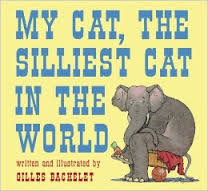
My Cat, the Silliest Cat in the World by Gilles Bachelet (Amazon.com link)

I read this one mostly because I was curious about how it would go over.  It’s basically one big visual joke: the author describes various things about her cat, but all of the illustrations are of a big elephant.  A few months ago, I heard it read at a storytime at another library, and the reader just jumped in without any explanation.  The kids in that audience mostly just looked perplexed, as if they were too polite to comment on what was obviously a huge mistake.  This time, I took a moment to read the kids the title and point to the literal Elephant in the Room, asking, “Is that a cat?!”  They all answered no, and from then on, at the least the older kids (maybe three and up) were in on the joke.  The illustrations are a lot of fun, showing the elephant sleeping on the TV, playing with yarn, and performing other cat-like activities.  The kids especially liked the page showing elephants with different patterns (black-and-white, leopard-spotted, etc.), and (of course) the picture of the elephant scooping poop into the litter box.

trunk

I Broke My Trunk by Mo Willems (Amazon.com link)

The hardest thing about this storytime was choosing which Elephant and Piggie book to read, but I settled on this one because it focused on Gerald’s trunk, and because it’s so much fun to read aloud.  Piggie is shocked to see Gerald with his trunk all bandaged up.  When she asks him what happened, he tells her a long, crazy story about trying to lift two hippos, a rhinoceros, and a piano on his trunk.  Surprisingly, that’s not how his trunk got broken…  The kids and parents all loved this one, and one mom took it home to share with her older son, who had somehow missed reading this book in the series.

foot

What to Do If An Elephant Stands on Your Foot by Michelle Robinson and Peter Reynolds (Amazon.com link)

A hapless girl is told what not to do when an elephant steps on her foot, and then proceeds to do exactly the wrong thing every time.  She startles the elephant, is chased by a tiger, gets treed by a rhinoceros, frightened by snakes, and threatened by a crocodile, until finally she is rescued by monkeys.  It’s a funny story with lots of ways for kids to participate: sneezing loudly, miming climbing a tree, taking deep breaths, etc.  The kids also enjoyed naming the animals as we got to each one.  This is a good example of a “circle story,” since the elephant is startled all over again at the end.

beautiful

A Beautiful Girl by Amy Schwartz (Amazon.com link)

A little girl out on a walk meets a baby elephant who comments on her very strange trunk.  When she explains that it is actually her nose, he asks her if she eats peanuts with it or sprays herself with water.  She tells him all the things she actually uses her nose for.  She then meets a robin, who thinks she has a silly beak, a fly, who asks if she has one hundred eyes, and a goldfish, who marvels at her silly gills.  The kids laughed at many of the misunderstandings.

SONGS:

Elephants Have Wrinkles

I learned this song back when I briefly taught Kindermusik, and I’ve loved it ever since.  I like to ask the kids for suggestions of where elephants have wrinkles (tonight we did legs, ears, tails, and bellies), and sing the song faster each time.  Click on the triangle for the tune:


Elephants have (pat legs on each syllable)
Wrinkles, Wrinkles, Wrinkles (clap hands on each syllable)
Elephants have (pat legs on each syllable)
Wrinkles (clap hands on each syllable)
Everywhere! (stomp feet on each syllable)
On their nose! Oh-oh! (touch your nose, and mime a trunk)

Repeat

Elephants have wrinkles…

On their legs! On their nose! Oh-oh!

The Elephant Goes Like This And That

The elephant goes like this and that (swing arm like a trunk)

He’s oh, so big (spread arms wide)

And he’s oh, so fat!

He has no fingers (wiggle fingers)

And he has no toes (point to toes).

But goodness gracious, what a nose! (touch your nose and mime a long trunk)

Head and Shoulders, Knees and Toes

I do the standard version of this song, which most people probably know, but do it faster and faster each time.

Going to the Zoo by Tom Paxton

I did this song on the ukulele, and gave the kids rhythm instruments to play along:  The tune, lyrics, and uke chords are below:

Daddy’s taking us to the zoo tomorrow (C)
Zoo tomorrow, Zoo tomorrow. (G7)
Daddy’s taking us to the zoo tomorrow, (C)
And we can stay all day. (C  G7)

CHORUS:
We’re going to the zoo, zoo, zoo!  (F)
How about you, you, you? (C)
You can come too, too, too! (G7)
We’re going to the zoo, zoo, zoo! (C G7 C)

See the elephants with the long trunk swinging,
Great big ears and a long trunk swinging.
Snuffing up peanuts with the long trunk swinging,
And we can stay all day!

CHORUS

See all the monkeys, they’re scritch, scritch, scratchin’.
Jumping all around and scritch, scritch, scratchin’.
Hanging by the long tails scritch, scritch, scratchin’,
And we can stay all day!

CHORUS

Well, we stayed all day, and I’m getting sleepy,
Sitting in the car getting sleep, sleep, sleepy.
Home already and I’m sleep, sleep, sleepy,
‘Cause we have stayed all day!

We’ve been to the zoo, zoo, zoo!
So have you, you, you!
You came too, too, too!
We’ve been to the zoo, zoo, zoo!

But Mommy’s taking us to the zoo tomorrow
Zoo tomorrow, Zoo tomorrow.
Mommy’s taking us to the zoo tomorrow,
And we can stay all day!

CHORUS

CRAFT: Paper Elephant Puppets

Elephant Finger Puppet by Kiley

Elephant Finger Puppet by Kiley

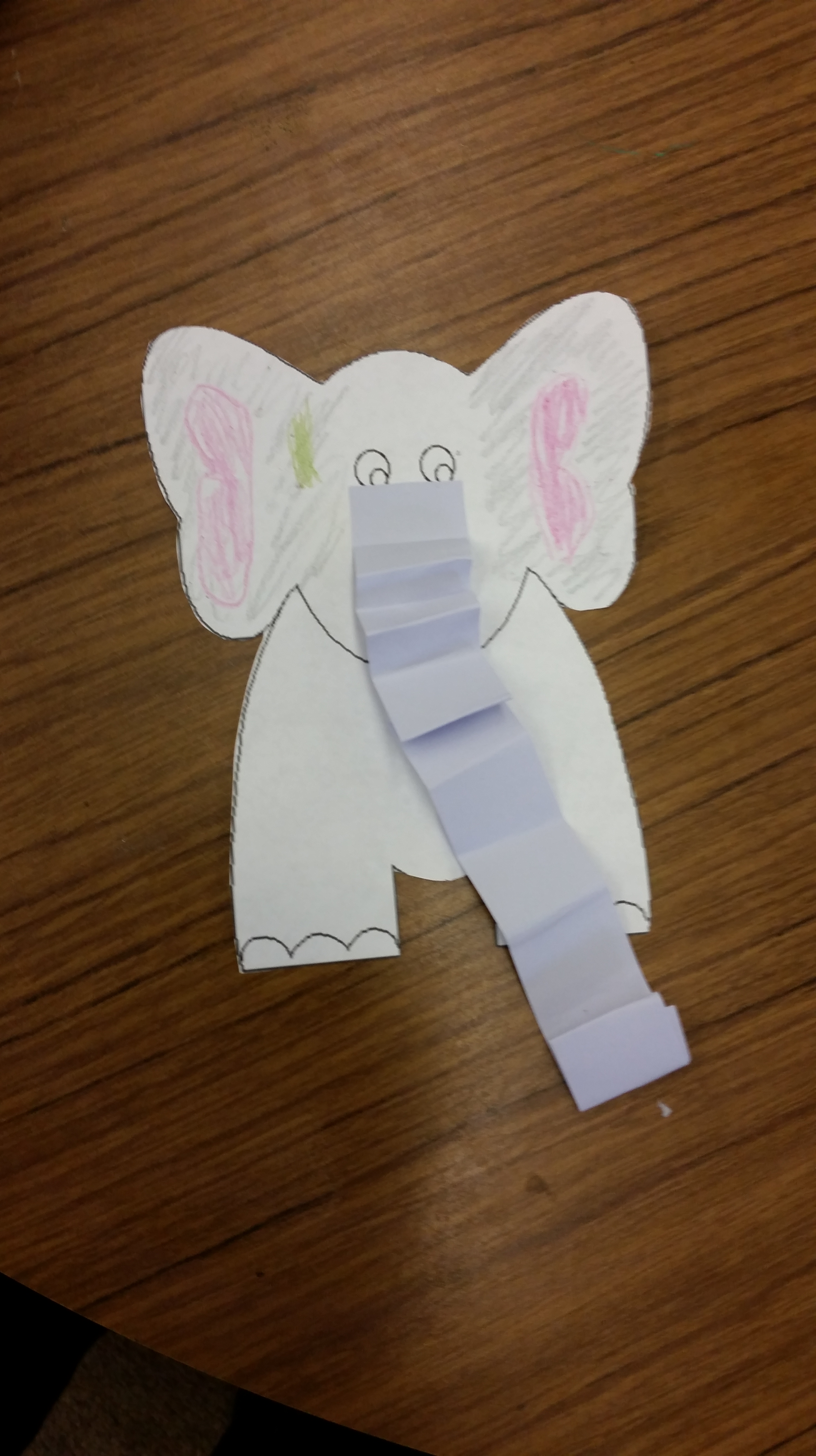
I found this elephant finger puppet template on KidsArtPlanet.comhttp://www.kidsartplanet.com/artsandcrafts/2007/12/10/elephant-paper-finger-puppet/.  I copied and pasted the photo into Word and enlarged it a bit, then printed it, and cut it out.  Originally, I planned to have the kids use their fingers as the trunks, but a couple of them wanted to make paper trunks instead.  For them, I cut out strips of paper, and showed them how to fold them accordion style and glue them over the hole.  It actually turned out really well, because the hole ended up looking like a mouth underneath the trunk.  (I’ve also seen similar crafts that use party blowers for the trunk, which would be cute, and might also make elephant noises).

Elephant with paper trunk

Elephant with paper trunk

OTHER PICTURE BOOKS ABOUT ELEPHANTS:

Go to Sleep,Gecko by Margaret Read MacDonald; illustrated by Geraldo Valerio (Amazon.com link)

I wish I had remembered this story when I was pulling books, because it’s one of my favorites.  It’s a Balinese folktale about a gecko who complains to Elephant, the village boss, about the fireflies, who keep blinking their lights on and off outside his window.  Elephant talks to the fireflies, who tell him that they are only trying to light the path because Buffalo leaves poop in the road.  But Buffalo says he is only trying to fill the holes left by Rain, and Rain says she is only trying to make puddles for the mosquitoes so that Gecko will have something to eat.  I love the moral: This world is all connected.  Some things you just have to put up with.”  A wonderful read-aloud that fits well with either a folk-tale or environmental theme.

How to Catch an Elephant by Amy Schwartz (Amazon.com link)

This one is ridiculous, but so much fun to read.  It’s basically one long joke about how to catch an elephant with three cakes, two raisins, a telescope, and tweezers.  Warning: elephants hate cake!  The best part of this book are the descriptions of the angry elephant rampaging on the cake: “That cake is flatter than a tortilla in Oaxaca.”

What are your favorite books about elephants?

Some Like It Hot: Experiments with Temperature

For the last week of my five-week Sizzling Science workshop for fifth and sixth graders, we explored temperature.

I started out with a brief discussion of hot and cold, asking the kids what they thought happened to the molecules of a substance as it got hot.  They guessed that the heat would make the molecules move around more.  At this point, I had planned to do an experiment where I put drops of red food coloring in three glasses of water (one hot, one warm, and one cold) to show that the dye spread more rapidly through the hot water.  Unfortunately, the water heater didn’t seem to be working, so I wasn’t able to get any hot water.

Instead I pulled out a hand boiler and passed it around.  It’s a cheap toy, but a fun one. In middle school, my friends and I used to have temperature wars with the hand boiler in our classroom.  Each of us would hold one end, and we’d see whose hand was warmer by which side the liquid migrated to (I think that was how we ended up breaking the teacher’s hand boiler, and having to buy a replacement: no easy feat in the days before Amazon).  I explained that the liquid inside the bottom bulb reacts to the heat in your hand, expanding to run through the tube in the middle, and appearing to “boil” in the bulb at the top.  We talked about how traditional thermometers work on this same principle, with the mercury moving up the tube as it gets warm and expands.

Hand Boiler

Hand Boiler

At this point, I brought out a digital thermometer, and explained that these work with a special kind of electronic component called a thermoresistor or thermistor.  At low temperatures, it does not conduct electricity, but as heat is applied, it becomes more and more conductive. A microcontroller inside the thermometer uses the amount of electrical resistance to determine the temperature.  I put the digital thermometer in a glass of water, and then added some rock salt.  The kids watched as the temperature slowly dropped.  We talked about how salt is used to melt ice on the roads, and how we would also be using it to make ice cream.  The milk and sugar in ice cream freezes at a lower temperature than water, so ice alone is not cold enough to make it solidify.  Adding salt to the ice lowers the freezing temperature, causing it to melt, but also to become colder.

I followed up the salt demonstration with another demo where I put calcium chloride in a glass of water.  This time the water heated up several degrees almost instantly.  I explained that calcium chloride is also used to melt ice on roads.

Now it was time to make ice cream in a bag.  I’ve done this activity many times over the years.  It was one of the first library programs I helped with at my first children’s librarian job in Raleigh, NC.  But this was the first time I had used it as a science experiment.

I started by showing the kids all the steps, which are:

  1. Pour 1/2 cup of half-and-half into a small Ziploc bag (I tried to find the yellow-and-blue-make-green kind of bags; but all I could find were the kind with the slider on the top, which unfortunately seem more prone to leaking).
  2. Add 2 tablespoons of sugar and 1/4 teaspoon vanilla to the bag
  3. Seal the bag up tightly, and set it inside a large Ziploc bag
  4. Fill the large bag with ice, followed by several tablespoons of ice cream salt (the recipe calls for 6 tablespoons, but I just eye-balled it)
  5. Shake the bag, or squish the small bag with your hands, for five to ten minutes until the mixture freezes.  The ice cream will be soft, more like a milkshake.

I set up the ingredients on a counter, and had the kids pair up to help each other.  One kid would hold the bag open, while the other poured in the ingredients.  I helped some of them pour the milk and vanilla (the vanilla was especially prone to spilling).  Then they all went to town shaking the bags.  A few of the big bags broke (they don’t make bags like they used to), so we did have some ice and rock salt spills, but thankfully no milk (whew!).  I gave the kids spoons and straws to eat the ice cream. A few complained that the ice cream tasted salty at first, so I ended up suggesting that they rinse the salt water off the outside of the small bag before they ate it.

Large Ziploc Bag with ice and ice cream salt surrounding the smaller bag full of ice cream mixture

Large Ziploc bag with ice and ice cream salt surrounding the smaller bag full of ice cream mixture

That part all went pretty smoothly, except I wish I had thought to bring a dairy alternative.  I had one student who not only could not drink milk, but ended up having a contact allergy just from touching it (that came as a surprise even to her mom).  Luckily, she had some medicine on hand for the hives, but I felt badly about it.  Ice cream needs to have a fairly high fat content to make it creamy rather than icy, and the girl suggested she might try making it with coconut milk, which I thought was a good idea.  I actually tried it at home–substituting the half-and-half with 1/2 cup Silk Brand Coconut Milk, and it turned out really well.  It does taste fairly coconutty, which may not appeal to everyone, but I bet it would work with Almond Milk as well.

Ice Cream made with Coconut Milk

Ice Cream made with Coconut Milk

I had intended to follow-up the ice cream with homemade thermometers, but the ice cream took about 45 minutes of my hour long class.  Instead I showed the kids the thermometer, and a number of them took some portion of the materials home.  I used the thermometer model described by Mike Calhoun on Education.com: http://www.education.com/activity/article/make_a_homemade_thermometer_middle/ because it seemed less messy than the water thermometer on SteveSpanglerScience.com: http://www.stevespanglerscience.com/lab/experiments/water-thermometer-sick-science.  But that night I woke up in the middle of the night worried that someone’s little brother might drink their thermometer, which contained rubbing alcohol, so maybe the water thermometer would have been better.  Both of them are a bit tricky to transport without spilling.

Basically, both thermometers involve sealing a drinking straw inside a water bottle with modeling clay, with the top sticking out.  For Calhoun’s model, you first fill the bottle about a quarter full of equal parts water and rubbing alcohol, and add a few drops of red food coloring. For the water thermometer, you fill the bottle all the way to the top with water, dyed blue with a few drops of food coloring.  In both cases, you mold the modeling clay around the drinking straw at the mouth of the bottle, trying to make an airtight seal, while keeping the straw itself open.  When you put the bottle in hot water, or hold it with your hands, the liquid inside the bottle expands and travels up the straw (the rubbing alcohol reacts more easily to heat, which is why you don’t need to fill the bottle completely).  You can even use another thermometer to gauge the temperature, and then mark that on the side of the straw or on the bottle (with the water thermometer, you can even tape an index card to the portion of the straw that sticks out of the bottle, and mark the temperature on that).

Water thermometer from SteveSpanglerScience.com

Water thermometer from SteveSpanglerScience.com

Homemade Thermometer from Education.com

Homemade Thermometer from Education.com

I was sad to say goodbye to the kids in the class, many of whom I had become quite attached to.  They were a wonderful group, and I’m hoping to see them at future workshops.  I was nervous about offering these science classes at first, but they ended up being the highlight of my summer. I’d love to hear other ideas or activities that have been successful in other classes or libraries, so please share them in the comments.

Circuit Training: Basic Electronics at the Library

This week’s Sizzling Science theme for fifth and sixth graders at the Burlingame Library was Fun with Electronics.  For this one, I stole an idea from the Maker Faire in San Mateo, as well as a project recommended by my coworker, Carbelle Imperial.  The first was a popsicle stick flashlight, and the second a Brush Bot.  This was by far the most expensive workshop I’ve done so far, since I bought the Brush Bot kits from the Maker Shed (a pack of 12 costs $34.99, and I needed 2 packs).

I started out by talking to the kids about electronics, asking them where the word comes from, and discussing what electrons are (one of the three parts of an atom, and the one that carries a negative charge).  I brought out a AA battery, and pointed out the positive and negative terminals.  I explained that a chemical reaction inside the battery causes electrons to build up at the negative end.  The electrons want to travel to the positive end, but cannot travel through the battery itself because of a substance inside called a separator.  (I passed around this diagram from Online Digital Education Connection to illustrate the different parts of the battery.)  I pulled out a piece of aluminum foil and used it to connect the two battery terminals, then walked around to let the kids feel how hot the foil had become, using it as an illustration of a very basic circuit.

It was clear that three or four of the kids already had a great deal of background knowledge of electronics, and were quick to answer questions.  Most of the group stayed quiet though, so it was hard to gauge how much they knew.

I told the kids that they would be using a simple circuit to make a flashlight, and asked them what parts they thought they would need (some of them had already sneaked a peek at my model when they came in the door, so they knew a lot of the answers).  The parts were: a 5mm white LED, a 3-volt lithium coin battery, 1/2″ copper foil tape (which I had pre-cut), jumbo-sized popsicle sticks, small binder clips, and Scotch tape.  We talked a little bit about the function of each part, and I pointed out that the LED had a long leg (the positive lead), and a short one (the negative lead).

In retrospect, I should have handed out each part a step at a time.  As it was, I handed out all the materials at once, and a number of the kids jumped right in without waiting for instructions.  That left me with a lot of troubleshooting to do, and several of them had to start over.  On the other hand, making mistakes and then correcting them may have taught them more than blindly following the steps, so I guess it worked out.

Anyway, the basic process is this:

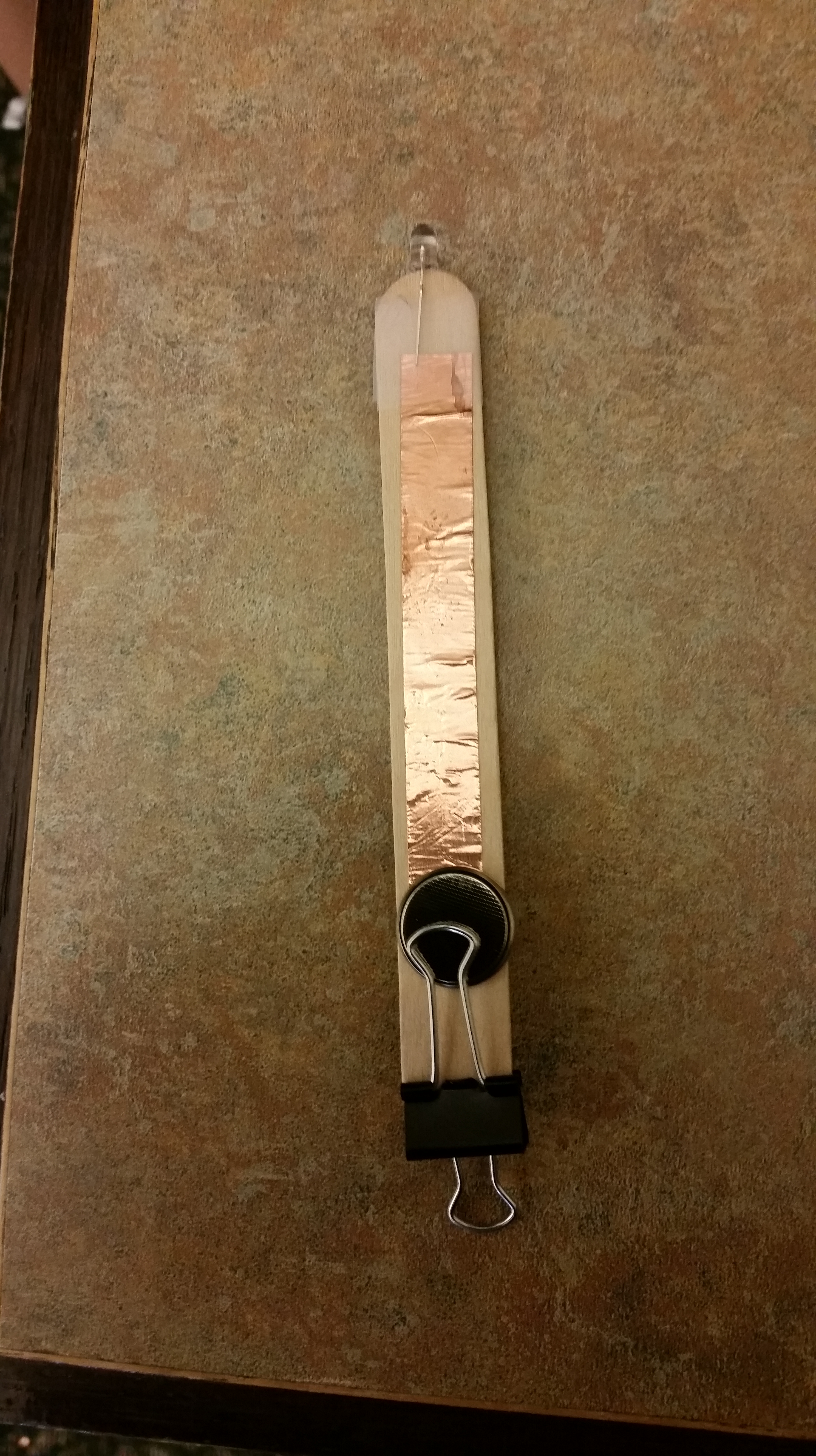
1) Run a strip of copper foil down one side of the popsicle stick.  Make a small roll of foil at the end, leaving sticky spot close to the center of the stick.

2) Attach the battery to the sticky roll of foil.  The positive (+) side of the battery should be down, touching the foil.  (This was one of the most common mistakes).

3) Clip the binder clip on the end of the popsicle stick closest to the battery.  Flip the metal leg of the clip down.  It should rest on top of the battery.  If it doesn’t reach, adjust the foil and battery to move the battery closer.

4) Flip the popsicle stick over, and run the second strip of copper foil down that side.  Again, when you flip the metal leg of the binder clip down, it should rest on the foil.

5) Place the LED on the end of the popsicle stick opposite the binder clip, with the long leg (positive lead) straddling the side with the battery.  Both legs should be touching the foil tape on each side of the popsicle stick.  If both legs of the binder clip are down, the LED should light up.  If it’s working, tape the legs of the LED down with the Scotch tape.

6) Now you have a simple flashlight with a switch.  To turn it off, flip the top leg of the binder clip back away from the battery.

A completed popsicle stick flashlight

A completed popsicle stick flashlight

The bottom side of the popsicle flashlight

The bottom side of the popsicle flashlight

Some common problems the kids ran into were: putting the LED on backwards (with the short leg on the battery-side of the popsicle stick instead of the long one); running the copper tape over the end of the popsicle stick (in those cases, I just tore the foil, so it was no longer connected); putting the battery on upside down (with the positive side facing up; and putting the battery too close or too far away from the binder clip (sometimes the kids had the hold the binder clip down against the battery to keep the light from flickering). Incidentally, you could make the flashlight with the positive side of the battery facing up, as long as the LED was also attached the opposite way, with the long leg facing the battery-side of the popsicle stick.

I did this project with the kids all sitting in a circle on the floor, to make it easier to distribute supplies and handle questions.  The funny thing was that this project was intended to be a more defined, step-by-step activity, but by now the kids were so used to coming up with their own ideas and prototypes, that many of them went off to tinker with the design, and add extra LEDs (one boy had five!).

A flashlight with 5 LED's

A flashlight with 5 LED’s

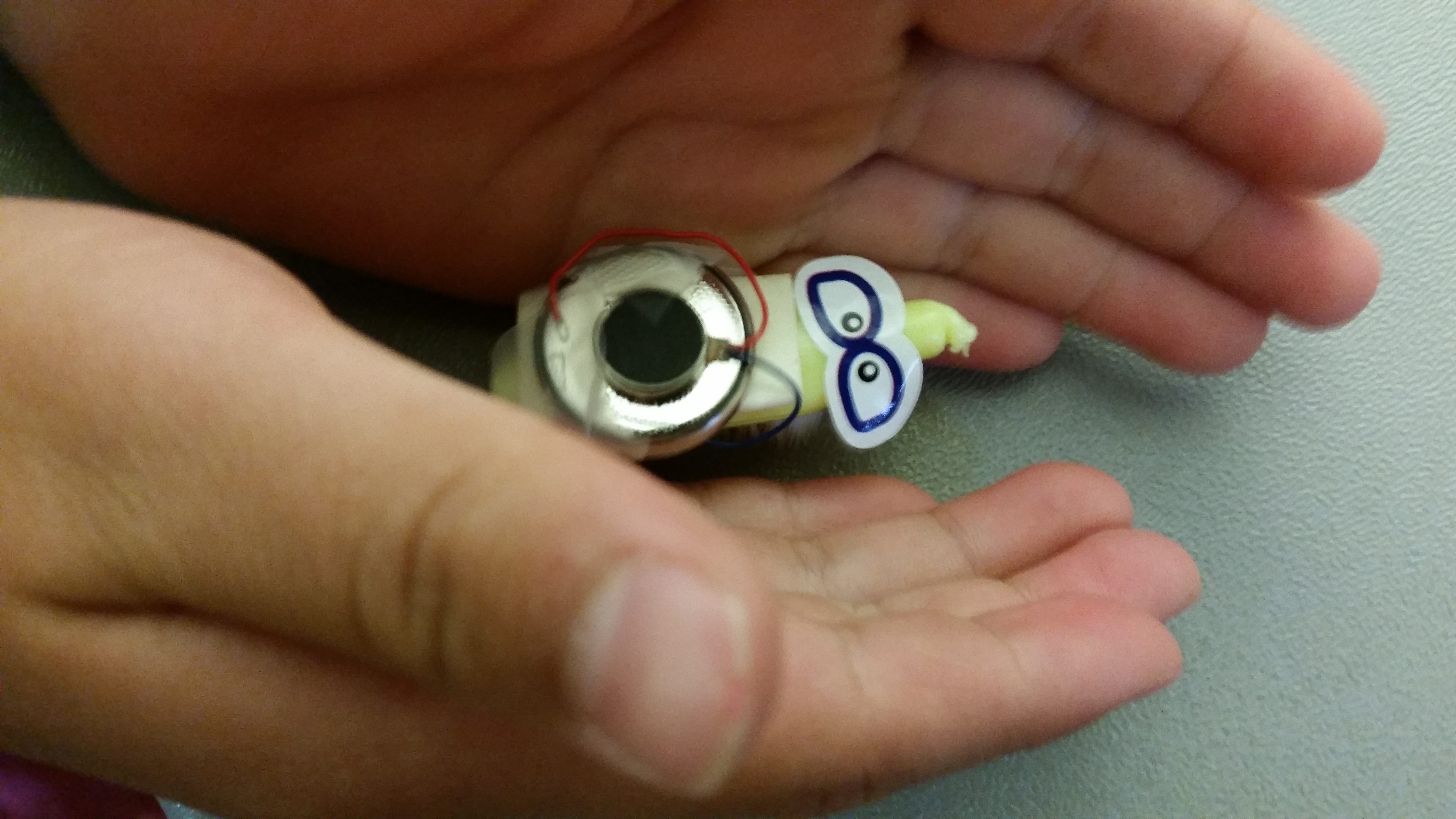
Once everyone had a working flashlight, I asked them to move to the tables, and brought out the Brush Bot project.  This one was much more straightforward.  It’s basically a tiny robot made from the head of a toothbrush, a vibrating micro pager motor (the thing that makes cell phones vibrate) with adhesive on one side, and a coin battery.  The coin battery is encased in a plastic cover with two wires coming out.  I had cut the heads off the toothbrushes ahead of time, cut the adhesive tape included with the kit into small pieces, and trimmed the wires, stripping the plastic back to leave a 1/4″ of copper.

All the kids had to do was stick the motor on top of the battery, use a piece of adhesive to stick the battery onto the toothbrush, and twist the ends of each of the wires from the motor around the ends of one of the battery wires (it doesn’t matter which one).  If it works, the motor vibrates, and the brush twirls around (the battery and motor will also move around without the toothbrush, so it might be fun to experiment with that or with other types of bases).  The kit comes with stickers for the kids to decorate their robots.

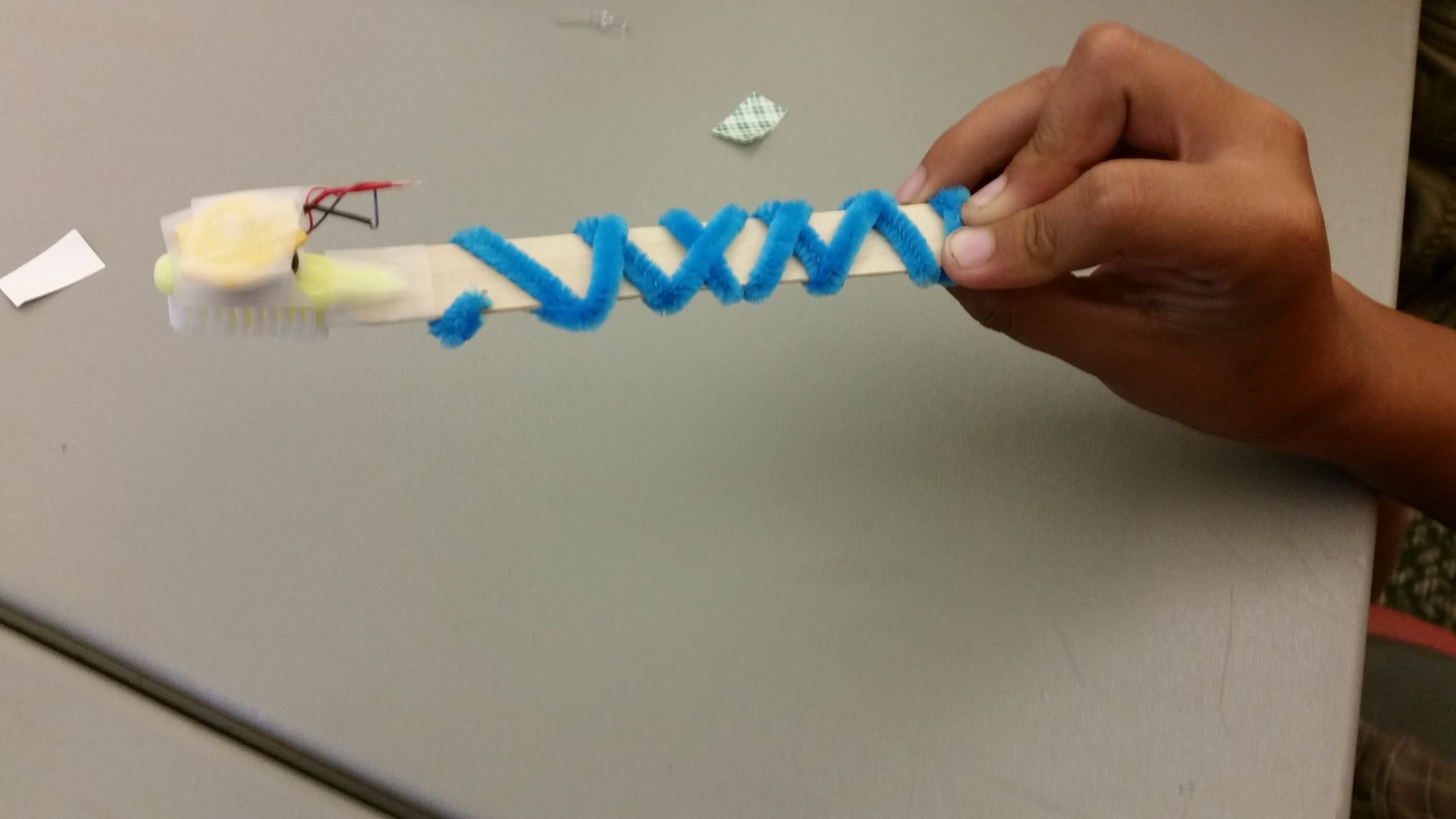
A brushbot decorated with pipe cleaners

A brushbot decorated with pipe cleaners.  The small black circle on the top is the vibrating motor.  The yellow disc beneath it is the battery.  It is attached to the toothbrush with an adhesive strip.

I had to do a fair amount of troubleshooting with this project too.  The biggest, and most frustrating, problem was that some of the batteries didn’t seem to work. (I checked them over later, and found that they had lost some of their voltage.  They could still light an LED, but were no longer strong enough for the motor.  I did find a simple workaround though: I had a few coin batteries left over from the flashlight project, so I helped the kids use Scotch tape to attach one of the motor wires to the positive terminal of one of those batteries, and the other wire to the negative terminal.  It worked just as well, and helped reinforce the idea of creating a circuit. In fact, I think if I could find a cheap source for the micro pager motors, it might be an easier and less expensive way to do this project.

A Brush Bot with the motor attached directly to the positive and negative terminals of a 3V button battery

A Brush Bot with the motor attached directly to the positive and negative terminals of a 3V coin battery

I gave the kids some pipe cleaners to add appendages to their robots.  By this time, they were off creating all kinds of new designs.  My favorite was a kid who attached a toothbrush head to his popsicle stick flashlight, and made a vibrating toothbrush with an on/off switch!

20150722_145226

A vibrating toothbrush with on/off switch

I’m still amazed by the kids in these workshops.  They have so much creativity and enthusiasm, and I’m almost sad to see this workshop series come to an end.  Next week’s theme is Hot and Cold, so we are making ice cream in a bag and homemade thermometers.  I’m just hoping it’s not too messy!  Wish me luck!

Marshmallow Warfare! Fun with Physics at the Library

image

This week’s theme for the Sizzling Science program for grades 5 and 6 at the Burlingame Public Library was Fun with Physics.  We made marshmallow catapults, and a huge mess, but it was fun!

I started out by asking the kids what they knew about physics.  One of them described physics as the study of motion, which was a good lead-in to our project.  We talked about why understanding how things move is important, for everything from planes and rockets to much simpler tools like spears and rocks.  We talked briefly about the history of catapults, which originated in Ancient Greece and were used widely in the Middle Ages to hit castle walls, or sending flaming projectiles (or disgusting, illness-producing ones like garbage or corpses) onto the castle grounds. (I forgot to mention that catapults are even used today to launch planes from ships.)

I brought out my kids’ Angry Birds: Knock on Wood Game, which includes a simple plastic catapult for launching a toy bird, and demonstrated it, asking the kids how it worked.  We talked about potential energy (the energy stored up when you pull the launcher back), and kinetic energy (the motion energy released when the toy bird flies into the air).  We talked about the different things to consider when targeting with a catapult: the amount of tension you apply when you pull the launching arm back, the vertical speed (how high the projectile flies), the horizontal speed (how far it flies), and gravity (how fast it falls).

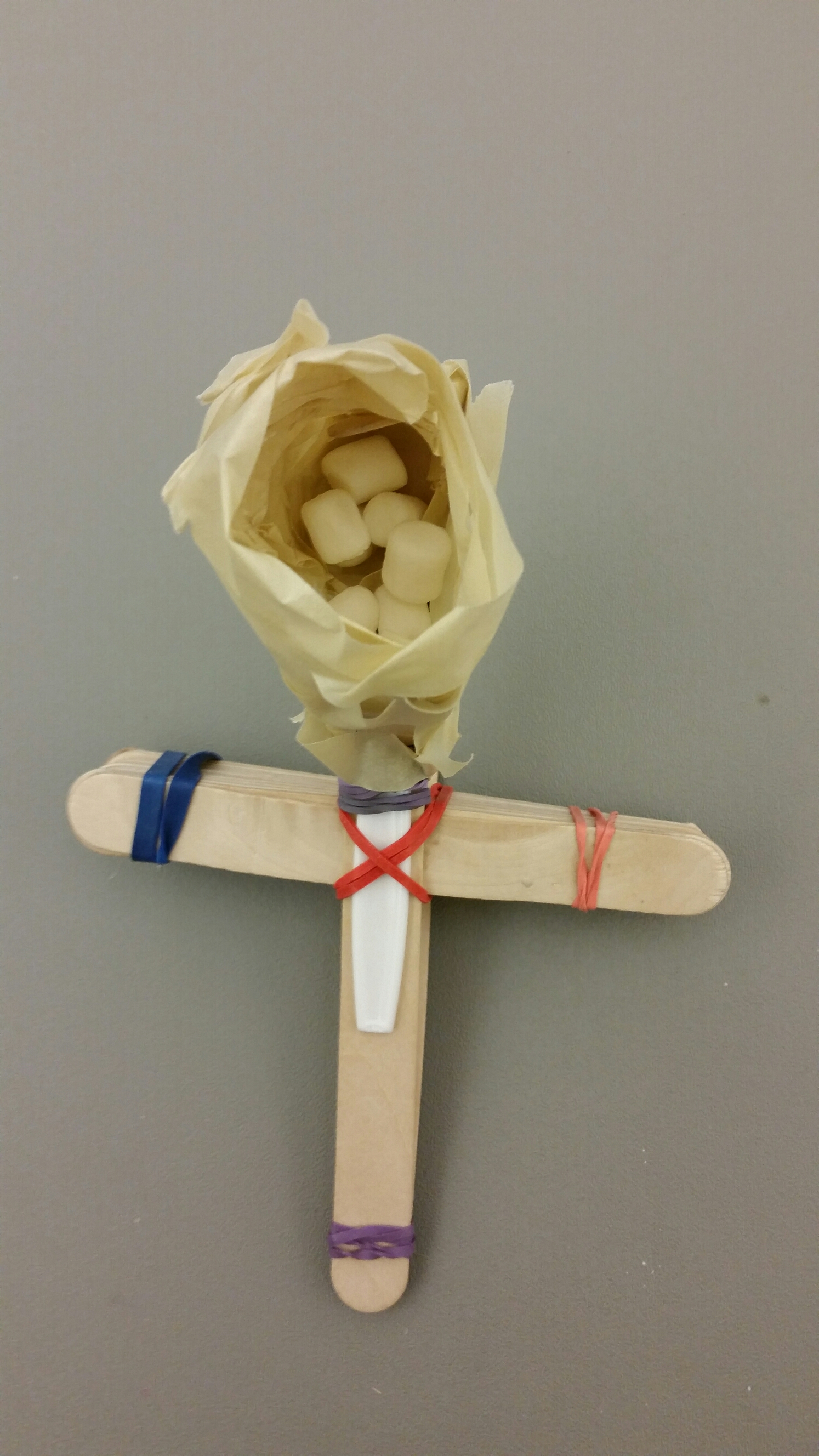
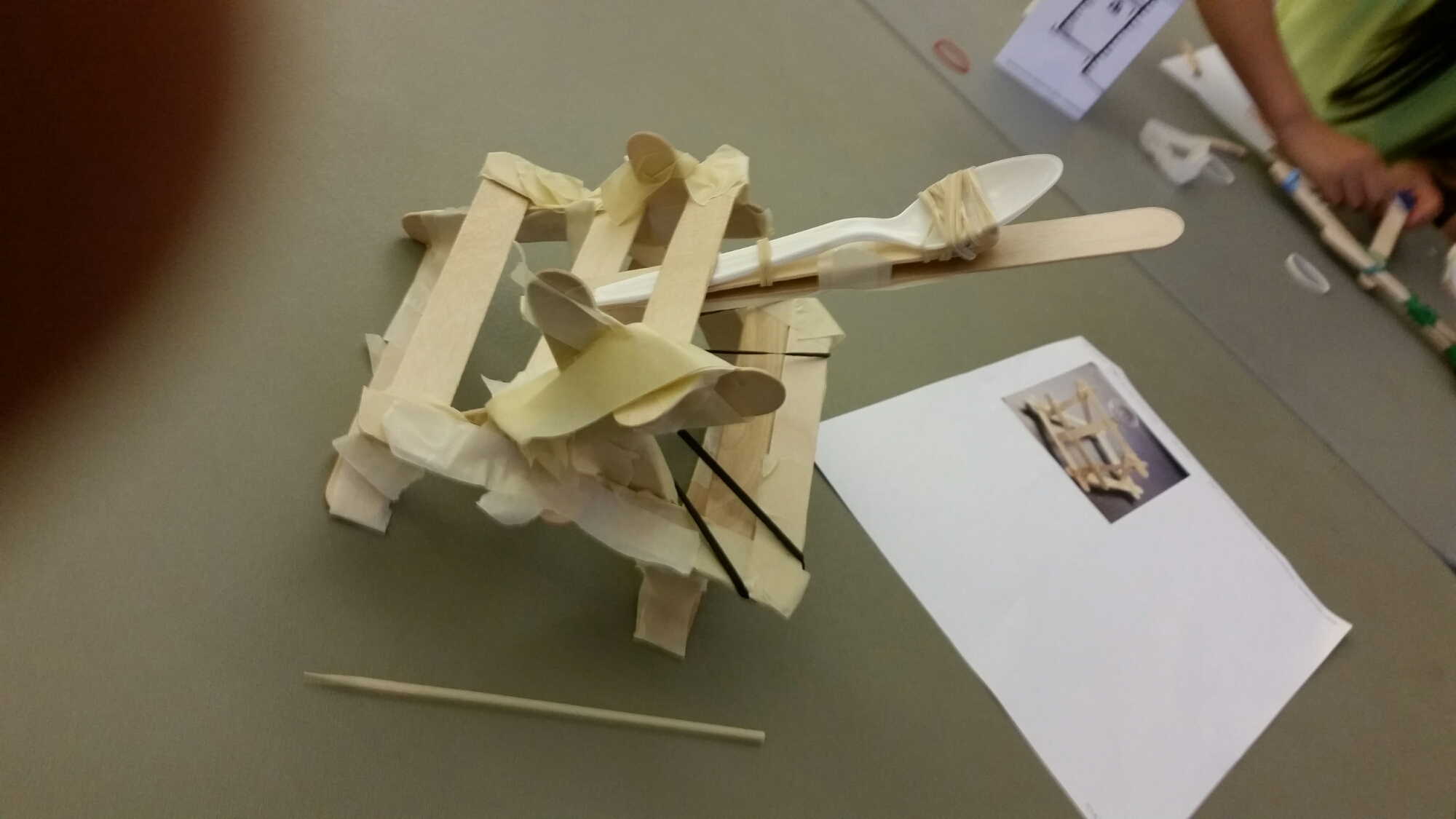
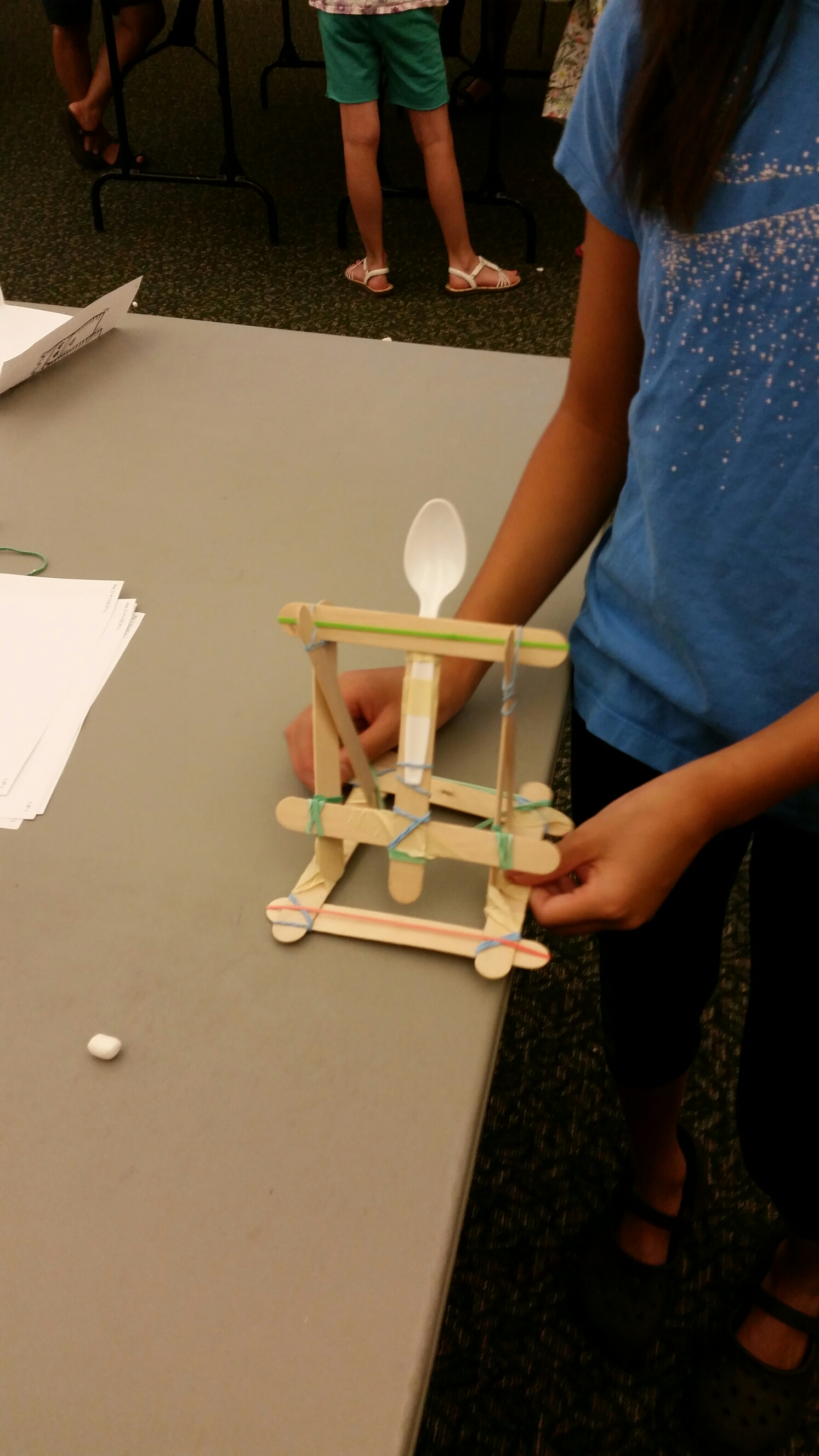
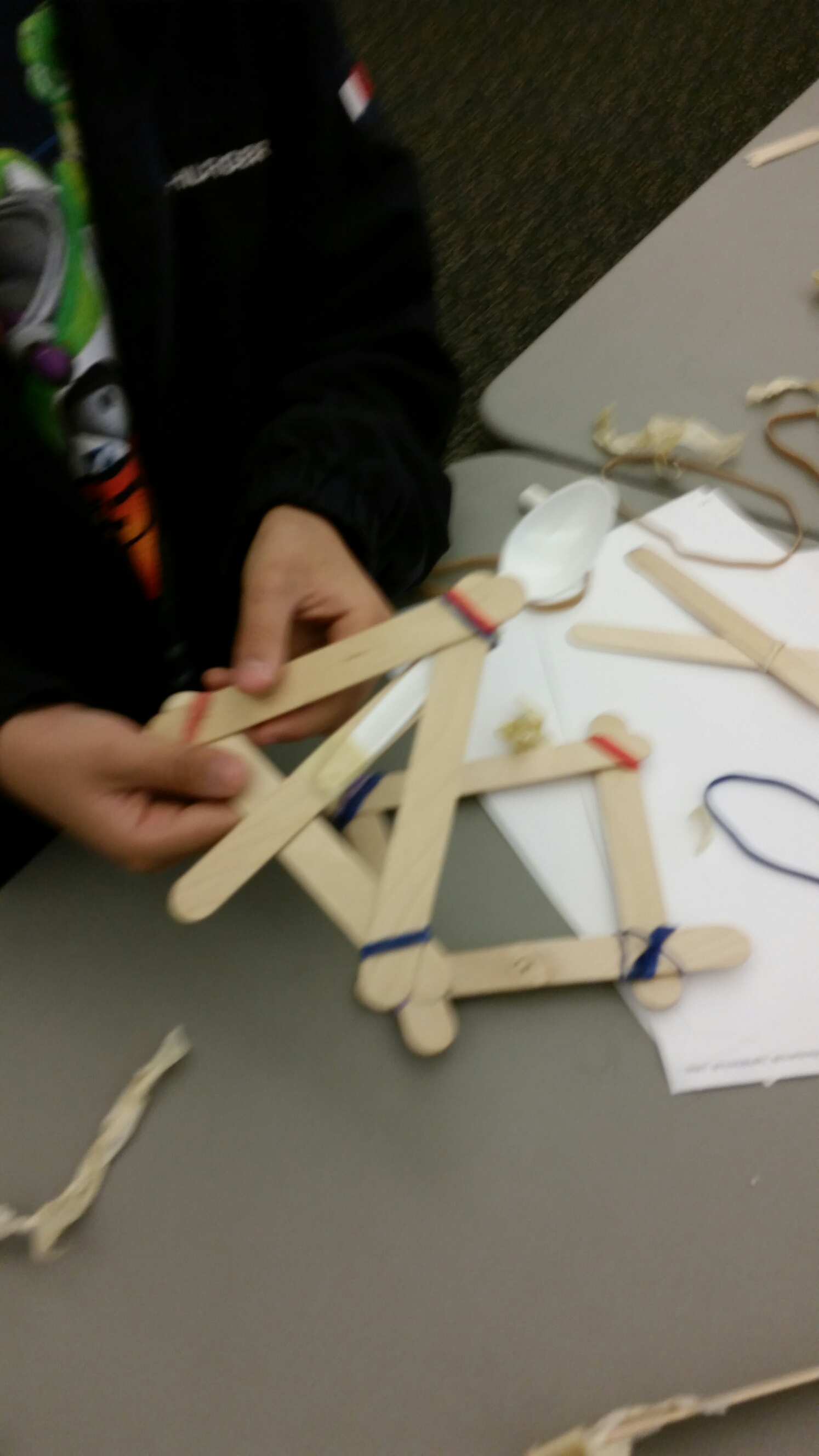
I told the kids that they would be designing and creating their own catapults, and had them break into pairs.  I passed out pictures of different catapult designs, including this one from Z Home Team, this one from DevinCollier.com, and this one from teachengineering.org (I had made a sample of this one, except I used a spoon instead of a popsicle stick with a cup on the end.  I gave them a few minutes to discuss what they wanted to make while I set out the supplies.  The materials I provided were: small wooden skewers,wooden clothespins, rubber bands (all sizes), large popsicle sticks, masking tape, plastic spoons, marshmallows (mini, regular, and jumbo).  I told them they could each make their own catapult, but they could work with their partner to brainstorm and refine their design.  Then I set them loose to gather supplies and build.

They spent the rest of the hour building different types of catapults.  Most of them set out copying the designs I provided, but almost all of them ended up making changes, or coming up with something entirely new.  A couple made handheld models (more like a slingshot), and one boy made a masking tape “cup” so he could launch several marshmallows at once.  Some of them worked eagerly with their partner, while others barely even spoke to theirs.  A couple asked for my help trying to copy a design, but I thought it was interesting that as soon as I left them, they both created something original. Here are some of the designs the kids came up with:
image

image

image

image

image

image

Soon there were marshmallows all over the room, and I had to establish a “non-human targets only” rule.  I did put out printouts of a castle, folded into thirds so it could stand up, on each of the tables for the kids to use as a target.  Originally, I had imagined them taking turns shooting at the paper castles, to see which catapults were the most accurate and which could shoot the farthest, but they were all engaged in different parts of the design process for the whole hour.  In the end, I think that was the biggest takeaway: the experience of testing out a design, refining it or rebuilding it entirely, and testing again.  Afterwards, one mom commented that her daughter had taken another class a while ago where they took the kids step-by-step through the process of building the Z Home Team-style catapult, but that she thought it was a lot more fun to let the kids design their own (a big relief to me!).

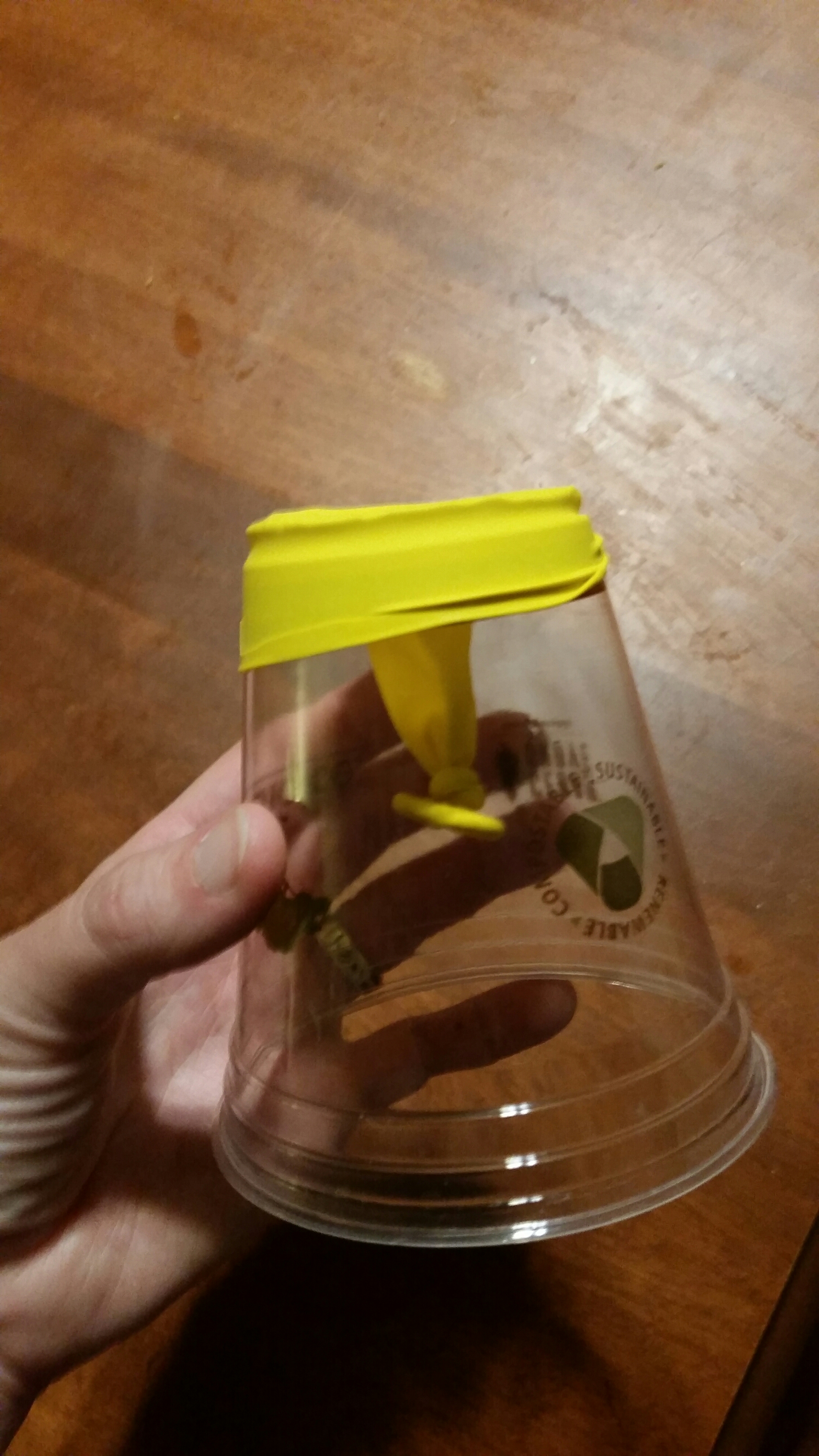
I had actually prepped a whole other project–a balloon launcher–but we never got to it.  It’s super simple.  You cut the bottom out of a plastic cup (which I had done ahead of time).  Then you tie a knot in the end of an uninflated balloon, and cut the bottom out of it.  You stick the knot through the hole in the bottom of the cup, then stretch the open bottom of the balloon around the cup’s base.  After that, you can put a marshmallow, or some other small object, inside the balloon, stretch the knot back, and let go.  It’s very effective!  I actually demonstrated to a few of the kids who were still hanging around while I was cleaning up, and they were very impressed.  I gave them each a cup and a balloon to take home.

image

I’m still surprised how much I’m enjoying this classes, even though they are different than anything I’ve done before.  The kids have so much creative energy and ideas, and it’s amazing to see them in action.

Next week’s theme is Electronics.  I’ve ordered Brush Bot kits from the Maker Shed, and am thinking of pairing that with a popsicle stick flashlight.  Both of those projects are much more defined than this week’s catapult challenge, so I’m curious to see how they go.  I’d appreciate any advice anyone has, or other fun, easy electronics projects.

Picnic Time for Teddy Bears: Storytime about Stuffed Animals

Teddy Bear Picnic Day is July 10 (who thinks these things up, and how do I get that job?), so this week I did a Teddy Bear storytime.

Year ago, when I was working at the Woodside Library, we used to do a Teddy Bear Picnic every year.  The kids would bring a favorite stuffed animal, and we would read teddy bear stories, sing songs, and hold a contest where every stuffed animal received an award (softest bear, silliest bunny, and my favorite (for the tattered ones)…most loved).  We even had a teddy bear doctor, who would give each animal a check-up.  This was always hilarious, because the kids would present all kind of symptoms: “My bear has a fever.” “My bunny has a stomach-ache.” “My Spiderman was shot!”  My coworker would examine each animal, and write them a prescription, like “Give three hugs each day.” Then we would serve Teddy Grahams and apple juice, and send them on their way.  It was always a highlight at the end of summer.

So I was feeling a bit nostalgic when planning this storytime, and dug out some of my favorite books.  Here they are:

wheres-my-teddy1

Where’s My Teddy? by Jez Alborough (Amazon.com link)

My friend Kerri Hall shared this book with me when we were in library school at UNC, and I’ve loved Jez Alborough ever since.  It’s a rhyming story about a boy named Eddie, who has lost his teddy, Freddie.  While nervously searching through the forest, he finds his teddy bear, only to discover that he’s grown to an enormous size.  But then a giant bear appears, moaning that his teddy bear has suddenly shrunk.  The boy and the bear are equally terrified to see each other, and both grab their own teddy bears and run “all the way back to their snuggly beds, where they huddled and cuddled their own little teds.”  The rhymes are so catchy, I can almost recite this book by heart, and the illustrations are large, and adorable.  The page with the frightened bear and boy always gets a laugh.

my friend bear

My Friend Bear by Jez Alborough (Amazon.com link)

I was planning to read That Rabbit Belongs to Emily Brown by Cressida Cowell, but the kids seemed to enjoy Where’s My Teddy? so much that I decided to read the sequel (actually it’s the third book in what is actually a picture book trilogy with It’s the Bear, but I’ve read it often as a stand-alone).  In this one, Eddie is walking in the woods with Freddy, and wishing his teddy bear could talk.  Once again, he sees the giant teddy bear, but this time he knows who its owner is.  Sure enough, along comes the bear, and frightened, Eddie hides behind the big teddy.  This leads to a misunderstanding, where the bear thinks his teddy bear can talk, and after sorting all that out, the boy and the bear end up becoming friends.  It’s funny, like the first book, but also sweet, and the ending got a few “Awws” from the parents.

dear bear

Dear Bear by Joanna Harrison (Amazon.com link)

This is one of my favorite picture books, and one that would work well for a letter-writing theme.  Katie is terrified of the bear she is sure is living in the closet under the stairs.  She tells her mother, who suggests that she write the bear a letter and tell him to go away, which she does.  She is surprised to receive a letter back from the bear, thanking her for the suggestion because he needs a vacation.  When he comes back, he leaves a present for Katie outside the closet door.  The two exchange letters back and forth, until finally the bear invites Katie to a tea party under the stairs.  Nervously, she accepts, but when she arrives, she finds, not a big scary bear, but a large friendly teddy bear.  One of the kids asked how the bear could write letters, and then sagely said, “Maybe her parents wrote the letters.”  The book definitely hints at this, although it never says it outright.

Corduroy

Corduroy by Don Freeman (Amazon.com link)

One of my all-time favorite books from my own childhood, and one I still love to read.  It’s such a simple story, about a department store teddy bear who loses the button to his overalls, and goes on a quest to find it.  The humor of Corduroy’s interpretation of the world is timeless: the escalator is “a mountain,” the mattress department is “a palace.” Of course, most mattresses nowadays don’t have the “buttons” on the top that Corduroy mistakes for his own missing button.  But it’s still one of the few picture books I know that depicts a family in an apartment instead of the typical suburban house, as well as featuring a beautiful African-American girl who saves the day by adopting Corduroy from the store.  (Incidentally, I stumbled across this blog post by Lisa Rosenberg, the real-life inspiration for Corduroy’s Lisa). There’s been a lot written recently about the lack of diversity in picture books.  I’m acutely aware of that here in the Bay Area, where most of my storytime audiences look nothing like the kids in the books I’m reading.  Corduroy does a wonderful job of creating a lovable, classic story while silently conveying the message that children come in all different shades and backgrounds, and any of them can be a hero.  Plus I always get choked up on the last page.

SONGS:

Going on a Bear Hunt

This was one of my favorite activities when I was a kid, and I love to throw it into a storytime.  The kids echo most of the lines (the ones in parentheses).  I like to play up wiping grass off my pants, and the mud off my feet, and shaking off the water from the lake.  It’s always a hit:

We’re going on a bear hunt!
(We’re going on a bear hunt!)
It’s a beautiful day!
(It’s a beautiful day!)
We’re not scared!
(We’re not scared!)

We’re coming to some grass.
(We’re coming to some grass).
Can’t go over it.
(Can’t go over it.)
Can’t go under it.
(Can’t go under it.)
Have to go through it.
(Have to go through it.)
Swish! Swish! Swish! Swish! (Rubbing hands together)

We’re coming to some mud.
(We’re coming to some mud.)
Can’t go over it.
(Can’t go over it.)
Can’t go under it.
(Can’t go under it.)
Have to go through it.
(Have to go through it).
Squilch! Squelch! Squilch! Squelch! (Clapping hands together).

We’re coming to a lake.
(We’re coming to a lake.)
Can’t go over it.
(Can’t go over it.)
Can’t go under it.
(Can’t go under it.)
Have to swim across it.
(Have to swim across it.)
Splish! Splash! Splish! Splash!

We’re coming to a cave.
(We’re coming to a cave.)
Can’t go over it.
(Can’t go over it.)
Can’t go under it.
(Can’t go under it.)
Have to go inside.
(Have to go inside.)
Tiptoe…tiptoe…tiptoe…tiptoe…
It’s dark in here…
(It’s dark in here…)
It’s cold in here…
(It’s cold in here…)
Two yellow eyes…it’s a bear!

Run!
Swim across the lake!
Run through the mud!
Run through the grass!
Into the house!
Slam the door!
Lock it!
We’re never going on a bear hunt again!

Teddy Bear, Teddy Bear

We have a collection of animal puppets in our kids area at the library, so for this song I had the kids each pick a puppet to act it out with.  Then I asked the kids what else they would like the puppets to do.  One girl said, “The Hokey Pokey!” So we did the Hokey Pokey with the puppets, which was a lot of fun.  The turning around part is a bit hard with puppets, but because they were animals, we could put their noses in, and their ears and tails and tummies.  Here’s the teddy bear song (you can also just chant it):

Teddy Bear, Teddy Bear,

Turn around.

Teddy Bear, Teddy Bear,

Touch the ground.

Teddy Bear, Teddy Bear,

Tie your shoe.

Teddy Bear, Teddy Bear,

I love you!

The Teddy Bear’s Picnic

This is great song by John Walter Bratton, with lyrics by Jimmy Kennedy.  The best ukulele version I’ve found is on Doctor Uke (http://www.doctoruke.com/teddybearspicnic.pdf).  It’s kind of a tricky song to sing because of the chord change.   My favorite version by far is the one by Jerry Garcia, which you can listen to here: https://www.youtube.com/watch?v=67Mowhcj8OM.

CRAFT: PomPom Creatures

PomPom Creature by Kiley

PomPom Creature by Kiley

PomPom Creature by Olivia

PomPom Creature by Olivia

The biggest challenge with this was finding a way to stick the pompoms together.  I gave the kids tacky glue, which worked okay, but I’d love any suggestions on the best way to attach pompoms.  It was still a fun craft, and I loved the way the creatures came out.

OTHER BOOKS: 

I Lost My Bear by Jules Feiffer (Amazon.com link)

I was hoping to read this book, but unfortunately our branch’s copy was out, and the one I ordered from another library didn’t arrive in time.  It’s a great story about a little girl who is looking for her lost teddy bear.  Her mom tells her to think like a detective, and the hunt begins.  I especially love her sister’s suggestion that sometimes when you throw another stuffed animal, it will find the lost one (I actually tried that in the park once when my son lost a Lego R2D2, and it actually worked!).

Knuffle Bunny by Mo Willems (Amazon.com link)

I didn’t read this one because I shared it fairly recently, but of course I have to include it in my list of favorite stuffed animal stories.  When Trixie (who is too young to talk) goes with her dad to the laundromat, she loses her beloved Knuffle Bunny.  She tries everything she can to make her Daddy understand that Knuffle Bunny is missing, including going boneless, but he just doesn’t get it.  Luckily, Trixie’s mom knows exactly what’s wrong, and the whole family rushes back to the laundromat.

That Rabbit Belongs to Emily Brown by Cressida Cowell (Amazon.com link)

I meant to read this one, although I can’t do it nearly as well as my former boss, Thom Ball.  Emily loves her stuffed rabbit, Stanley.  Unfortunately, Queen Gloriana also has her sights set on Stanley, even though Emily refuses to give him up.  Finally, the Queen kidnaps Stanley, but complains that he no longer looks happy.  So Emily teaches her the secrets of having a happy toy companion of her own.

I Must Have Bobo! by Eileen Rosenthal; illustrated by Marc Rosenthal (Amazon.com link)

I like this one for toddler storytime.  Willy loves his toy monkey, Bobo, but so does Earl the cat.  A simple story with funny illustrations, as Willy has to constantly search for Earl’s latest hiding place.

What are your favorite books about stuffed animals?