Take Me Out to the Ballgame: Books About Baseball

Image

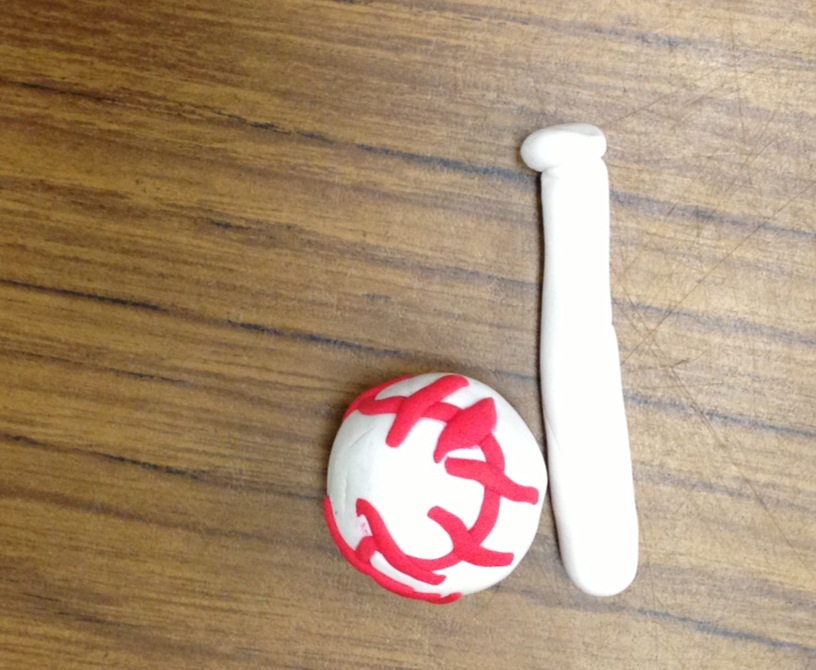
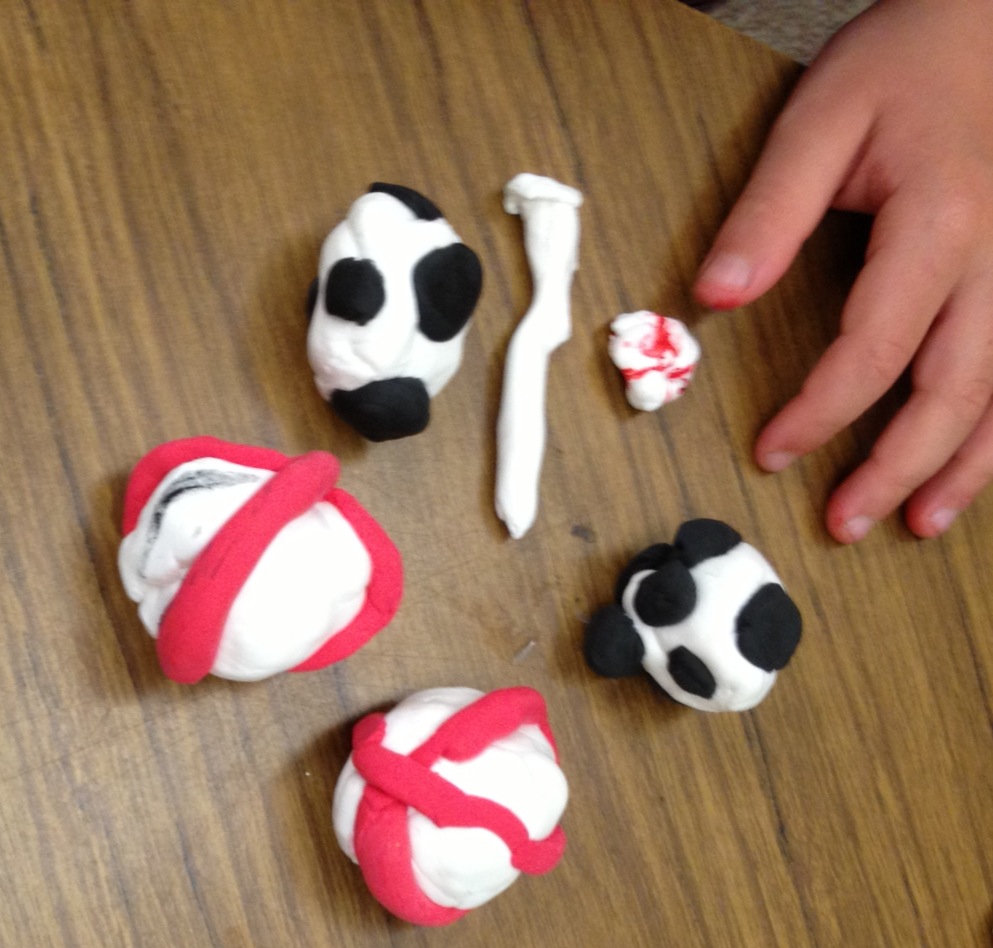
Model Magic Bat and Baseball by Ria

March 31 is Opening Day for Major League Baseball, and most of the kids in Pacifica are already deep into softball and Little League practice.  So this week, I did a storytime about baseball.  Here’s what we read:

randy

Randy Riley’s Really Big Hit by Chris Van Dusen (Amazon.com link)

This book is nominated for the 2014-2015 California Young Reader Medal, and I had already shared it with some second grade classes last month.  It’s a rhyming story about a boy who is terrible at baseball, but a genius at invention.  When he looks through his telescope and sees a giant fireball rocketing towards Earth, Randy Riley quickly invents a robot who hits the greatest home run ever, and saves the town.  This one was a really big hit with the kids in my storytime group, and quickly got snatched up at the end.

homer

Homer by Diane de Groat and Shelley Rotner (Amazon.com link)

The story about a dog baseball game featuring a big golden retriever named Homer, this is an adorable, funny book told in photographs.   The kids got into a mini-scuffle over who would get to check it out.

abbott

Who’s On First? by Abbott and Costello; illustrated by John Martz (Amazon.com link)

An illustrated version of the classic Abbott and Costello routine.  This would be a fun one to read with a partner, or use for Reader’s Theater.  The illustrator makes each player (Who, What, I Don’t Know, etc.) a different animal, making them easy to identify as the joke continues.  I’m not sure that all the kids got the joke, but they laughed as the dialogue got more heated and complicated, and several of them asked to check it out at the end.

tball

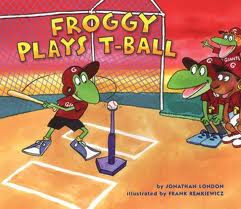
Froggy Plays T-Ball by Jonathan London; illustrated by Frank Remkiewicz (Amazon.com link)

The Froggy books are always a hit, especially because the kids love joining in on yelling, “FROGGGYYY!”  (It’s a great opportunity to point out the word on the page too, which is important for pre-readers).   In this book, Froggy makes several mistakes at his T-ball game: throwing himself out, catching actual flies instead of fly balls, and finally running towards his real home, instead of home plate.

SONGS:

B-I-N-G-O!  I sang this to go along with Homer, and used a dog puppet, who barked the missing letters, and licked the kids’ faces in between verses.

Take Me Out to the Ball Game  We did this as a sing-along, and I played it on the ukelele.  (I found the chords on Ultimate-Guitar.com).

INSTRUMENT PLAY-ALONG WITH A CD: I’m Gonna’ Catch You by Laurie Berkner, from Under a Shady Tree: a catchy song with a brief baseball reference.

CRAFT: Model Magic Baseballs

Image

Model Magic Baseballs, Soccer Balls, and a Bat by Olivia

This ended up being a lot of fun.  Originally, I had planned to just use white Model Magic for the ball, and have the kids draw in the lines for the seams with a red marker.  But I had a tiny bit of red Model Magic left in my bin, along with a package of black, so the kids ended up rolling thin strips of the red for the baseball seams instead.  They also used the black to make soccer balls, and some of them even made baseball bats.

If you aren’t familiar with Model Magic, it’s a soft, light, air-dry modeling clay made by Crayola, and available in most craft stores and on Amazon.com.  It worked beautifully for the balls, because it actually bounces.  It’s also light enough that, even if the kids threw the balls at one another, they wouldn’t hurt.  My son has used Model Magic for years to make little models of whatever he was interested in at the time: Pokemon, Mario, etc.  It’s far less messy than Play-Doh, and really easy to manipulate.

OTHER BASEBALL BOOKS

I also read baseball books to two classes of second graders this week, which was fun because I could share some of the longer ones.  Here’s what I read:

Becoming Babe Ruth by Matt Tavares (Amazon.com link)

The second graders enjoyed this true story about George Herman Ruth, who was such a troublemaker as a child that his parents sent him away to St. Mary’s Industrial School for Boys.  St. Mary’s was strict (the boys could even be whipped if they so much as talked at mealtime), but the one thing that George loved there was baseball.  After he became a professional ball player, he heard that St. Mary’s had been destroyed in a fire, so he invited the school’s band to join him for the rest of the baseball season, and raised money to help them rebuild.   Very readable, with large, colorful illustrations.

Casey Back at Bat by Dan Gutman; illustrated by Steve Johnson and Lou Fancher (Amazon.com link)

A funny follow-up to the old poem, Casey at the Bat.  In this story, Casey hits the ball, which rockets off over the fence, knocks the Tower of Pisa, breaks the nose off the Sphinx, scares the dinosaurs into hiding, and plummets back onto the field, where Casey is flied out.  The kids enjoyed the outrageous silliness of it, and it gave me a chance to put in a plug for Gutman’s chapter book series, The Baseball Card Adventures.  These are sports adventure stories for slightly older kids (grades 4-8) about a boy who uses baseball cards to travel back in time to meet famous ball players.

Casey at the Bat by Ernest L. Thayer; illustrated by C. F. Payne (Amazon.com link)

One of the second grade teachers had this book in her classroom, and pulled it out so the kids could hear the original poem.  Some of the vocabulary is a bit advanced, but the illustrations by C. F. Payne do a great job of conveying the story.  The kids all seemed to enjoy it.

There Goes Ted Williams by Matt Tavares (Amazon.com link)

This was the favorite of a lot of the boys.  Another picture book biography by Matt Tavares (author of Becoming Babe Ruth).  This one tells the story of Ted Williams’ rise to fame as the greatest hitter who ever lived.  It includes an exciting anecdote about how his plane was damaged by enemy fire in the Korean War, forcing him to choose between ejecting and possibly breaking his legs, or taking his chances with a crash.  The kids also were appreciatively grossed out by the description of Williams hitting until blood streamed down his hands.  My only complaint about this book is that the kids were curious about when Williams lived and died, which wasn’t included in the text or the notes at the end.  But the kids in both classes loved it.

What are your favorite picture books about baseball?

Hopping into Spring

photo (84)

It’s officially Spring, although, unlike the rest of the country, the San Francisco Bay Area hasn’t had much of a Winter.  Still, you can see some blossoms appearing on some of the fruit trees, and hear frog songs in the creeks and bushes.  I hadn’t ever really thought about frogs as a harbinger, until I noticed that several picture books made that connection.  So I made them the focus of my Spring storytime as well.  Here’s what we read:

magic

Tap the Magic Tree by Christie Matheson (Amazon.com link)

I’m in love with this book.  It reminds me a lot of Press Here by Herve Tullet, because each page asks the reader to interact with the book in a different way.  The first page asks you to tap a bare tree, making a green leaf appear on the next page.  Tap the tree again, and more leaves appear.  Then buds appear, and turn to flowers, which transform into apples.  The leaves change color and fall off, and the whole thing begins again.  I read this book to three different groups this week: one preschool, one toddler, and one mix of ages.  They all loved following the directions on each page and seeing what came next.  A great book for units on trees or the seasons.

frog

The Wide-Mouthed Frog by Keith Faulkner and Jonathan Lambert (Amazon.com link)

I read this in honor of my coworker, Gwen Miller, who is retiring this month.  This is one of her favorite read-alouds.  It’s a pop-up version of the old joke about the wide-mouthed frog, who goes around asking other animals what they like to eat, until he meets an alligator who eats wide-mouthed frogs!  Sadly, our copy doesn’t circulate, so no one could check it out, but the kids all asked to have a chance to look through it before they went home.

tadpoles

999 Tadpoles by Ken Kimura and Yasunari Murakami (Amazon.com link)

I prefaced this book by asking the kids if they knew what frogs started out as.  Surprisingly, only one of them knew about tadpoles, so I think if I do a frog theme in the future, I will be sure to share a book that describes that process in more detail.  This book was a hit anyway.  When 999 tadpoles become 999 frogs, their parents have to seek out a larger place to live.  On the way, their father is taken by a hungry hawk, and they all join together to save him.  The illustrations of the 999 frogs dangling in a huge chain from the hawk’s claws made all the kids laugh, and there was a mini-squabble over who would get to check it out at the end.

spy

I Spy With My Little Eye by Edward Gibbs (Amazon.com link)

I had originally planned to read City Dog, Country Frog by Mo Willems for my last book, but I had this one in my stack and the kids begged to hear it.  It’s an I Spy game using very simple clues to help kids to guess different animals: a blue whale, a gray elephant, a green frog.  What sets it apart are the large, colorful illustrations, and the hole in each page showing the color of the next animal.  The kids easily guessed all the animals, even the orangutan.  A great book for color or animal themes.

SONGS:

Five Green and Speckled Frogs  

I sang this with a crazy frog puppet I found in our animal bin, which makes burping noises or buzzing sounds when you put your hand in his mouth.  The kids all clambered around me for a turn.

INSTRUMENT PLAY WITH A CD:

Red Red Robin by Rosie Flores from Sing Along with Putumayo (Amazon.com link)

CRAFT: Paper Frog

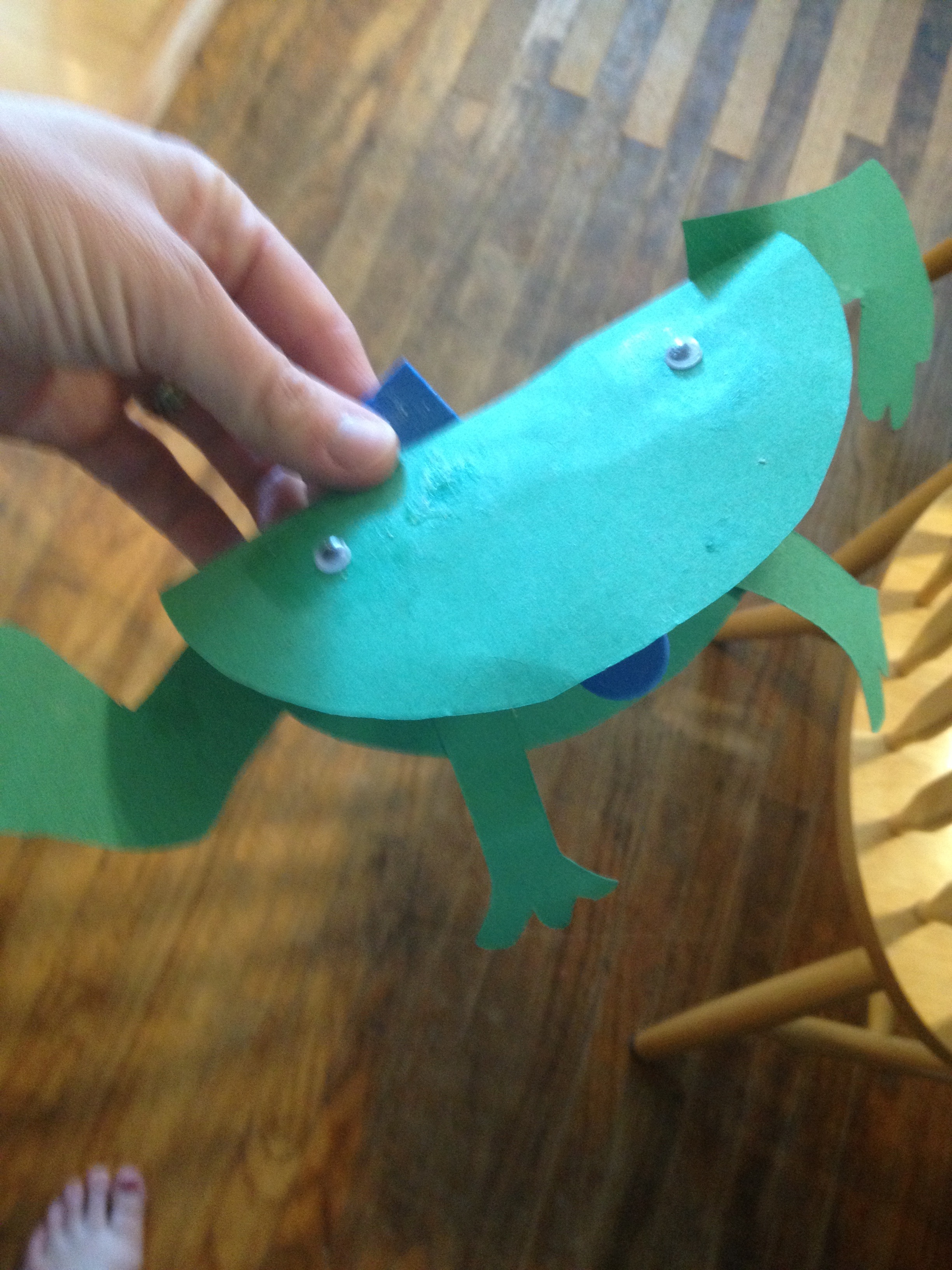
Paper Frog by Lily

Paper Frog by Lily

There are lots of different versions of this craft online, mostly involving paper plates (here’s an example from Drexel Paper Cuts).  For mine, I cut out circles, and front and back feet from green construction paper.  I folded each circle in half, and cut a narrow piece out of the middle. I had some foam craft sticks in different colors for the tongue, and wiggly eyes (if I had had more time, it would have been fun to make eyes that stuck out on the top).

All of the frogs turned out differently.  Several kids put the eyes inside the folded piece of paper, so they looked like the one below.  They all loved the foam craft sticks, and some kids even made their own crafts (stick people and airplanes) by taping several of them together.

Paper frog by Olivia

Paper frog by Sara

OTHER BOOKS:

Spring is Here by Will Hillenbrand (Amazon.com link)

An adorable book about a mole who tries to wake up his friend Bear in time for Spring.  Large, colorful illustrations and simple, repetitive text would make it perfect for toddlers.  My daughter loved it.

City Dog, Country Frog by Mo Willems; illustrated by Jon J. Muth (Amazon.com link)

This is a sweet, somewhat sad, story, far different from most of Mo Willems’ other picture books.  It even has a different illustrator, and features large, expressive paintings of the animals in the countryside.  A city dog visits the country throughout the year, playing games with his friend Frog, until the Winter comes and Frog is nowhere to be found.  The following spring, the dog returns and makes a new friend.  A lovely, subtle book about the cycle of the seasons and the cycle of life.

Everything Spring by Jill Esbaum (Amazon.com link)

A lovely book of large photographs featuring different things you might see in the Spring: baby birds, frogs, fawns, flowers, etc.  I didn’t get this one in time to share at storytime, but it would have worked well because of the photographs of tadpoles turning into frogs.

What are your favorite picture books about frogs or Springtime?


The Luck of the Irish: Books for St. Patrick’s Day

St. Patrick’s Day is a terrible holiday for storytime.  Sure, there are several picture books about leprechauns and lots of adapted Irish folk tales, but they are almost all far too long to read to a preschool or toddler group.   Often I end up making it a “green” theme for that age group.  That was what I had originally planned for this week too, but instead of Family Storytime, we had a guest from the Spindrift School of Performing Arts lead a Movement and Music class, so I was off the hook.

This week though, I read to two classes of second graders, so I finally got to share the longer books.  It was actually a lot of fun.  The kids seemed to enjoy all of them (they’ve gotten in the habit of voting for their favorites at the end, and each of the books got a fair number of votes).  Plus I got to try out my Irish accent (admittedly I was a bit nervous to learn that one of the teachers was a first generation Irish-American, whose parents immigrated here before she was born).  Luckily she didn’t seem offended.  (By the way, if you enjoy playing around with accents, my friend Mai recently sent me this link from the BBC, where a dialect coach named Andrew Jack gives a quick overview of different accents across the UK).

These are the books I read:

snake

The Last Snake in Ireland by Sheila MacGill-Callahan; illustrated by Will Hillenbrand (Amazon.com link)

An original story about St. Patrick’s attempts to rid Ireland of its last snake.  After trying to trick, and then capture, the snake in a wooden box, St. Patrick saves it from a eagle, and finally drops it into Loch Ness in Scotland, where it grows into the Loch Ness Monster.  It’s hard to find a book about St. Patrick that doesn’t delve too much into theology (always a bit risky in a public school or library setting), so this was a fun way to represent him.  Many of the kids, especially the boys, said this book was their favorite.

jamie

Jamie O’Rourke and the Big Potato by Tomie DePaola (Amazon.com link)

Based on an Irish folk tale that DePaola heard from his grandfather, this is the story of Jamie O’Rourke, a man so lazy he would never lift a finger to help feed himself and his wife.  Then one day, he captures a leprechaun, who tricks him into accepting a potato seed instead of his pot of gold.  Jamie plants the seed, and grows the biggest potato in the world.  The whole town ends up eating it all winter long, until everyone is so sick of potatoes that they offer to keep Jamie and his wife supplied with food all year, as long as Jamie O’Rourke doesn’t plant another potato seed.  It would be fun to do a planting activity along with this book, and let the kids plant potato eyes to grow their own potatoes.

lucky

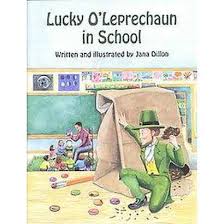
Lucky O’Leprechaun in School by Jana Dillon (Amazon.com link)

Someone is eating bites out of the cupcakes and cookies in Mr. Eliot’s classroom.  The kids suspect the new kid, Kevin O’Malley, until they discover there’s a leprechaun hiding in the ceiling.  Kevin helps them catch the naughty thief, and makes him promise to grant them one wish: a field trip to the moon.  The kids really enjoyed this one, and spent several minutes afterwards talking about what they would wish for: mostly they wanted money or infinite wishes.  This one actually is short enough to share with preschoolers, and I have read it at library storytimes in the past.  It is also one of a series of books about Lucky O’Leprechaun.

puck

King Puck by Michael Garland (Amazon.com link)

A lonely man lives in the mountains with only his books, the fairies, and his goat Finny for company.  Until one day the fairies enchant his goat to make him talk.  The two head off to the fair in Killorglin, where Finny is crowned King Puck for a day, and granted one wish: more books to read.  This book was a huge hit, mostly because of the illustrations.  The kids kept commenting on how they “almost look real” (they are computer-generated), and they loved pointing out the fairies hiding on each page.  The note at the back of the book explains about the history of the King Puck contest, which really is held every year in Killorglin.  The girls especially liked this one, and I think it would probably work for a preschool storytime.

hungry

The Hungry Leprechaun by Mary Calhoun and Roger Duvoisin (Amazon.com link)

An original story about a hungry man who finds an even hungrier leprechaun.  The man, Patrick O’Callahan, badgers the leprechaun into trying to conjure up some gold, but the leprechaun has forgotten how to do magic.  His attempts to make gold out of dandelion soup and the sunbeams on the floor yield them nothing but a puddle full of frogs, but when he tries to enchant the rocks, they turn into something white and tasty that feeds them both and everyone else.  The kids liked the part where the leprechaun says something like, “We boiled them in a POT and ATE them.  We should call them POT-ATE-o’s.”  Several kids commented on how only every other page is in color, and the color is limited, which gave me a chance to discuss how printing in color used to be expensive, and was usually used sparingly (this book was published in 1962, and unfortunately appears to be out of print).

What are your favorite books for Saint Patrick’s Day?

What a Feeling! Books about Emotions

Emotion Wheel by Olivia

Emotion Wheel by Olivia

This week for Family Storytime, I read books about emotions.  I noticed that most of the books out there with that theme focus on negative emotions like anger and fear, but they are some of my favorites.  Here are the ones we read:

grumpy

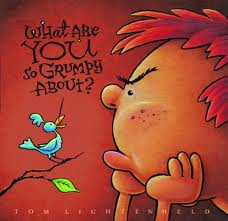
What are You So Grumpy About? by Tom Lichtenheld (Amazon.com link)

This book does a great job of illustrating the frustrations of being a kid: boring grown-up conversations that never end; trips to dull museums; bland grown-up cereals.  Tom Lichtenheld takes each one to an hilarious extreme, ending with the worst: somebody making you laugh when you were trying to be grumpy, and making you forget what you were grumpy about.  This one always gets laughs, from the parents as well as the kids.

friend

My Friend is Sad by Mo Willems (Amazon.com link)

My favorite of the Elephant and Piggie books, and one of the best for very beginning readers.   When Piggie sees that Gerald is sad, she tries to cheer him up by dressing as a cowboy, a clown, and a robot, but only makes him feel worse.  I had the kids say the repeated “Ohhhhh”s along with Gerald.   A good, funny story about friendship as well as emotion.  The kids all loved it.  By now they are all so familiar with Gerald and Piggie books that they couldn’t wait to get to the end page, which always has Mo Willem’s Pigeon hidden inside of one of the illustrations.

mousemad

Mouse Was Mad by Linda Urban; illustrated by Henry Cole (Amazon.com link)

This is one of the best picture books about coping with anger.   Mouse is so angry, he jumps up and down, stomps his feet, screams, and rolls on the ground.  The problem is that other animals (hare, bear, bobcat, and hedgehog), each do those things much better, and when he tries to emulate them, he always ends up falling into a mucky mud puddle and getting even angrier.  Finally, he stands still…and breathes…something he can do better than anyone else.  A great way to teach an important skill for regaining calm, but taught in the context of a lively, non-preachy read-aloud.  My daughter, who could teach bobcat a thing or two about screaming, loves this book, so I’m hoping its quiet lesson will rub off.

crankenstein

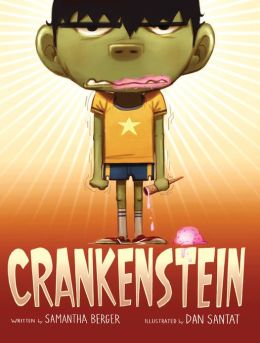
Crankenstein by Samantha Berger; illustrated by Dan Santat (Amazon.com link)

Another funny book about being grumpy.  Crankenstein is a monster.  When you say, “Good Morning!  How are you?” he says, “MEHRRRR!”  He also says “MEHRRR” to lots of other things: getting ready for school, standing in long lines, and going to bed.  But then he meets another Crankenstein, who makes him laugh.  The kids enjoyed joining in on the “MEHRRR’s,” and this one grabbed the attention of some of the boys who love monsters.

SONGS:

If You’re Happy And You Know It:  I added new verses with other emotions: If you’re sad and you know it, cry ‘Boohoo!’;  If you’re shy and you know it, hide your face…peek-a-boo!;  If you’re grumpy and you know it, stomp your feet; etc.

INSTRUMENT PLAY WITH A CD:

My Energy by Laurie Berkner from Under a Shady Tree (Amazon.com link)

CRAFT: Emotion wheel

Emotion wheel by Sarah

Emotion wheel by Sarah

This was an easy craft I found on the Allen County Public Library Youth Services web site, on a page with a list of other good books and songs about emotions.  I adapted it a little, and created a Word document with circles for the kids to draw faces in.  You can print the template here.  I also cut out arrows out of cardstock, and punched holes in them for the metal brads (I attached the arrows to the page ahead of time because that part seemed a little tricky, and the brads are a bit sharp.  I just pushed them through the middle of the paper and twisted them a bit until the arrow could spin easily, then separated the metal tabs on the back of the page to hold them in place).

The kids had fun drawing in their faces.  I liked that this made for a simple reading activity too, since they had to learn the emotion word (happy, sad, angry, or scared), in order to know what kind of face to draw.

OTHER BOOKS:

The great thing about this theme is that you can really use just about any picture book and talk about the emotions the characters may be feeling.

Today I Feel Silly: And Other Moods that Make My Day by Jamie Lee Curtis; illustrated by Laura Cornell (Amazon.com link)

One of the few celebrity authors I actually like.  In this book Jamie Lee Curtis explores a wide range of emotions based on situations that kids can easily relate to: feeling angry at not being included in a friend’s playdate; being sad after a fight with a friend; feeling happy at learning how to do something new.  The text is simple, well-written rhymed verse, and the illustrations are whimsical and full of feeling.  The book comes with an emotion wheel at the back, although I noticed the one from the library copy we have was missing.

How Are You Peeling?  Foods with Moods by Saxton Freymann and Joost Eiffers (Amazon.com link)

The emotional vegetables and fruits in this book, all made from actual food, are hilarious: angry peppers, kissing strawberries, joyful peas.  This is a great book for a food-themed storytime as well.

Baby Happy, Baby Sad by Leslie Patricelli (Amazon.com link)

Perfect for babies, toddlers, and beginning readers, this board book goes through all the things that make baby happy (getting an ice cream!) and sad (dropping the ice cream).

Katie Loves the Kittens by John Himmelman (Amazon.com link)

I’m including this one because it does a great job of conveying a common experience that everyone, especially young kids, can relate to: being SO excited that you rush in and do something you regret later.  This story is about an adorable dog named Katie, and three little kittens.  When her owner brings home three new kittens, Katie can’t contain herself: she rushes in howling and scares the kittens.  Then she feels ashamed and sad.  The cycle repeats several times, until she finally learns to control her excitement.  The illustrations are darling (no one conveys shame better than a dog), and it’s a terrific read-aloud, with lots of opportunities for kids to howl.

Llama Llama Red Pajama by Anna Dewdney (Amazon.com link)

Another story all parents and kids can relate to: Llama Llama feels alone and scared in bed, while Mama Llama is on the phone downstairs.  Adorable rhyming book with wonderful illustrations.  Many of the other Llama Llama books (Llama Llama Mad at Mama; Llama Llama Misses Mama) would work for this theme as well.

When Sophie Gets Angry…Really Really Angry by Molly Bang (Amazon.com link) Recommended by Jeanine Asche and Erica Hohmann

Vivid colors and bold descriptions capture just how it feels to be really, really angry, and how Sophie calms down.   This is a simple story about a little girl’s frustration and anger that kids can easily relate to, and one that conveys both the overwhelming feeling of rage and the fact that it eventually passes.

Grumpy Gertie by Sam Lloyd (Amazon.com link) Recommended by Shelley Jacobsen

I haven’t read this one yet, but it looks like a fun, simple way to teach kids that the face they project to the world can affect others.  Gertie is determined to tell the world just how grumpy she is, until a monkey teaches her how to turn her frown upside down.

The Pout Pout Fish by Deborah Diesen; illustrated by Daniel X. Hanna (Amazon.com link) Recommended by Kim Day

Adorable rhyming story about a pouty fish, whose ocean friends all try to cheer him up, until he turns upside down and becomes a kissy fish instead.

What are your favorite books about emotions?

Hail to the Chief: Books about the Presidents

Abe Lincoln Finger Puppet by Paxton

Abe Lincoln Finger Puppet by Paxton

Here’s a (very) little known fact: I once ran for President!  Although my entire campaign consisted of this one post from an old blog I shared with two of my friendsHere’s a (very) little known fact: I once ran for President!  Although my entire campaign consisted of this one post from an old blog I shared with two of my friends.

Anyway, last Monday was President’s Day, so I thought I’d give a president-themed storytime a try.  I was pleased to find that there are some pretty good picture books out there, some of which I really enjoyed.  The only problem was that my Family Storytime audience  was almost all toddlers.  Don’t get me wrong: I was thrilled to see them, especially because a few of them were new families.  But I quickly realized that, even though I had picked relatively short books, they were still too long and complex for the under-two set.   I adapted by throwing in a lot of songs in between books, excerpting some pages here and there, and then completely abandoning the theme at the end.  In spite of it all, I actually had a great time.  I would rather be a librarian than President any day!

Here’s what I ended up doing.  I’ve included the books that I had planned to read in the list at the end:

washington

George Washington’s Teeth by Deborah Chandra and Madeleine Comara; illustrated by Brock Cole (Amazon.com link)

If your kids don’t like to brush, read them this book.  Poor George Washington.  Not only did he have that whole Revolutionary War thing to deal with, he also suffered from horrible teeth that rotten and hurt and fell out all the time!  This book tells you exactly how, and when, he lost each one, all in solid, entertaining rhymed verse, which is quite an art.  A lot of the story was lost on the toddlers, but they hung in there, especially whenever I held up my fingers each time George lost a tooth, to show just how few he had left.  The older kids were mesmerized, and one of the moms said at the end, “I never knew that!  It’s kind of disgusting.”  And it is.  But it’s a great picture book all the same.

teacher

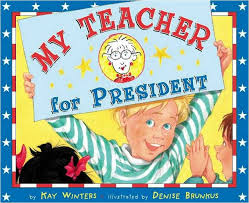
My Teacher for President by Kay Winters; illustrated by Denise Brunkus (Amazon.com link)

I was relieved to have this book in my stack because it was short and simple, with large illustrations.  A kid explains all the reasons why his teacher would make a great president: she is a great listener; she goes to lots of meetings; she is good at finding people jobs.  Each two page spread shows the teacher demonstrating the skill (like catching a loose snake on the page about being good in an emergency), as well as showing how she might put it to use if she were President.  This would be a nice lead-in to a discussion about what kinds of challenges Presidents face, and what kind of person would make a good leader.

lincoln

Abe Lincoln’s Hat by Martha Brenner; illustrated by Donald Cook (Amazon.com link)

This one was far too long to read in its’ entirety, so I ended up just sharing parts of it.  It’s actually an easy reader about Abe Lincoln, featuring some fun anecdotes about his career as a lawyer.  The part I mostly wanted to share (because of the craft I had planned) was that Lincoln carried letters and important papers inside his hat.  This would make an excellent book to share with an elementary school class for Lincoln’s birthday, since it does a good job of conveying his cleverness, integrity and good humor.

elephants

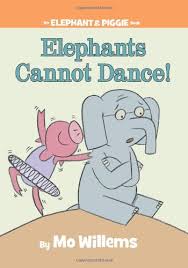
Elephants Cannot Dance by Mo Willems (Amazon.com link)

Okay, this was the point where I completely abandoned the theme.  All the other books in my stack were far too long for the toddlers.  So I grabbed this book from the shelf behind me, and it was great.  I even had the kids try to do the dance steps along with Piggie.  In this story, Piggie tries to teach Gerald to dance, even though Gerald tells her emphatically that “Elephants Cannot Dance.”  In the end, Piggie is forced to agree, but meanwhile Gerald has found a following for his “Elephant Dance.”  Totally unrelated to presidents, but the toddlers loved it (thank you, Mo Willems!), and hey, at least elephants represent a political party.

SONGS

Brush Your Teeth: This Raffi song is always a hit, and it paired perfectly with George Washington’s Teeth.

Head and Shoulders, Knees and Toes: This didn’t connect with any of the books, but was great for bringing the wandering toddlers back in.  I do the song several times, doing it faster and faster every time.  Sometimes, if I want to especially tricky, I’ll have the kids try to sing it backwards: Nose, and Mouth, Ears and Eyes, Ears and Eyes…etc.   I also ham it up a bit by flapping my lips with my fingers when we sing the word “Mouth” and pinching my nose when we sing “Nose.”  Yes, I am a huge goof-ball, which is yet another reason why I will never be President.

Bringing Home a Baby Bumblebee: Another song for the toddlers.  I have a big bee puppet that I brought out for the first verse.  After that I asked for animal suggestions, and we had to invent new rhymes for each one: “I’m bringing home a baby lion.  Won’t my Mommy really start a-crying?” “I’m bringing home a baby grizzly bear.  Won’t my Mommy pull out all her hair?”  etc.

INSTRUMENT PLAY WITH A CD: This Land is Your Land from 20 Great Kids Songs (Amazon.com link)

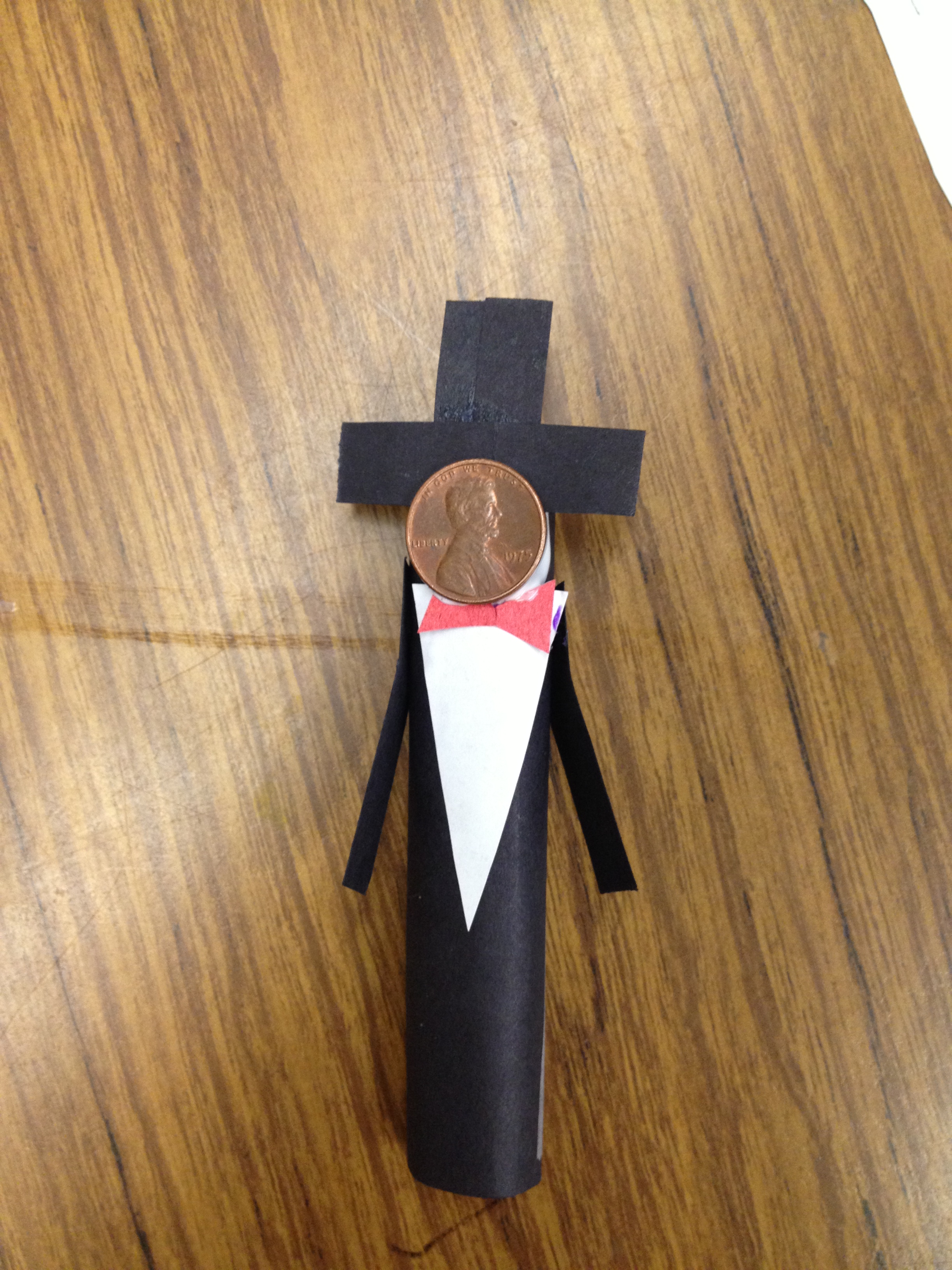
CRAFT: Abe Lincoln Finger Puppet

Abe Lincoln Finger Puppet

Abe Lincoln Finger Puppet

I thought this craft from Spoonful.com was adorable.  I gave each child a rectangle of black paper, which they rolled around a finger and taped or glued together, a tiny black strip for the hat, a white paper triangle for the shirt-front, a penny for the face, and a red paper bowtie.  They were all very cute.  I thought it was funny that even though I told them at the beginning that Lincoln’s face is on the penny, most of them glued the penny on upside down.

You can do the same craft for Washington, Roosevelt, or Jefferson, but it would be more expensive!

OTHER BOOKS ABOUT PRESIDENTS:

So You Want to Be President by Judith St. George; illustrated by David Small (Amazon.com link)

This one was too long for my family storytime, but I read it to a second grade class a while back when we were showcasing Caldecott Award winners.  It’s a nice overview of the presidents, and the ways they were alike and different.  There are a number of funny anecdotes and quotes, and the caricature-style illustrations are fun.

What Presidents Are Made Of by Hanoch Piven (Amazon.com link)

Another books with simple stories and facts about different presidents.  This one is short enough to use with Kindergartners, or even older preschoolers, especially if you just share certain stories.  Hanoch Piven has a unique collage style, where he uses objects that represent different people to create mixed-media caricatures (for example, his illustration of Ronald Reagan uses jelly beans, and George W. Bush has a hot dog nose).   The stories are simple and fun, and give a more human portrayal of each president.

Grace for President by Kelly DiPucchio; illustrated by LeUyen Pham (Amazon.com link)

I was really hoping to share this one, but in the end, it was too long.  When Grace learns that there has never been a female president, she is determined to start by winning the class election.  What I find interesting about this book is that the school election mirrors the electoral college process, with different students representing different states, and some having more votes than others.  In the end, the decision comes down to one vote, and Grace’s hard campaign work pays off.  This would be a great book to share around election time.

President’s Day by Anne Rockwell; illustrated by Lizzy Rockwell (Amazon.com link)

This is a nice story about the holiday, featuring a school play about different presidents, with an election at the end.

What are your favorite books about the presidents?

Have a Heart! Books for Valentine’s Day

photo (73)

Yet another holiday-themed storytime.  Fortunately, Valentine’s Day comes with much better picture book options.  (Thanksgiving is terrible, and don’t even get me started on St. Patrick’s Day).  I actually had a great day reading to different age groups: two classes of second graders, and then my family storytime, which included several of my regular Kindergartners, as well as some new toddlers.

Here were the Family Storytime books:

froggy

Froggy’s First Kiss by Jonathan London; illustrated by Frank Remkiewicz (Amazon.com link)

I love the Froggy books.  Yes, they tend to follow the same pattern: Froggy makes lots of mistakes, adults are always yelling at him, and towards the end, he always gets embarrassed and turns “more red in the face than green.”  But they are fun to read aloud, have funny illustrations, and the kids love them.  Plus, they are a wonderful opportunity for teaching print awareness, which helps young children understand the connection between the words they hear and the writing on the page (a recent study found that students whose teachers called attention to printed words while reading aloud performed much better on reading tests up to two years later).  With the Froggy books, I like to show the kids the places where someone yells out “F-R-O-G-G-Y!” (a words that’s usually written in bright bold letters across the page). I tell them to watch for that word, and then join in.  In this story, Froggy is smitten by the new girl at school, Frogilina, who always gives him a surprise at lunch.  One day, she gives him a kiss!  Blaahhh!  I love that Froggy is not interested in romance, and that he gives his special Valentine to his mom (plus he serves her breakfast in bed!).   There were several eager kids asking to check this one out.

splat

Love, Splat by Rob Scotton (Amazon.com link)

Splat is another popular picture book series.  In this one Splat, a fluffy black cat, wants to give a Valentine to Kitten, even though every time he sees her, she “pulls his ears, and pokes his belly, ties his tail and calls him smelly.”  To make matters worse, Spike, the big bully cat at his school, likes Kitten too.  The illustrations are adorable, and the kids always giggle at the parts where Kitten calls Splat smelly.  This one got snatched up too.

ballad

The Ballad of Valentine by Alison Jackson; illustrated by Tricia Tusa (Amazon.com link)

I love this wild West parody of “My Darling, Clementine,” about a man who tries to send his true love a message, but things never go his way.  The mailman can’t find her address, the homing pigeon flies to Madagascar, the Pony Express messenger gets bucked clear to Arizona.  The parents seemed to get the humor more than the kids, but I was grateful to have this book because some of the toddlers were getting restless after the two longer books, and the singing in this one seemed to draw them back in.  Alison Jackson also wrote the wonderful I Know An Old Lady Who Swallowed a Pie, which is one of my Thanksgiving mainstays.

day

The Day it Rained Hearts by Felicia Bond (Amazon.com link)

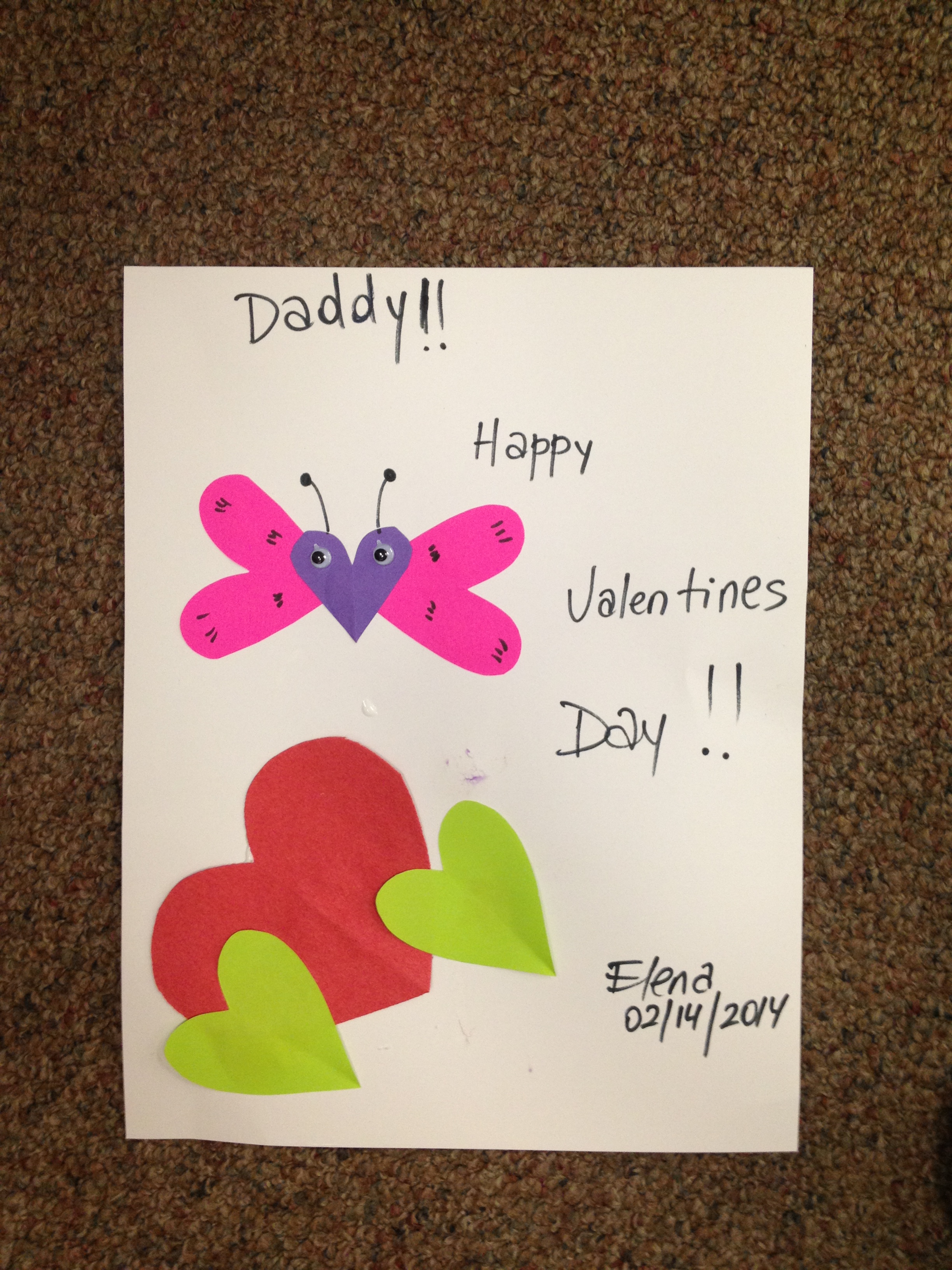
One day just before Valentine’s Day, it starts raining hearts.  Cornelia Augusta catches several and uses them to make special Valentine’s for each of her animal friends: a ring of hearts for the dog; a heart with a cotton ball in the middle for the rabbit; a big heart with holes cut in it for the mouse.  This one was a great lead-in for the heart craft we did at the end.  I was planning to throw some small paper hearts like confetti, but I forgot.

SONGS:

Skidamarink-a-Dink-a-Dink: I like to teach the kids how to say “I Love You” in sign language, and we do that each time it comes up in the song.  Here’s a very trippy animated video of the song, with the lyrics in the subtitles.

Five Green and Speckled Frogs: We did this one after the Froggy book.  I have the kids stand up and jump up and down on the line, “One jumped into the pool.”  I often do this with a frog puppet, and pretend it is catching flies on the kids’ heads.   Here’s an animated video for this song.

If All the Raindrops:  We sang this song before The Day It Rained Hearts.  As I did last week, I asked the kids for suggestions of what they’d like the rain to be and we made up our own verses.  Our rain was made up of milkshakes, pie, cookies, and lots of other goodies.

INSTRUMENT PLAY WITH A CD: Who’s My Pretty Baby? by Elizabeth Mitchell from You Are My Little Bird (Amazon.com link)

CRAFT: Fun with Hearts

photo (76)

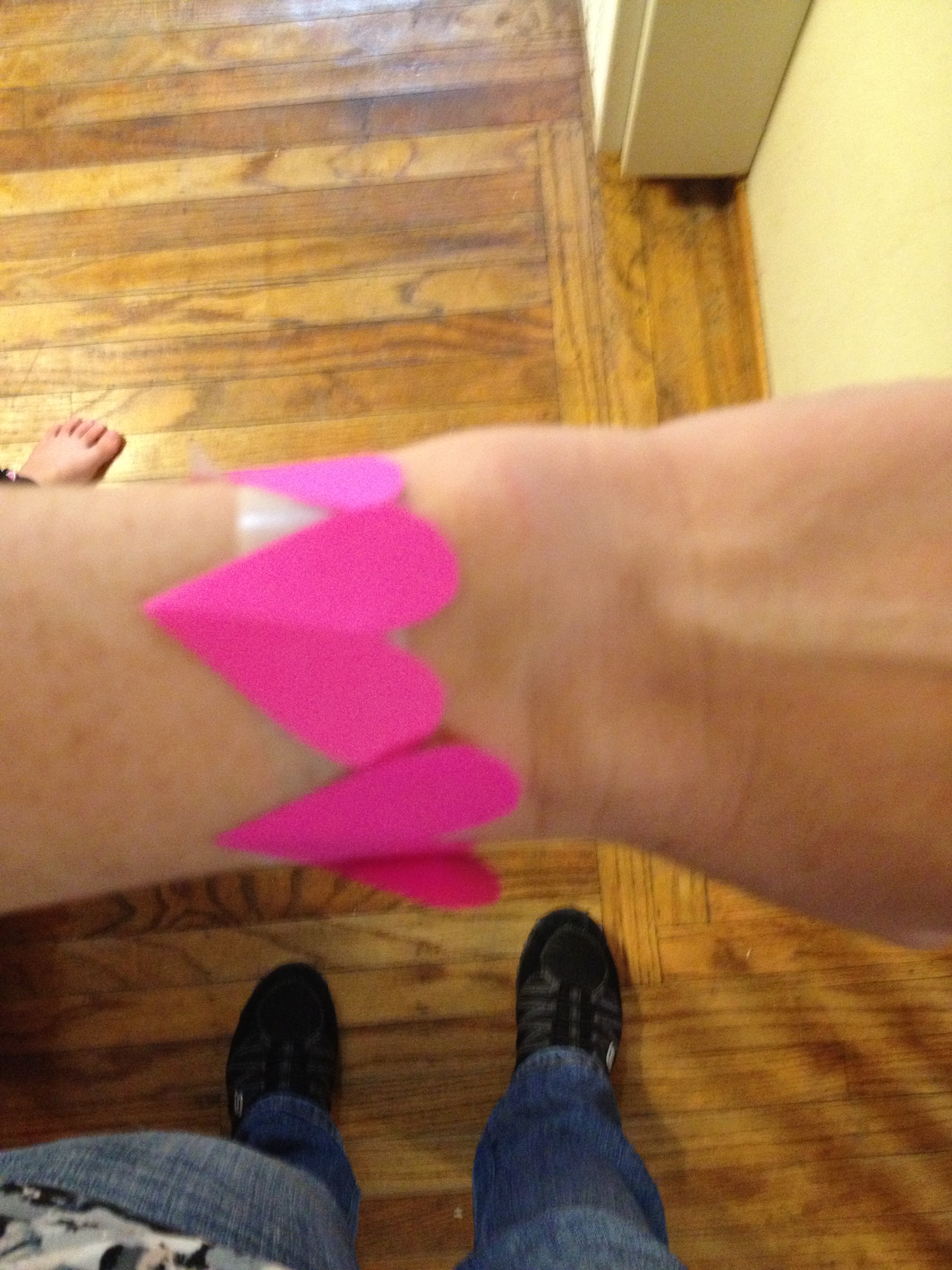
Heart bracelet by Ella

photo (74)

Heart person by Ella

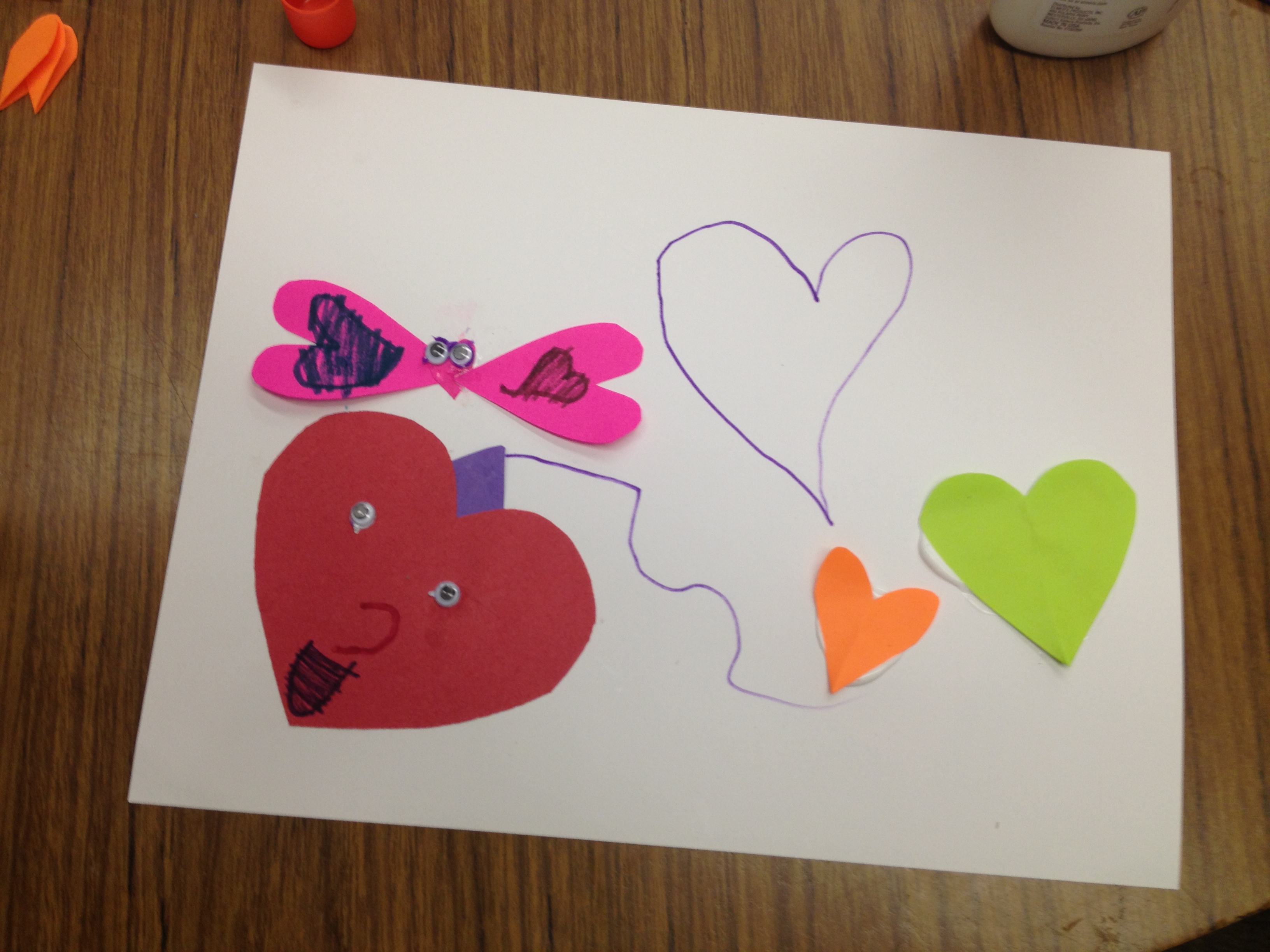
I cut out paper hearts in all different sizes and colors, and gave the kids glue sticks, white cardstock, and markers.  I had made an example page featuring several types of heart animals, but in the end all the kids did different things, and it was great fun to see what they came up with.  One little girl even taped several pink hearts together and made me a bracelet, which I thought was a neat idea.

Hearts by Olivia

Hearts by Olivia

OTHER VALENTINE’S DAY BOOKS:

Nate the Great and the Mushy Valentine by Marjorie Weinman Sharmat and Marc Simont (Amazon.com link)

I read this one to the second graders, and it worked really well.  When Nate’s dog Sludge receives a mysterious Valentine, Nate is on the job to find out who sent it.  But then his friend Annie begs him to help her find the missing Valentine she made for her brother, giving him two cases at once.  In the end, Nate is horrified to discover that someone has given him a Valentine. The book includes a section of craft ideas, jokes, and facts about Valentine’s Day, which were fun to share with the class.

Somebody Loves You, Mr. Hatch by Eileen Spinelli; illustrated by Paul Yalowitz (Amazon.com link)

This was a nice counterpoint to the Nate the Great, although I have to tell myself several pages before the end not to get choked up.  It’s a lengthy picture book about a lonely man named Mr. Hatch, who has no friends or family, and keeps to himself.  Then one day the mailman delivers a big box of chocolates with a card that says, “Somebody Loves You!” and Mr. Hatch’s whole life changes.  Wondering who could have sent the chocolates, he reaches out to help people in his community, and bakes brownies for his neighbors.  When the mailman discovers that he accidentally delivered the package to the wrong address, Mr. Hatch goes back to his lonely ways, thinking nobody loved him after all.  But by then, of course, everybody does.

Lilly’s Chocolate Heart by Kevin Henkes (Amazon.com link)

Great board book for toddlers and preschoolers.  When Lilly gets a chocolate heart for Valentine’s Day, she wants to save it.  But there seem to be no good hiding places.  In the end, she finds the perfect place: in her mouth!

Be Mine, Be Mine, Sweet Valentine by Sarah Weeks and Fumi Kosaka (Amazon.com link)

Cute, rhyming lift the flap book featuring different animals giving each other the things they like best.  Preschoolers enjoy guessing what’s under the flap based on the animal and the rhyme: a bone for the dog, cream for the cat, etc.

What are your favorite picture books about Valentine’s Day?

It’s Raining, It’s Pouring: Stories About Rain

Rain books by Jonas and Alyssa

Rain books by Jonas and Alyssa

I’ve lived in the Bay Area now for almost 15 years, and I still don’t understand the weather.  The only things I know for certain are that it’s good to bring a jacket, even when it’s seventy degrees outside, because ten minutes from now it might be twenty degrees colder.  September is often hot.  June is often cold.  And winter is always rainy.  Until now.  Now the reservoirs are so low that we’ve all been urged to cut our water usage by twenty percent, and many towns across the state are in danger of running out of water entirely.

So, in lieu of a rain dance, I did a rain storytime.  The weather report now says it’s going to rain all this weekend, so maybe it worked!  Here’s what we read:

rain

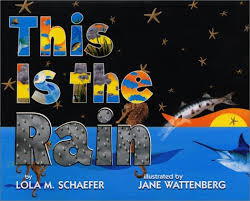
This is the Rain by Lola M. Schaefer; illustrated by Jane Wattenberg (Amazon.com link)

There’s a new goal in our library system to incorporate more nonfiction into storytimes, so I gave it a try tonight.  This book is actually a cumulative poem about the water cycle.  It starts with “This is the ocean, big and vast/that holds the rainwater from the past.”  Each page adds a new part of the cycle: water vapor, clouds, and then a depiction of water running down streams back into the ocean.  I had to explain some of the terminology, like “vapor,” and talk a bit about what was happening.  I don’t think it was the best book I could have chosen in terms of giving a clear explanation of what makes the rain, but the kids loved the illustrations!  Jane Wattenberg has filled the book with funny visual jokes: dinosaurs in the ocean (to represent the past); starfish in place of stars; birds holding umbrellas. The kids were all clambering around me, pointing and explaining over every page, and the book was quickly snatched up at the end.

ready

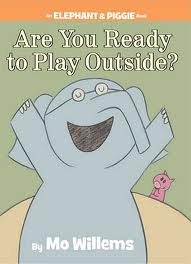
Are You Ready to Play Outside? by Mo Willems (Amazon.com link)

Mo Willems makes my job so easy.  All of his books are so much fun to read aloud, but especially the Gerald and Piggie books.  They are written ostensibly as beginning readers, with very simple text, usually with a fair amount of repetition.  But they are also hilarious.  They are especially fun to read with a partner, and they would be perfect for small groups of kids to act out.  In this one, Piggie is upset when it starts raining, ruining her plans to play outside.  Then she and Gerald discover how much fun it can be to play in the rain… just as the rain stops.  Luckily, Gerald saves the day by creating a rain shower of his own.  I got lots of laughs over this one, and a small tugging match ensued at the end over who was going to get to check it out.

rainy

Rainy Day! by Patricia Lakin and Scott Nash (Amazon.com link)

This book also reads like a beginning reader, with simple, rhyming text.  Four crocodiles named Sam, Pam, Will and Jill are all bored on a rainy day.  They decide to go outside anyway, and wind up playing mini-golf and baseball (with hailstones!), finding a dog, and going to the library.  The kids liked the rabbit librarian, cowering in terror from the crocodiles.

patterson

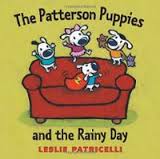
The Patterson Puppies and the Rainy Day by Leslie Patricelli (Amazon.com link)

I brought this one out in my stack, but I hadn’t planned to read it because it was so similar to Rainy Day, but several of the kids spotted the cover and begged to hear it.  I was glad because it was a hit!  This book is about four puppies who are bored on a rainy day, who decide to pretend they are at the beach.  In the end, they pour water all over the living room floor, and have a wonderful time playing in the “ocean,” until their parents walk in the room…

SONGS AND ACTIVITIES:

If All the Raindrops

I used this song a lot when my daughter was a toddler, to get her to open her mouth for the toothbrush.  For storytime, I sang the first verse through normally, then asked the kids what they would like the snow and sunbeams to be.  We added their suggestions into the second and third verses, so we had sunbeams made of lemonade and butter (and hair!).   These are the original lyrics (click on the arrow above to hear the tune):

If all the raindrops
Were lemondrops and gumdrops
Oh, what a rain that would be!
Standing outside, with my mouth open wide
Ah Ah Ah Ah Ah Ah Ah Ah Ah Ah!
If all the raindrops were lemondrops and gumdrops,
Oh, what a rain it would be!

If all the snowflakes
Were candy bars and milkshakes…

If all the sunbeams
Were bubblegum and ice cream…

Making a Rain Storm

This is such a simple activity, but always fun.  I ask the kids to do what I’m doing in order to make a rainstorm.  First we rub our hands together, then click our tongues (to sound like drops of rain), then clap our hands, then slap our knees, then stomp our feet.  Finally I have them all stand up, and we all jump at the same time to make a thunderclap, and then we do all of the actions in reverse to make the rain “stop.”

CRAFT: Rain on the Green Grass Book

photo (72)Rain book by May

Rain book by Olivia

Rain book by Olivia

I got the idea of making a book from my coworker, Reeba Lynn.  I was almost kicking myself for not doing one earlier.  In Kindergarten, my son was so proud of his “keep box,” a little collection of simple paper books he made throughout the year.  And my daughter has made several similar books in her preschool class that she loves to read to me.

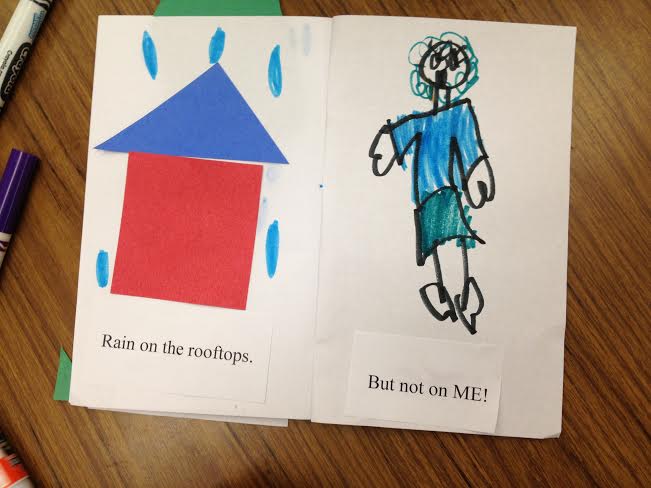
The book Reeba showed me had a more complicated rain poem, but I decided to do the nursery rhyme Rain on the Green Grass (Rain on the green grass/Rain on the tree/Rain on the rooftops/But not on ME!).  I cut out Reeba’s umbrella picture (there are lots of other ones online), and printed out the words to go on each page (here’s a Word document for the text: Rain on the green grass).  For the rest of the illustrations I cut out basic shapes from colored construction paper: jagged green strips for the grass; lumpy round green shapes for the treetops; brown strips for the tree trunk; red squares for the house; and blue triangles for the roof.  It did take a fair amount of prep, but I was able to do a lot of the cutting with the paper cutter.

I folded two sheets of white paper to make each book, and stapled them along the side.  I had an example for the kids to follow, and for the most part, they did a good job (there were a couple of kids who accidentally made their books read from left to right, but I explained that’s how books are made in Japan, so they could either read it that way, or consider it a whole new rhyme).  If I had more time, I would have glued the text on ahead of time, so they could just add the pictures.  I had them glue the umbrella on the cover, along with the title, “RAIN! by ________.”   Then they glued the text and pictures on each page, and added rain with markers.  For the last page (“But not on ME!”), I asked them to draw a picture of themselves.  Each book turned out a little bit differently, and they all seemed engaged by the process of making them.

OTHER BOOKS ABOUT RAIN:

There were lots of other books I could have read (I had originally planned to read the new California Young Reader Medal nominees, but some of the books didn’t come in time, so I had to change topics, and work with the rain books that were available in our small local branches).  Anyway, here are a few others:

Down Comes the Rain by Franklin Branley; illustrated by James Graham Hale (Amazon.com link)

Franklin Branley writes wonderfully clear science books for early elementary school children.  This one explains every step of the water cycle with a few simple science experiments to illustrate some of the concepts.

Storm is Coming! by Heather Tekavec; illustrated by Margaret Spengler (Amazon.com link)

When the animals on a small farm hear there’s a storm coming, they all think Storm must be a scary monster.  They hide in the barn in terror, and then are happy when wind, rain, lightning and thunder apparently scare Storm away.  Cute story with colorful illustrations.

Umbrella by Taro Yashima (Amazon.com link)

Such a sweet story, I wish I had been able to get it in time to share.  A little girl can’t wait to wear her new red rain boots and carry the umbrella she receives for her birthday, but her parents insist she has to wait for a rainy day.  It’s not only a lovely story about rain, but about the small steps kids take towards growing up.

Red Truck by Kersten Hamilton; illustrated by Valeria Petrone (Amazon.com link)

Perfect for toddlers, this is about a red tow truck who pulls a school bus from a deep puddle.  There are lots of fun truck noises for the kisd to join in on.

Cloudette by Tom Lichtenfeld (Amazon.com link)

A little cloud worries that she is not big enough to make a difference, until she finds her own way to save the day.   I’ve read this one several times, and the kids always love it.  The illustrations are adorable.

Come On, Rain! by Karen Hesse; illustrated by Jon J. Muth (Amazon.com link)

This one was a little too long for my group, but it sums up how I’ve been feeling through this dry winter.  A little girl in a hot city neighborhood can’t wait for the rain.  When it finally comes, she and her friends go out dancing in their bathing suits, and so do their mothers!

Thunder Cake by Patricia Polacco (Amazon.com link)

This one was also a little too long, but it’s one of my favorite picture books.  A little girl is afraid of the thunder, until her grandmother teaches her how to make thunder cake.  I’ve never tried the recipe on the last page, but it looks delicious.  The story also teaches kids how to count the seconds between the lightning and thunder to see how close the storm is.  We very rarely get thunder here (I actually miss it!), but this is a lovely story about overcoming your fears.

It’s Raining, It’s Pouring by Kin Eagle; illustrated by Rob Gilbert (Amazon.com link)

An extended version of the nursery rhyme, featuring an old man in a wide variety of weather and precarious situations.  The illustrations are colorful and funny.  I’ve used this many times for baby and toddler storytimes.

The Aunts Come Marching by Maurie J. Manning (Amazon.com link)

A clever parody of the Ants Go Marching song (which would also have been a good one to include for storytime).  This is a counting book about a little girl and her aunts who go marching through town in the rain.  Lots of great drum noises, and fun to sing.

What are your favorite books about rain?  Please share them in the comments.

The Year of the Horse

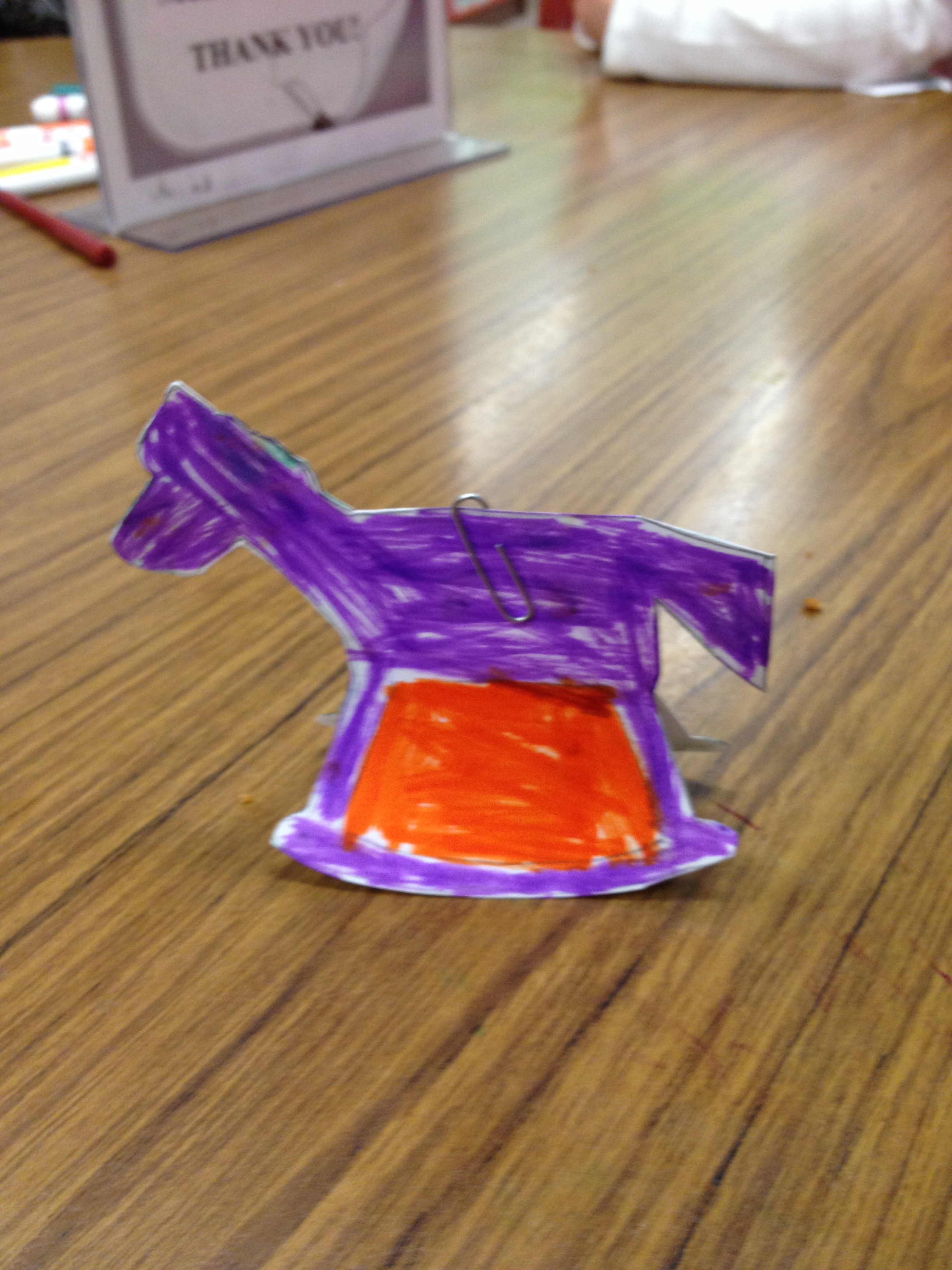
Paper Rocking Horse by Kiki

Paper Rocking Horse by Kiki

This year, Chinese New Year begins on January 31, and it’s the year of the Horse (you can find a list of all the animal signs and dates on TravelChinaGuide.com).

I didn’t know much about Chinese New Year until we moved to the Bay Area, but it’s such a fun and colorful celebration.  At my son’s school, each Kindergartner decorates a box in bright colors, with holes in the front so they can wear the box on their heads and still see out.  One of the teachers wears a big dragon’s head, and the kids line up behind her, making a huge 60-person dragon that winds around the play-yard, while the first graders pop big sheets of bubblewrap behind them.  It’s something the whole school looks forward to every year.

For storytime this week, I read books about horses and Chinese New Year.

dragon dance

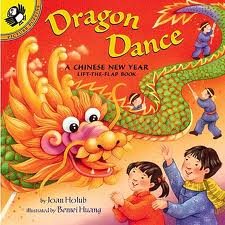
Dragon Dance: A Chinese New Year Lift-the Flap by Joan Holub; illustrated by Benrei Huang (Amazon.com link)

This one was new to me, but the kids always love Lift-the-Flaps (although they argue over who is going to get to open them).  It’s a simple rhyming book that explains the different parts of the New Year celebration: sweeping away the old year, buying fish and flowers at the market, getting red envelopes, and of course, enjoying the big dragon parade.  The illustrations are warm and colorful.  A good introduction to the holiday for toddlers on up.

clip

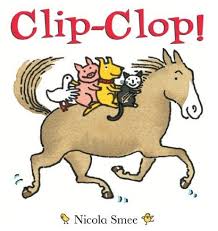
Clip Clop by Nicola Smee (Amazon.com link)

This is actually a board book, and unfortunately out of print, but it’s a great horse book, especially for younger kids (I read it again today to both a preschool class, and a toddler storytime, and they all loved it).  Mr. Horse offers a cat, a dog, a pig and a duck a ride on his back, but when he gallops too fast, and then stops suddenly, they all fly off into a haystack.  The kids enjoy saying the repeated, “Clip Clop!  Clippety Clop” lines.

unicorn

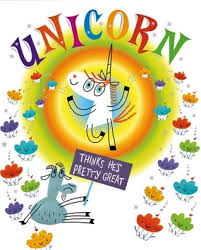
Unicorn Thinks He’s Pretty Great by Bob Shea (Amazon.com link)

Okay, I know unicorns are not horses, but I thought the kids would love this one, and they did.  It was the clear favorite of the evening, for the 5 year-olds especially.  Goat is jealous of Unicorn, and why wouldn’t he be?  Not only can Unicorn fly, he makes it rain cupcakes!  But when Goat finally meets Unicorn, he finds that he’s got some special talents of his own that Unicorn admires, and to Goat’s surprise, they end up becoming friends.  I love all of Bob Shea’s books, especially I’m a Shark and Oh, Daddy!

my pony

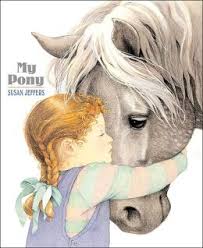
My Pony by Susan Jeffers (Amazon.com link)

This is the book for little girls who love horses.  I would have been all over it as a kid.  The little girl in this story wants a pony more than anything else in the world, but her parents say a pony is too expensive, and they don’t have room for it.  So she draws a pony instead, a beautiful dapple-gray she calls Silver, and together they fly through the sky and meet lots of other ponies.  The illustrations are gorgeous.

SONGS:

Giddy-up!

I do this one often as a bouncing rhyme for babies and toddlers.  This time I had the kids gallop in a line around one of the bookshelves.  They especially liked the sudden “Whoa!” when we would all stop short. You sing it to the tune of The William Tell Overture:

Giddy-up, giddy-up, giddy-up-up-up!
WHOA, Horsie!

Old MacDonald Had a Farm

INSTRUMENT PLAY WITH A CD: Hop Up, Ladies from Putumayo Folk Playground (Amazon.com link)

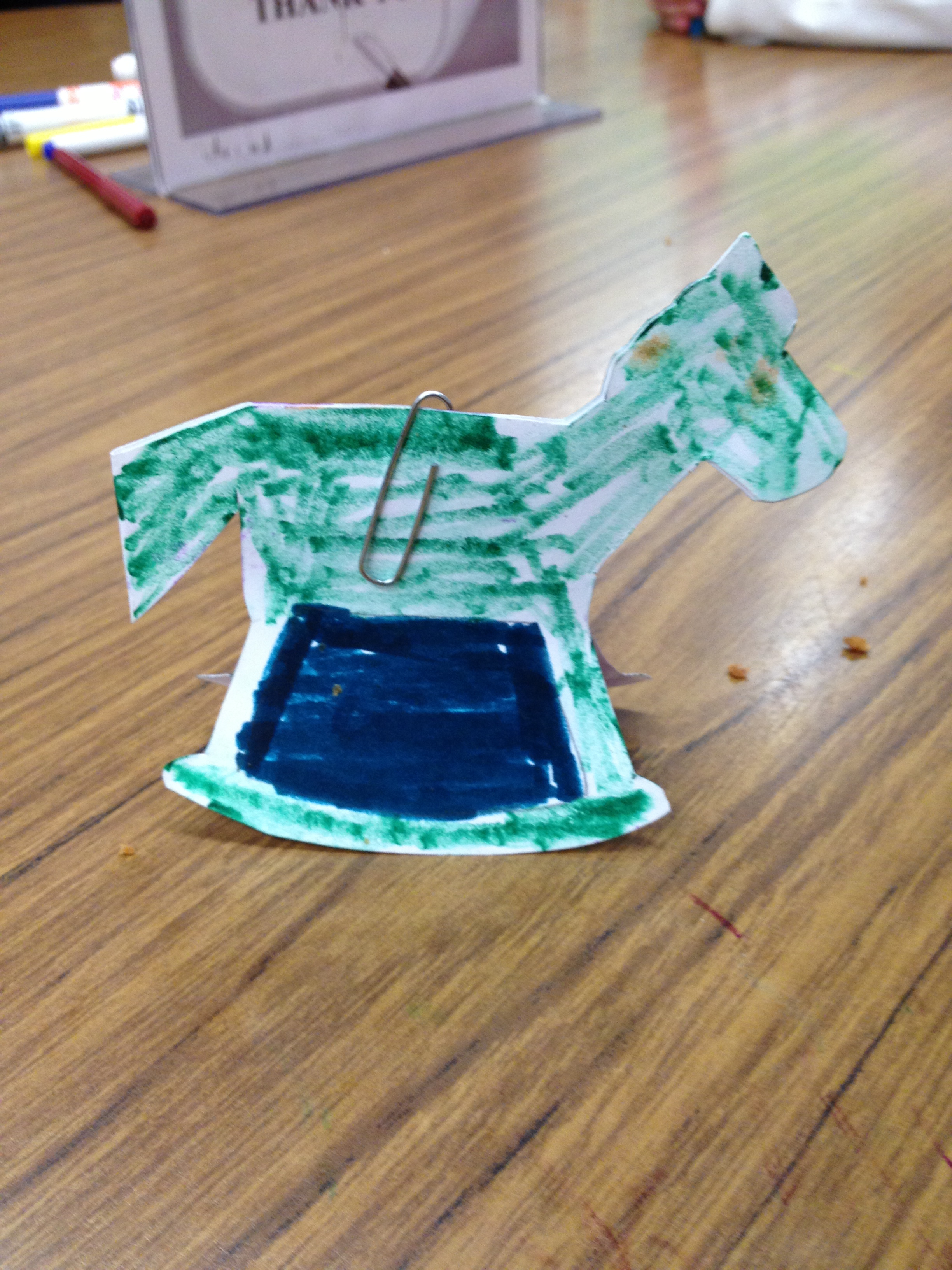
CRAFT: Paper Rocking Horses

photo (67)

Paper Rocking Horse by Kiki

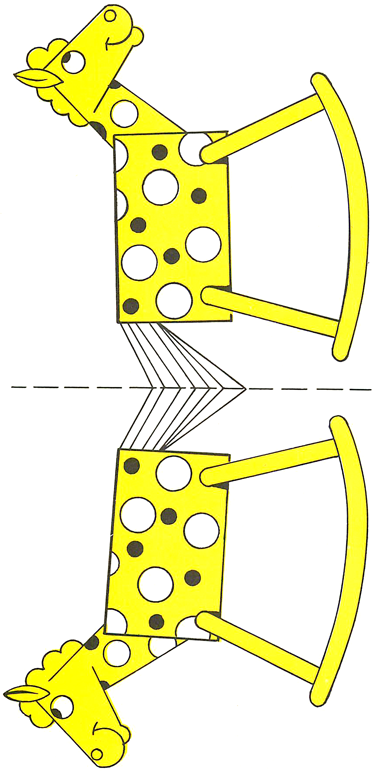
I adapted this craft from AHC Arts & Crafts, which has a tremendous number of craft ideas.  I printed their template, but since I wanted the kids to be able to color their rocking horses however they liked, I traced the template onto white card stock and cut it out (I had to redraw the lines for the base).  I folded the paper in half before I cut it, so it would make a mirror image of the horse.  Then I folded it over, so the two horse shapes lined up.

I gave each child a pre-folded horse to color in with markers on both sides, and a paperclip to put on the back, clipping the two horse shapes together.  If you bend the bottom of the two horses slightly apart, it will stand up.  If you touch the tail lightly, it will rock just like a real rocking horse.

Other Chinese New Year Books:

Bringing in the New Year by Grace Lin (Amazon.com link)

This is the book I usually read for Chinese New Year, and I still love it.  It’s shows a family preparing for the New Year by sweeping their house, making get-rich dumplings, getting haircuts, and looking forward to seeing the dragon, which is presented on pages that fold out into a big spread at the end.  In the past, I’ve brought bubblewrap for the kids to pop on the page with the firecrackers.  Simple enough to work for toddlers as well as preschoolers and older kids.

This Next New Year by Janet S. Wong; illustrated by Yangsook Choi (Amazon.com link)

I didn’t get this book in time for my storytime, but it’s a good one.  A Chinese-Korean boy shares what the New Year means to him and his friends from other cultural backgrounds.  I like that the story gives a sense of having a fresh start: a chance to clear away all the mistakes of the past and look forward to the future.  A little too lengthy for toddlers, but I think this would work well for preschoolers and elementary school kids.

My Lucky Little Dragon by Joyce Wan (recommended by Sapphira Edgarde)

Sapphira writes, “Our daughter is a dragon, but this book describes a child who has a good trait from each of the signs. Then at the end it says how lucky the reader is to have this particular baby, and there’s a heart-shaped mirror on the last page, which is always a big hit.”

Other Horse Books:

Are You a Horse? by Andy Rash (Amazon.com link)

When Roy gets a saddle for his birthday, he sets out to find a horse.  The problem is, he doesn’t know what a horse looks like.  Kids like shouting out the names of the other animals he thinks might be a horse, including a snake, a crab, a lion, and a zebra.  Plus it has a funny surprise ending.

What are your favorite horse or Chinese New Year picture books?

Who Was Randolph Caldecott?

This is Not My Hat Collage by Geovanni

This is Not My Hat Collage by Geovanni

Every January, I try to do a series of storytimes related to the upcoming announcement of the newest winner of the Caldecott Medal.  This year’s winner will be announced on Monday, January 27 at the Midwinter Meeting of the American Library Association.

This week, I read some of my favorite Caldecott Medal Winners from previous years, both for my Family Storytime, and to two classes of second graders.  But before I get to those, it occurred to me that I had never thought to wonder who Randolph Caldecott was, and how the award came to be named after him.  So I looked him up.

According to the Randolph Caldecott Society UK web page, Caldecott was a British artist, who lived from 1846-1886, and was known for his children’s book illustrations.  Every year, he would select or write a collection of stories and rhymes, which he would illustrate and publish at Christmastime.  The books were enormously popular, and brought him international fame.  Like many of the best children’s authors and illustrators (Dr. Seuss, Maurice Sendak, Margaret Wise Brown, and Beatrix Potter to name a few), Caldecott never had children of his own.   Sadly, he suffered from heart problems and gastritis, and died a few weeks before his 40th birthday, while traveling in St. Augustine, Florida.

I haven’t been able to find an explanation for why the American Library Association in 1937 decided to name the medal after Randolph Caldecott.  After all, according to the guidelines, the award-winning artist “must be a citizen or resident of the United States,” and Caldecott was British.  Why not name it after an American illustrator like Johnny Gruelle, Wanda Gág or N.C. Wyeth?  My only guess is that it had to do with the quality of Caldecott’s illustrations, and the seamless way he integrated them with the text.  Maurice Sendak is quoted as saying, “Caldecott’s work heralds the beginning of the modern picture book. He devised an ingenious juxtaposition of picture and word, a counterpoint that never happened before. Words are left out—but the picture says it. Pictures are left out—but the word says it.”  And that is the quality that defines the best picture books.

I just learned about a new book by Leonard Marcus entitled Randolph Caldecott: The Man Who Could Not Stop Drawing.  I will have to check it out to find out more, especially after reading this intriguing conversation between Leonard Marcus and Brian Selznick, winner of the 2008 Caldecott Medal (I love to show kids Selznick’s book The Invention of Hugo Cabret, which is not a picture book, but a 533 page heavily illustrated novel).  In the meantime, you can see samples of some of Caldecott’s illustrations on the Randolph Caldecott Society web site.

But now, back to the storytime.   After I explained the Caldecott Medal to the kids, and showed them the seal on the covers of the winning books, I read these:

hat

This is Not My Hat by Jon Klassen (Amazon.com link) 2013 Caldecott Medal

It amazing the range of reactions I get whenever I read this book aloud.  I remember sharing it with some second grade classes last year where some of the kids were very nervous.   In one class, every time the little fish bragged about his certainty that the big fish whose hat he stole would never find him, this one boy would say, “No!  Don’t say that!  He’s going to eat you!”  This year, though, all the second graders laughed.  The Kindergartners at storytime, however, looked concerned.   The fish is so shockingly naughty and brazen (although, of course, most of the best and most memorable children’s book heroes are naughty).  The beauty of the book, though, is that the ending is unspoken.  Klassen leaves you with the image of the big fish wearing his hat, and leaves the rest to your imagination.   So when I asked my storytime group what happened at the end, they said, “The big fish got his hat back.”  The second graders, on the other hand, said, “The little fish got eaten.”

officer

Officer Buckle and Gloria by Peggy Rathmann (Amazon.com link) 1996 Caldecott Medal

I think about this book every time I stand on a swivel chair, which I do often, in spite of this being in part a cautionary tale about that very thing.  My only complaint about this book is that it’s really one you want to sit down with and pore over by yourself, to enjoy all the humor in the illustrations, and some of that gets lost in a storytime setting.  But the kids love it anyway.  At my family storytime, many of them exclaimed over it when they first saw me pull it out of the stack, so clearly they had heard it before (and hopefully had a chance to look at it up close).  Officer Buckle’s safety speeches suddenly become a big hit at schools when he is partnered up with a new police dog named Gloria, until Officer Buckle discovers why.  This is a wonderful story about a friendship and the importance of working together, and it has great safety tips besides.

kitten

Kitten’s First Full Moon by Kevin Henkes (Amazon.com link) 2005 Caldecott Medal

I remember being surprised the first time I saw this book, because the style was so drastically different from Henkes’ other books like Chysanthemum and Lilly’s Purple Plastic Purse.  But since then, this has become one of my favorite read-alouds (along with A Good Day, which is perfect for toddlers).  The language in this book is so simple, and compelling: ”It was Kitten’s first full moon. When she saw it, she thought, there’s a little bowl of milk in the sky. And she wanted it.”  The story is funny because of all of Kitten’s mistakes and accidents, but you also feel her frustration, so it is deeply satisfying when she comes home wet and exhausted to find her own bowl of milk on the porch.  There was a little tussle over who was going to get to check this one out after I read it.

amos

A Sick Day for Amos McGee by Philip C. Stead; illustrated by Erin H. Stead (Amazon.com link) 2011 Caldecott Medal

I’ll admit, I hadn’t ever noticed the mouse and the red balloon that appear several times throughout this book, until one of the second graders pointed them out.  And then I was instantly transported back to reading Goodnight, Gorilla by Peggy Rathmann with my son when he was small, and trying to find the red balloon and mouse on every page.  It’s a subtle reference, but I loved it.  The kids loved the pictures of the zoo animals packed into the bus to visit their sick zookeeper friend, and the idea of the owl being afraid of the dark.

SONGS:

1,2,3,4,5, I Caught I Fish Alive

B-I-N-G-O  To go along with Officer Buckle and Gloria, I brought out the library’s St. Bernard hand puppet (who likes to lick people’s faces), and we barked the missing letters.

INSTRUMENT PLAY WITH A CD: Old MacDonald Had a Farm by Rufus Thomas from Sing Along with Putumayo (Amazon.com link)  This rock-and-roll version of Old MacDonald is always fun.

CRAFT: This is Not My Hat Collage

olivia

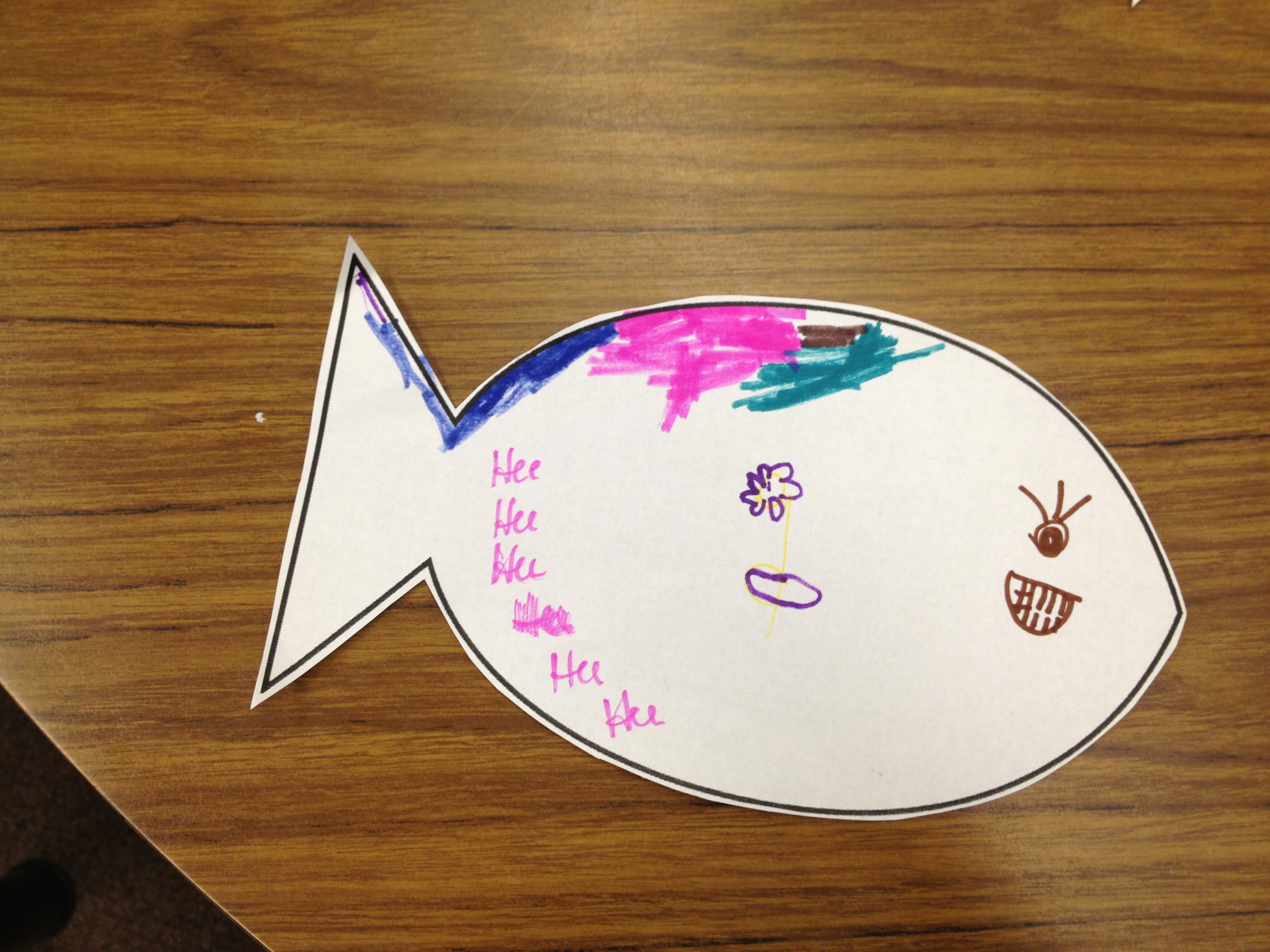
For this craft, I cut out pieces for the kids to color and assemble the little fish from This is Not My Hat, and brought some plants from my yard for them to glue down.

I originally had a crazy idea for taping the fish to a piece of yarn, and cutting a slit in the paper, so it would look like the fish was disappearing behind the plants when you pulled the yarn.  But I would have needed thicker paper, and it seemed to complicated for the short time the kids had to assemble the craft.  Still, I mocked it up with my daughter, and even though we tried it with construction paper, which is flimsy, she still had a lot of fun playing with it.

I drew the fish shapes freehand, and they’re not great, but if you’d like the template, you can print it out here: fishtemplate

OTHER BOOKS:

Along with A Sick Day for Amos McGee and This is Not My Hat, I read these four books to some second grade classes this week:

The Man Who Walked Between the Towers by Mordicai Gerstein (Amazon.com link) 2004 Caldecott Medal

This is one of my absolutely favorite Caldecott winners to read aloud, although I usually share it with older kids.   In 1974, Philippe Petit walked, danced, ran, and lay on a tightrope across the Twin Towers.   It was an illegal act, so he and some friends disguised themselves as construction workers, then carried the 400 pound cable up the elevator, and then up ten flights of stairs to the roof.   Getting the wire across the gap was a harrowing experience all its own, and at one point, the cable fell, pulling Petit’s friends in the other tower to the edge of the roof.   And then he stepped out onto the wire, a quarter of a mile above the ground.  The illustrations in this book are dizzying.  The kids are always transfixed.   And even though Petit broke the law (yes, another naughty character, but a real one!), he did so ready to face the consequences.  After he stepped off the wire, he held out his hands for the cuffs.  He was sentenced to perform in Central Park for free.   There is one line at the end of the book that says, “Now the towers are gone,” and always, always the kids ask why.  The first year I read it, I wasn’t prepared, and in the pause while I tried to frame my answer, I could hear a bunch of kids exclaiming to each other the bits of information they knew.  Fortunately, I knew that this year on September 11 the principal at the school had spoken to all of the classes in the school, explaining about the tragedy, and telling the kids that they should “remember the heroes.”  So this time, when the question came, I was able to remind them of that, and, while I’m sure they still had questions, they seemed to accept that.  That question is the only reason I haven’t read this book at my regular storytime, since I’m not sure how comfortable my storytime parents will be with whatever explanation I give, and the inevitable questions that will follow.   But otherwise, this is an exhilarating book, and one of the best examples of a nonfiction picture book I know.

Where the Wild Things Are by Maurice Sendak (Amazon.com link)  1964 Caldecott Medal

I shared this book with the second grade because I wanted to show them that they all knew at least one Caldecott winner.  This book is so much a part of our popular children’s culture now (most of the kids had seen the movie too), but I also wanted them to stop and think about how revolutionary the book and the art were when it first came out.  Max is the ultimate naughty character, fulfilling that fantasy all kids probably have of running away and going wild.   I like to mention how controversial this story was, even down to the last line.  In an interview, Sendak once talked about an argument he had with his editor, Ursula Nordstrom, “One of the fights I had with Ursula—and her whole office—though it seems silly now, was with the last line of the book [about Max’s dinner]: “and it was still hot.” It bothered a lot of people, and they wanted me to change it to “and it was still warm.” Warm doesn’t burn your tongue. There is something dangerous in “hot.” It does burn your tongue. Hot is the trouble you can get into. But I won.”  We were lucky Sendak was always a bit like Max.

Sylvester and the Magic Pebble by William Steig (Amazon.com link) 1970 Caldecott Medal

This was one of my favorite books as a child, and I still love it.   Sylvester the donkey is thrilled to find a pebble that makes wishes come true, until he has a run-in with a dangerous lion, and accidentally wishes he were a rock.   Steig really draws out the drama of Sylvester, helpless and alone on the hill as the seasons pass, while his parents worry and mourn.  Of course, it has a joyfully happy ending, where the family is reunited, and they decide to lock the magic pebble away, at least for a while, realizing that now that they were together again, “they all had all that they wanted.”   Before I read this book, I usually tell the kids that William Steig wrote the picture book Shrek, which, oddly, most of them have never seen, although most of them have seen the movies.

So You Want to be President by Judith St. George; illustrated by David Small (Amazon.com link)  2001 Caldecott Medal

I made the mistake of reading this book last to one of the classes, and it was a bit too long.  Still, it’s a fun collection of facts about the presidents, both the traits that many of them shared, as well as the things that made each one unique.  The illustrations by David Small are colorful and funny, and there are some great quotes scattered throughout the text.  My favorite is from Ulysses S. Grant, about his own musical ability, “I know only two tunes: one of them is Yankee Doodle, and the other isn’t.”  This is a great book to share on President’s Day or around Election time.

You can find the complete list of Caldecott Medal winners here.  Please tell me your favorites, and more importantly, who do you think will win this year?


Ringing in the New Year

I had so much fun at this week’s storytime, seeing most of my regular families, and some I hadn’t seen in a long time.  Auld Acquaintances!  But if there are any publishers, children’s authors, or aspiring children’s authors reading this, please take note: there is a desperate shortage of books about New Year’s.   

I had pulled or ordered over every book I could find in our system on New Year’s Eve or New Year’s Day.  There weren’t many, not even on Amazon, and the ones I found were mostly too long to read at story time.  There are LOTS of books on Chinese New Year, which I’m looking forward to covering in a few weeks.  But publishers appear to have dropped the ball on New Year’s Eve, and I don’t mean the one in Times Square.

I ended up resorting to an odd mix of books about babies (in honor of Baby New Year) and parties and the year in general.   Luckily there are a fair number of these.  These were the ones I ended up reading:

newyears

The Night Before New Year’s by Natasha Wing; illustrated by Amy Wummer (Amazon.com link)

The only actual New Year’s book I read.  It’s a rhymed book, and the meter is awkward in some places, but overall it meets my requirements for a good holiday book: it covers the major traditions without being dry, and tells a story in the process.  In this case, it’s about a girl and her brother who want to stay up until midnight on New Year’s Eve, but don’t quite make it.   The kids enjoyed this one, and it was eagerly snatched up at the end.  After the book, we all counted down from 10 and yelled, “Happy New Year!”  It would have been fun to throw confetti too, except for the inevitable clean-up.

Mustache Baby by Bridget Heos; illustrated by Joy Ang (Amazon.com link)

Okay, this was a stretch, but I justified it by mentioning Baby New Year.  I had originally pulled this one because it was on a list of best picture books published in 2013 (a topic I will be covering soon).  And the kids loved it!  There was even a minor brawl over it at the end.  When a baby is born with a mustache, the delivery nurse tells his startled family that they need to find out if it’s a good guy mustache or a bad guy mustache.  The baby starts out taking on all kinds of good mustachioed roles: cowboy, Spanish painter, sword fighter, and man of the law.  But then the mustache begins to curl on the ends…  The illustrations are very funny.

Frog and Toad All Year by Arnold Lobel (Amazon.com link)

I read the first story in this early chapter book, partly because it fit the theme of a new year, and partly because there’s an Arnold Lobel exhibit at the Contemporary Jewish Museum in San Francisco, including a concert of songs based on his works on January 12.   I also thought it would fun for some of the Kindergartners in my storytime to get to know Frog and Toad, who were favorite characters from my old childhood.  In the story I read, Frog drags Toad out on a cold winter day, and gets him to go sledding.

Xander’s Panda Party by Linda Sue Park; illustrated by Matt Phelan (Amazon.com link)

Another stretch, but I justified it because it was about a party.  Xander wants to throw a panda party, but since he’s the only panda at the zoo, he reconsiders and invites all the bears.  When he finds out the koala isn’t really a bear, he extends his invitation to mammals, but rhinoceros insists on bringing his bird.  In the end, of course, he ends up inviting every creature at the zoo, including the people.  Cute rhyming story that the kids seemed to enjoy.  It got checked out immediately too.

CRAFT: Decorated Calendars

photo (64)

Calendars decorated by Alyssa, Jonas and Sarah

I happened to be at Michael’s the other day, and picked up a bunch of small picture frame calendars for 60 cents each.  The kids had fun drawing, stickering, and collaging on them with pictures I cut from magazines.   A cheaper way to go would be to print out calendars (or even just the month of January) from CalendarLabs.com and have the kids decorate those.

OTHER BOOKS:

The Stars Will Still Shine by Cynthia Rylant; illustrated by Tiphanie Beeke (Amazon.com link)

This is actually a really sweet book, that would work well for New Year’s, even for toddlers.  It’s a lovely poem about all the nice things that will remain the same: “…this new year/the sky will still be there/the stars will still shine/birds will fly over us/church bells will chime…we shall have peaches/we shall have pie/we shall have ice cream three scoops high”   The illustrations are soft, colorful, and peaceful.

Squirrel’s New Year’s Resolution by Pat Miller; illustrated by Kathi Ember (Amazon.com link)

This one was a bit too long for my storytime, but I liked that it addresses the idea of writing New Year’s Resolutions, which might have been a fun craft idea too.  Squirrel is frustrated that she can’t come up with any resolutions of her own, but she ends up helping each of her friends keep theirs.

Shanté Keys and the New Year Peas by Gail Piernas-Davenport; illustrated by Marian Eldridge (Amazon.com linkSubmitted by Lindsey Tear

Grandma has made all the lucky foods for New Year’s Day, but she forgot the black-eyed peas.  So Shanté Keys sets out to find some.  I haven’t seen this one yet, but I’ve requested a copy for our library system.   As a kid, we always had kidney beans, cornbread, and collard greens for New Year’s Day, a tradition that I miss, so I can empathize with Shanté Keys.

Happy New Year, Pooh! by Kathlein Weidner Zoehfield (Amazon.com linkSubmitted by Lindsey Tear

This book is out of print, unfortunately, but it looks sweet.  Winnie the Pooh and his friends are sad to see that the calendar has come to an end, until Christopher Robin tells them they have a whole new year ahead.

Frog and Toad Together by Arnold Lobel (Amazon.com link) Submitted by Barbara Bruxvoort

Another Frog and Toad book, but one that may be even more appropriate for New Year’s.   It’s even referenced in this article on keeping your New Year’s resolutions.   The two stories that fit best are “A List,” where Toad makes a list of things he plans to do, and “Cookies,” where Frog and Toad try to find the willpower not to eat all the cookies.

P. Bear’s New Year’s Eve Party by Paul Owen Lewis (Amazon.com link) Submitted by Neeru Penumella

This one isn’t in our library system either, probably because it’s only available in paperback, but it looks like fun.  The book uses the arrival of each of P. Bear’s friends to demonstrate counting and telling time.

Are there any great New Year’s books I’m missing out on?  Please share them in the comments.