An Open Book: A Storytime About the Letter O

Early Literacy Tip: In books that feature a particular pattern with only one word changed, ask your child to fill in the new word. For example, in Open This Little Book, each animal opens “a little _____ book,” with a different color each time, based on the color of the book’s cover. Using context clues to decipher new words is an important early literacy skill.

This week we celebrated the letter O at storytime. We started by drawing the letter O together in the air (the kids really enjoyed this!). I also talked about how two O’s together making the sound “oo,” and we spent a minute saying fun “OO” words together as I wrote them on my whiteboard: BOO! Coo, Moo, etc. We also talked about words beginning with O (the kids suggested octopus, and I pulled an owl and an octagon out of my bag, and demonstrated an ocarina).

Here’s the rest of what we did:

Books:

Open This Little Book by Jesse Klausmeier; illustrated by Suzy Lee

I love to share books that surprise kids with unusual formats (pop-ups, books that open vertically, etc.) This book features a series of increasingly smaller books with different colored covers: Ladybug opens a little green book and reads about Frog, who opens a little orange book and reads about Rabbit, etc. The kids enjoyed calling out the colors of each book.

Owl Babies by Martin Waddell; illustrated by Patrick Benson

This is one of my all-time favorite picture books: the sweet story of three baby owls waiting for their mother to return. It’s beautifully written and illustrated, and the emotions are so relatable. I especially love the part where the baby owls close their owl eyes and wish their owl mother would come “And she came. Soft and silent, she swooped through the trees to Sarah and Percy and Bill.” The kids enjoyed chiming in on the repeated “I want my Mommy!” line.

One-Osaurus, Two-Osaurus by Kim Norman; illustrated by Pierre Collet-Derby

In these storytimes about letters, I like to showcase words that demonstrate how letters don’t always sound the way you expect them to. I think it’s important for kids to know that English isn’t always predictable, so that when they are learning to read later on, they are prepared for surprises that are part of the language itself and not any reflection on their reading ability. So, I wanted to share a picture book featuring the word “one,” which is one of the strangest o-words. This is also a fun, rhyming picture book about dinosaurs hiding, in what turns out to be a game of hide-and-seek.

Octopants by Suzy Senior; illustrated by Claire Powell

This rhyming picture book got lots of laughs. It’s about an octopus trying to buy underpants. He can’t find any, and gets increasingly frustrated, until a shopkeeper points out that his legs are really arms, and all he really needs is an octo-sweater. The page with all the fish in underpants is hilarious!

Songs & Activities:

These Are My Glasses by Laurie Berkner

We sang this after reading Open This Little Book. I use a lot of Laurie Berkner songs, but this one is my all-time favorite. Even older kids, who are sometimes reluctant to participate in action songs, enjoy doing this one.

These are my glasses,
This is my book.
I put on my glasses
And open up the book
Then I read, read, read,
And I look, look, look.
I take off my glasses,
And, WHOOP!, close up the book!

The Waves on the Ocean

We sang this with the parachute in Outdoor Musical Storytime. I put a fish puppet on the parachute and we waved it up and down. It’s to the tune of The Wheels on the Bus.

The waves on the ocean go up and down,
Up and down,
Up and down.
The waves on the ocean go up and down,
All day long!

Simon Says

We played a couple of rounds of Simon Says after reading One-osaurus, Two-osaurus, which ends with the dinosaurs playing the game. If you’re unfamiliar with it, it’s a classic childhood game where you ask the kids to do a particular action, but only when you start by saying, “Simon Says.”

For example: if you say, “Simon Says, ‘touch your nose,'” they should touch their noses, but if you just say, “touch your ear,” they shouldn’t do anything. It’s a fun listening challenge, and lot of the kids at storytime had never played it before.

Octopus’ Garden by Richard Starkey (Ringo Starr)

We sang this as our instrument play-along at the end.

[C] I’d like to be
[Am] Under the sea,
[F] In an octopus’ garden
In the [G] shade.

[C] He’d let us in,
[Am] Knows where we’ve been,
[F] In his octopus’ garden
In the [G] shade.

[Am] I’d ask my friends
To come and see
[F] An octopus’ [G] garden
With me.

[C] I’d like to be
[Am] Under the sea,
[F] In an octopus’ garden
In the [G] shade.

[C] We would be warm
[Am] Below the storm,
[F] In our little hideaway
Beneath the [G] waves.

[C] Resting our head
[Am] On the seabed,
[F] In an octopus’ garden
Near a [G] cave.

[Am] We would sing
And dance around,
[F] Because we know
We [G] can’t be found.

[C] I’d like to be
[Am] Under the sea,
In an [F] octopus’ garden
In the [G] shade.

[C] We would shout,
[Am] And swim about
[F] The coral that lies
Beneath the [G] waves.

[C] Oh, what joy
[Am] For every girl and boy,
[F] Knowing they’re happy
And they’re [G] safe.

[Am] We would be so happy
You and me,
[F] No one there to tell us
[G] What to do.

[C] I’d like to be
[Am] Under the sea,
[F] In an octopus’ garden
With [G] you.

[F] In an octopus’ garden
With you.
[F] In an octopus’ garden
With [G] you.

Stay & Play: Cup Stamping

This was a simple, if messy, Stay & Play. I just put out plastic trays, and added a few different colors of tempera paint to each one. I gave each child a piece of white paper and a paper cup, and explained that they could dip either the top or the bottom of the cup in the paint and stamp it on the paper to make an “O” shape. Some of them just used the cups as paintbrushes, which got very messy, but they had a wonderful time!

Do you have any favorite books or songs featuring the letter O? Please share them in the comments below.

Picture Book Highlight: Pop! Goes the Nursery Rhyme

Every now and then, there’s a picture book that works so perfectly for storytime that I know it’s going to be in my regular rotation for a long time. Pop! Goes the Nursery Rhyme by Betsy Bird and Andrea Tsurumi is one of those picture books.

It starts with the song “Pop! Goes the Weasel,” and then moves into several other famous nursery rhymes: Jack and Jill, Little Miss Muffet, Mary Had a Little Lamb. Each one gets interrupted by “Pop! Goes the Weasel!” partway through.

All the kids I’ve read this to have found this book hilarious. It’s fun to have them clap their hands or throw play scarves in the air whenever you point to the word “Pop!” (which is also a wonderful way to help them develop print awareness). You can also extend it by singing some of the songs after you read the book (especially Twinkle, Twinkle, Little Star, which they usually know), and throw in your own “Pop! Goes the Weasel” in the middle.

Highly recommended for storytime collections!

N-Chanting Stories: A Storytime About the Letter N

Early Literacy Tip: Point out words that share the same letters and sounds (like “La La La” and “Ma Ma Ma” in the book Noisy Night) to help kids learn to keep an eye out for patterns in the words they see.

Last week, we celebrated the letter N. As usual, we started by writing the letter N (upper and lower case) in the air together and then talking about words that started with N. The kids suggested “No,” and “nut.” I pulled a few other items out of a paper bag: a nose flute, a name tag, and a can of nuts (which was really one of those trick cans with a snake inside).

Here’s the rest of what we did:

Books:

That is Not a Good Idea! by Mo Willems

I read this with my Family Storytime group, which tends to skew a bit older. It’s a darkly humorous story about a goose who runs into a fox, who invites her to his house for dinner. Every time he invites her to do something (going for a walk in the deep dark woods, going to his house, tasting his soup), a small yellow gosling warns “That is NOT a good idea!” or “That is REALLY NOT a good idea!” In a surprise twist, the goose pushes the fox into the soup, and the book ends with the goslings saying, “We did try to warn him!” The kids loved joining in on the repeated “That is NOT a good idea!” parts.

I Love My New Toy by Mo Willems

One of my favorite Elephant and Piggie books. In this story, Piggie lets Gerald play with her new toy. He throws it in the air, but it breaks when it lands. Piggie is “mad and sad,” and Gerald is sorry, until a squirrel explains that the toy is actually a break and snap toy that’s meant to come apart. The representation of feelings (both named and unnamed) is spot on.

Nighttime Ninja by Barbara DaCosta; illustrated by Ed Young

Adorable, slightly suspenseful story about a ninja on a nighttime mission. Before he can achieve his goal, the kitchen light comes on and he is caught…and revealed to be a boy trying to sneak some chocolate ice cream from the freezer.

Noisy Night by Mac Barnett; illustrated by Brian Biggs

Fun book about a noisy apartment building, where everyone wonders what’s making the noises in the apartment above them: an opera singer singing “La La La,” a baby cooing, “Ma Ma Ma,” a sheep saying, “Baa Baa Baa,” etc. The kids enjoyed repeating the sounds on each page and trying to guess who is making them.

No, David! by David Shannon

A lot of the kids were already familiar with this popular book. I love to tell them (and their caregivers) that the book was based on drawings that David Shannon made as a child, which his mother saved and sent to him. The kids enjoyed seeing all the ways David gets in trouble, especially the page where he runs down the street naked.

Songs & Activities:

Old MacDonald

We sang this after reading That Is Not a Good Idea in Family Storytime. I always have animal puppets out on all of the chairs for that storytime, and it’s fun to ask the kids to hold up an animal for us to sing about.

[C] Old MacDonald [F] had a [C] farm,
E-I- [G7] E-I- [C] O!
And on that farm he [F] had a [C] cow,
E-I- [G7] E-I- [C] O!
With an moo-moo here, and an moo-moo there,
Here a moo, there a moo,
Everywhere a moo-moo.
[C] Old MacDonald [F] had a [C] farm,
E-I- [G7] E-I- [C] O!

Repeat with different animals…

Number Play Activity

For Outdoor Musical Storytime, I brought out a foam die and explained that we were all going to clap our hands, but first we would throw the die to see how many times to clap. Once we threw the die (which landed on 5), we counted the dots and then clapped 5 times. Then we tried the same thing with jumping and stomping. I’ve also done this with a second die that has different actions (clapping, jumping, stomping, etc.) on each side.

The Noble Duke of York

We sang this song with the parachute at Outdoor Musical Storytime. I threw a bunch of small animals on the parachute (one little girl volunteered her stuffed rabbit), and we lifted the parachute up and down with the song. Here’s a Barney video with the tune, in case you’re not familiar with it.

The noble Duke of York,
He had ten thousand men.
He marched them all to the top of the hill, (stretch up high or lift parachute)
And he marched them down again. (crouch down low or lower parachute)
And when you’re up, you’re up. (stretch up high)
And when you’re down, you’re down. (crouch down low)
And when you’re only halfway up,
You’re neither up, nor down. (stretch up high, then quickly crouch down)

No One Like You by Andrea Willis Muhoberac

For years, this was our opening song for Musical Storytime, and it’s still one of my all-time favorites. We used it as our instrument play-along at the end. Click on the triangle for the melody.

I like your [C] eyes.
I like your [F] nose.
I like your [G] mouth.
Your ears, your hands, your [C] toes.
I like your face.
It’s really [F] you.
I [Dm] like the things you say and [G] do.

There’s not a [F] single [G] soul
Who [C] sees the [Am] skies
The [G] way you see them.
Through your [C] eyes.
[F] And aren’t you [G] glad.
[E]You should be [Am] glad.
There’s [C] no one, [G] no one
Exactly like [C] you.

Stay & Play: Nature Rubbings

Really simple, inexpensive Stay & Play, which worked perfectly for Outdoor Musical Storytime.

Before storytime, we gathered several different types of leaves. For the Stay & Play, I put out the leaves, white computer paper, crayons and colored pencils and tape (taping the leaves to the back of the paper keeps them from sliding around). I also gave out picture books for the kids to put underneath their paper, since the tables at the park are a bit bumpy.

I showed the kids how to tape a leaf to the back of the paper, and then flip it over and run the crayon or colored pencil back and forth on the part of the paper where the leaf is. Most of the kids had never done this before and were surprised to see the outline of the leaf appear.

Do you have any favorite books or songs featuring the letter N? Please share them in the comments below.

Picture Book Highlight: Even Steven

Today I read Even Steven: A Book About Sharing by Carrie Finison & Daniel Wiseman to two preschool classes.

The book is about a boy named Steven who wants everything to be fun, fair, and even. He knows that cutting things in half is a great way to make things even. He discovers that works well for cookies, but not for crayons or books or nickels. He tries giving each person one of something, but that doesn’t work for roller skates or playground slides. Then he tries taking turns, which works well for the swings, but not with an umbrella or building with blocks. Eventually, he learns that things can be fun and fair without necessarily being even, and that some things (like your toothbrush!) don’t need to be shared at all.

This is such a fun and engaging look at all of the different ways to share. The kids thought parts of it (like the idea of sharing a lollipop or a toothbrush) were hilarious. Some pages ask the readers for ideas on how to share different things, like a sweatshirt, or the Earth. I didn’t dwell on these with the preschoolers (although one girl did raise her hand to suggest how she would share a sweatshirt), but I think they could make for a great discussion in a Kindergarten or elementary school classroom.

The book runs a little longer than the ones I usually read with preschoolers, but it kept them engaged. It will definitely be one I bring to my class visits in the fall. It’s one of those rare titles that conveys a complicated idea in a fun (and funny!), relatable way.

VolunTEEN: An Easy Library Program for Teenagers

Although I’m not usually involved with teen programming in my current job, I am one of volunteer coordinators for the two libraries where I work, so I do regularly work with teen volunteers.

Volunteers in our system usually have to agree to a commitment of at least six months, and have to have a background check and be fingerprinted if they are over 16. In spite of these requirements, we do have a fair number of teens who help with evening storytime, teach people how to use the 3D printer, help with prepping crafts, straightening shelves, or pulling books for weeding or redistribution, lead Dungeons and Dragons campaigns, and (for a while anyway) read with kids as part of a drop-in Reading Buddies program (this is being replaced by a more formal reading program led by interns).

Recently, one of the teen librarians in our library system started a VolunTEEN program, to provide a way for high school students to earn Community Service hours (a requirement for some of the schools in our area) without all of the normal volunteer requirements. We tried it out in our libraries this Spring, and it has been a big success!

The idea of VolunTEEN is that it’s an hour-long drop-in program overseen by a staff person, which makes it more of a library program, rather than a regular volunteer activity where volunteers are operating without as much direct oversight. We provide snacks, and usually set aside some basic tasks for the teens to do during that time. Some of the tasks they have done are:

  • Prepping storytime crafts (cutting out paper templates, checking markers and stamp pads, etc.)
  • Cleaning shelves (we provided them with cleaning spray and cloths, and showed them how to carefully move the books onto a cart, wipe down the shelf, and carefully put the books back in order. One teen enjoyed this so much that he stayed for an extra hour, and then came back the next month to do it again).
  • Checking board games to make sure all of the pieces are in the box
  • Checking video game and DVD cases for the corrent cartridge or disk
  • Straightening shelves (just for neatness, not organization)

Some tips that have made the program successful:

  • Connecting with the local high schools (especially the community service coordinators) to help promote the VolunTEEN hour. It especially helps when they advertise it in the weekly parent email newsletters
  • Providing tasks the teens can work on together, or at least at the same table or in the part of the library. Although not all of them were eager to socialize, some of them really enjoyed getting to talk to other students while they worked
  • Putting out name tag stickers, to identify them to library staff and each other
  • Providing a sign-in sheet to log their hours (I include a column for them to add their email address, so I can remind them about the next VolunTEEN date. I also have a spreadsheet where I keep track of who attended each month)
  • Providing snacks

This program has been a great way to provide community service opportunities for students who aren’t able to volunteer weekly. It’s also helped us with a lot of tasks that we don’t usually have time for, like cleaning the shelves. The turnout isn’t huge (at most we’ve had 6 students at a time), which makes it easy to manage. I’m also hopeful that these students will become more regular users of the library.

Have you hosted any teen programs that you love? Please share them in the comments below.

First M-Pressions: A Storytime About the Letter M

Early Literacy Tip: Ask kids to point out the word or words starting with a particular letter in the titles of the books you read. (Example: Can you find a word starting with the letter M?”) Learning to recognize letters is a key part of learning to read, and noticing them in the books they read helps them make the connection between the words they know and say, and the written words they see on the page.

Last week, we celebrated the letter M, a letter which has lots of fun word tie-ins. As usual, we started by drawing the letter M in the air together, and then listed words that started with M. Some of the words the kids suggested were: Mommy, moon, and monster. I also pulled out other items from a paper bag: a mouse puppet, a microphone and a marker.

Here’s the rest of what we did:

Books:

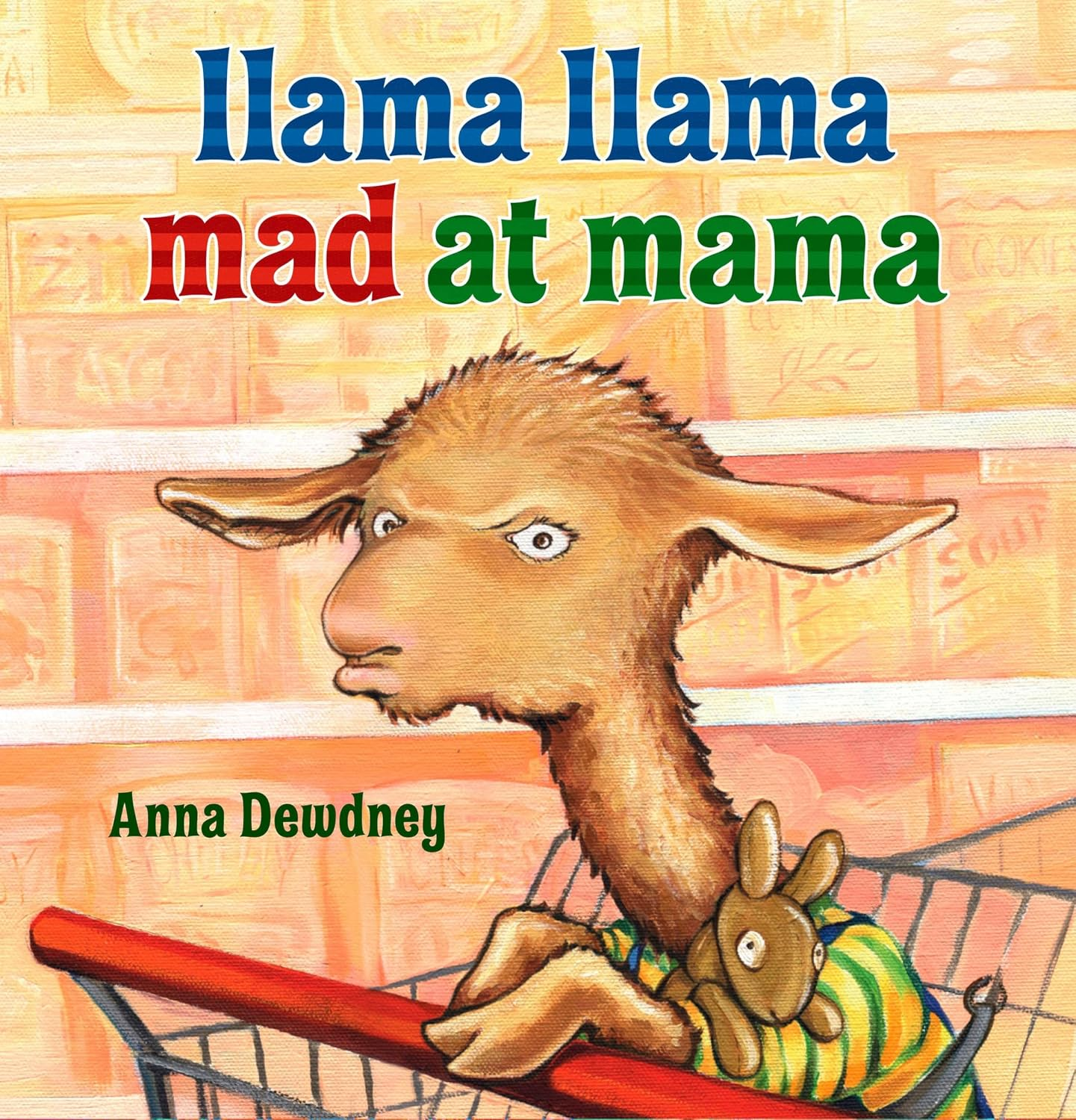
Llama Llama, Mad at Mama by Anna Dewdney

I think this is one of the most relatable Llama Llama books (a friend of mine told me recently that whenever her teenaged daughter is upset with her, she asks her, “Llama Llama, mad at Mama?,” which probably just annoys her more, but I thought it was funny). It was also nice to include this book because we read Llama Llama, Red Pajama last week. In this story, Llama Llama gets increasingly frustrated by a trip to the store. When his temper finally explodes, his Mama tells him that she thinks shopping is boring too, but she enjoys being with him.

Every Monday Mabel by Jashar Awan

I love this book so much! Every Monday, Mabel’s family watches her take her breakfast and a chair out to the driveway to see the best thing ever: the garbage truck! The descriptions of the garbage truck and its sounds (gah-dump!) are so much fun to read.

Mouse Mess by Linnea Riley

This is a long-time favorite of mine: the rhyming story of a mouse who enjoys playing in a human family’s kitchen, and making a huge mess.

M is for Mango by Atinuke; illustrated by Angela Brooksbank

This is an adorable book that uses a series of M words to tell a simple story about a little boy named Mo, whose mango is stolen by monkeys in a small Nigerian village. Perfect for toddler storytimes.

Songs:

If You’re Happy and You Know It

We sang this variation of the classic song after reading, Llama Llama, Mad at Mama. I really like adding in other emotions to this song, both because I think it’s important for kids to be able to name and share their “negative” emotions, and also because they love to act them out. If you’re not familiar with the original version, here’s a video from Super Simple Songs.

[C] If you’re happy and you know it, clap your [G7] hands (clap, clap)
If you’re happy and you know it, clap your [C] hands (clap, clap)
If you’re [F] happy and you know it, and you [C] really want to show it,
If you’re [G7] happy and you know it, clap your [C] hands! (clap, clap)

If you’re sad and you know it, cry “Boo hoo!” (say “Boo hoo!” and pretend to cry)

If you’re angry and you know it, say, “I’m mad!” (“I’m mad!” and stomp feet)

If you’re shy and you know it, hide your face… (cover your eyes and then uncover them and say, “Peek-a-boo!”)…

If you’re sleepy and you know it, yawn and stretch…

If you’re happy and you know it, shout “Hooray!”…

Hickory Dickory Dock

We sang this with the parachute in Outdoor Musical Storytime, and with the play scarves in Family Storytime. With the parachute, I put a mouse puppet on top, and we bounced it up and down with the song. With the play scarves, I had the kids pretend the scarf was a mouse and run it up and down their arms. I use the same tune as the one in this Learning Station video, but add in the additional verses below.

[C] Hickory [G7] Dickory [C] Dock! (clap hands in rhythm)
The mouse [G7] ran up the [C] clock. (run fingers up arm)
The clock struck one: BONG!
The [F] mouse ran down. (run fingers down arm)
[C] Hickory [G7] Dickory [C] Dock! (clap hands in rhythm)

Hickory Dickory Dock! (clap hands in rhythm)
The mouse ran up the clock. (run fingers up arm)
The clock struck two: BONG! BONG!
The mouse went, “BOO!” (cover your face and then uncover it when you yell, “BOO!”)
Hickory Dickory Dock! (clap hands)

Hickory Dickory Dock! (clap hands in rhythm)
The mouse ran up the clock. (run fingers up arm)
The clock struck three: BONG! BONG! BONG!
The mouse went “Whee!” (run fingers down body quickly)
Hickory Dickory Dock! (clap hands)

Hickory Dickory Dock! (clap hands in rhythm)
The mouse ran up the clock. (run fingers up arm)
The clock struck four: BONG! BONG! BONG! BONG!
The mouse said, “No more!” (hold hands out palms up and shrug shoulders)
Hickory Dickory Dock! (clap hands)

Monkey See and Monkey Do

I wish I could remember who originally taught me this song, because it’s one of my favorites. You can ask the kids to suggest other actions. I always end with “when you sit back on the ground,” which is a great way to get everyone ready to listen to the next book. Click on the triangle for the tune.

[C] When you clap, clap, clap your hands,
The monkey clap, clap, claps his [G7] hands,
Monkey [C] see, and monkey do,
The monkey [G7] does the same as [C] you!

Repeat with other motions: when you jump up and down; make a funny face; turn yourself around; and sit back on the ground.

Mi Cuerpo Hace Musica

One of my storytime families requested this song, which was a perfect fit for our letter M theme. We sang it in Spanish and English like the Learning Groove video below.

[A] Mi cuerpo, mi cuerpo [D] hace músic-[A]a
Mi cuerpo, mi cuerpo [D] hace músic-[A]a
Mis manos hacen Clap! Clap! Clap!
Mis [E7] pies hacen Stomp! Stomp! Stomp!
Mi [A] boca hace “La La La!”
[E7] Cintura hace [A] Cha cha cha! (shake your hips)
[A] Mi cuerpo, mi cuerpo [D] hace músic-[A]a
Mi cuerpo, mi cuerpo [D] hace músic-[A]a


My body, my body makes music!
My hands go Clap! Clap! Clap!
My feet go Stomp! Stomp! Stomp!
My mouth goes, “La La La!”
My hips go Cha Cha Cha!

Stay & Play: Paper Masks

This was a fun and easy storytime, although it definitely helps to have volunteers to prep the masks in advance. Before storytime, I printed a variety of paper masks onto cardstock and cut them out. Unfortunately, the mask in the picture was one that a coworker had cut out years ago, and I don’t know where she found it, but there are a lot of cute mask templates available at FirstPalette.com: Printable Animal Masks | Kids’ Crafts | Fun Craft Ideas | FirstPalette.com

For the Stay & Play, I put out the masks, markers, craft sticks, and tape (for attaching the craft sticks to the back). I also put out some colored feathers and glue, which some kids enjoyed adding to their masks. It was so much fun to see them all modeling their finished masks.

Do you have any favorite books or songs featuring the letter M? Please share them in the comments below.