Homeschoolers playing with the Super Space and getting help on the computer at the Homeschooling Open House.
We recently hosted a couple of programs at our library to connect with local homeschooling families and people who were considering homeschooling as an option. It’s been a fun and educational process for me, and I’ve learned that there are far more homeschooling families in our area than I thought.
Here are the two programs that we offered:
Homeschooling 101: A Virtual Presentation
One of the first in-person programs that we had to cancel back in the early days of the pandemic was a presentation by Jamie Heston, a local homeschooling consultant. At the time, she asked if it would be possible to offer the program online via Zoom instead, but we hadn’t really offered programs that way (other than a couple of author talks). Now, however, it seemed like a great way to connect to families who were considering homeschooling, but wanted to learn more.
Jamie often offers free presentations on behalf of the Homeschool Association of California. This was the same hour-long presentation, which covered the basics of how to register as a homeschooler, what the different options are, what documentation is required, how to transition back into traditional school if necessary, and a wide variety of recommended resources. I was surprised to learn how easy it is to register as a homeschool, and that families can start at any point, even in the middle of the school year. As a parent, I have been incredibly grateful for our local public schools, and the wonderful teachers my kids have had along the way, but it was still reassuring to know that it would be relatively easy to switch to homeschooling (at least from a legal perspective) if the school environment was not working well for some reason. Jamie also recommended this list of books about “unschooling” from Amber Dos Santos’ blog.
Homeschooling Open House
In order to convey that our libraries are interested in working with local homeschooling families, I advertised a Homeschooling Open House. A few months ago, I posted on a couple of Facebook groups for local families asking homeschooling parents to message me if they would be interested in being added to a mailing list specifically for homeschooling events. Once I had that mailing list, I sent them this simple survey, which asked them which days and times would work best. Based on the results of that, I ended up scheduling the Open House on a Monday afternoon from 1pm to 2:30pm.
My goals for the open house were pretty simple. I wanted to provide a space for the families to connect, to share information about library resources that might interest them, and to solicit feedback about what services and resources they would find most helpful. I prepared some handouts about our online databases and tips on using our library catalog, along with a basic library scavenger hunt (see below). I also created a more detailed printed survey, based on one that Kitty Murphy from the Medina County District Library in Ohio had shared with me when I asked for ideas from the Programming Librarian Interest Group on Facebook. And I set aside a table for a Curriculum Exchange, and advertised on the flier that participants were welcome to bring any materials they would like to share.
I really had no idea what to expect in terms of attendance. I thought we’d maybe get three or four families, so when people started pouring in, I was shocked! Within the first half hour, there were almost sixty people, with clusters of kids and parents all over the library. One of our interns helped the kids make pin-back buttons, and we put our two SuperSpace sets (giant Magna-Tiles) out in the children’s area. Several of the older kids clustered around a boy playing a video game on the computer (in retrospect, I should have set-up one of our Nintendo Switch games on the projector). A couple brought in boxes and boxes of materials for the Curriculum Exchange, although some of it was wildly outdated (including a book about Christopher Columbus from 1967). Other people brought in more current materials to share, and many of the parents hovered around that table the whole time. I did end up with a lot of leftover curriculum, which I offered to hold on to for a homeschooling meet-up that a local parent has just started.
In the end, I didn’t really get much of an opportunity to present our library resources, because people kept arriving at different times. They did take my handouts though, and if they had specific questions about our databases, I gave them a personal demonstration on a laptop I had set up on the table with the handouts and surveys. I did get a number of responses to the survey. From those, I learned that most of the parents were primarily interested in opportunities for their kids to interact with other homeschoolers, and rather than with students from traditional schools. There was a great deal of interest in STEM programs, and access to scientific equipment, like microscopes, so I have been talking to some of my coworkers about offering some science programs specifically for that community. A lot of them were also interested in Homeschool Graduate Panels (a chance to learn from the experiences of recent homeschooling graduates), which is something I haven’t explored yet.
Here are a few take-aways I took from these two homeschooling-focused events:
The homeschooling community is much larger and more networked than I thought, and families are also willing to travel long distances. Most of the families at the open house belong to the same two local homeschooling networks, and many of them live in San Francisco, or down the coast towards Half Moon Bay. I am excited to have the ability to connect with so many new families through these networks, and to promote our programs and services to them.
The homeschooling parents seemed genuinely happy to see the library reaching out. In the end, the Homeschooling Open House was more about providing an opportunity for families to connect with each other, which is a really easy thing to offer. One of the parents has just reserved our community room to schedule a regular meet-up for homeschooling families, something that requires no effort from us at all, other than providing access to the space.
Have you offered any programs for homeschoolers or about homeschooling? Please share your experiences in the comments below.
On Wednesday afternoon, I arrived at work to see a rare sight: actual high school students hanging out in the library. Lately, we’ve been getting a regular group of middle school boys, who like to play Roblox games on our laptops, but sometimes settle in for a game of Monopoly from our board game collection. They were at the library too that day, along with several elementary school kids, who had come to do a painting project we were hosting in our Community Room. There were families with toddlers and preschoolers browsing for books in the picture book area, and our regular older adults using the Internet on our computers. There were even several adults in their twenties or thirties who came in to check out books and use the copier.
After the pandemic had left our building mostly empty for several months after we reopened, I was thrilled to see the whole place full of people of all different ages, all coming to the library for different reasons. So, when a man came up to the desk to complain about the library becoming “a hangout for kids,” it was like being doused with a bucket of ice water.
Not that this complaint was anything new. My coworkers and I have often been confronted by people who have a very specific idea of what libraries should be: silent mausoleums of books overseen by somber, shushing librarians.
I get it. For someone who looks to the library as a quiet place to study and read, it can be upsetting to be distracted by middle schoolers joking around at a nearby table. But the reality is that very few of the people we serve have the time to sit and read during the day. And some of the people who hold this unchanged vision of libraries are the ones who don’t value them at all, like the man who posted on our local NextDoor years ago, arguing that our town didn’t need a new library because “you can buy all of your books on Amazon.”
Adapt or Die
Although the two library branches I work in are older one-room buildings designed largely around shelving for books, most of the newer libraries in our system have been designed to provide separate spaces for different needs: computer rooms, study rooms, teen areas, maker spaces, children’s rooms, etc. But it can be hard to convince people why these changes are necessary.
In spite of the fixed view of libraries and librarians that still appear in TV shows and movies, libraries have always had to adapt to the times. In all of my years working in different libraries, I’ve never once been asked for a scroll or a cuneiform tablet. I can’t help but wonder if there was an uproar when the first newfangled paper books appeared on library shelves.
Over the past few decades, libraries have had to cope with an astounding number of changes in media, going from vinyl records to cassette tapes to CDs, and from VHS tapes to DVDs, and all of it giving way to digital music, videos, and books, most of which can now be accessed from anywhere on a computer or smartphone with your library card. This digital revolution sometimes raises the question of why we need the actual library buildings at all, but it has come at the cost of leaving a lot of people behind.
Bridging the Digital Divide
Even though my main focus has always been on youth services, a lot of my time at work is spent helping people who don’t have the training or resources to deal with a world that is moving more and more online by the day. Recently, one of my regular patrons, a woman in her eighties, asked for my help setting up a Venmo account. The craft fair that she has always participated in as a vendor was suddenly telling everyone they needed to offer mobile payment options. When she told the organizer that she wasn’t familiar with those, she was told, “Maybe you should stay home.”
To people who use a smartphone everyday, learning to use Venmo may seem easy, but for this patron, it was a huge ordeal. In order to be able to access the money she hoped to get from the sale, she had to connect her bank account to her new Venmo account. But she had never used online banking, so she didn’t have a login to easily make the connection. I helped her set up her bank login, but it still wouldn’t connect to Venmo, because the bank used multifactor authentication (that annoying business with the one-time codes sent to your phone). Instead she had to enter her account info into Venmo and then wait a day or two to watch for two small deposits, (so actually the online banking login came in handy after all). After we finally got through all of that, I helped her learn to send and receive payments, and print out her QR code for people to scan at the sale. She was persistent and eager to learn, but the whole process was just another reminder of how wide the digital divide has become, and how each new innovation assumes that everyone has already adapted to the ones that came before.
Providing computer help and training takes a lot of time and patience, but I consider it one of the most important parts of my job, and so do my coworkers. To me it’s no different from helping someone find a book or article on a particular topic. They need information to help them with a problem, and we have the training and resources to help them. And unless you have tech-savvy friends or family, there are very few options for people who are faced with a task that requires a daunting online process they’ve never dealt with before.
Aside from tech help, our libraries also provide free access to computers, printers, copiers, scanners and the Internet, all of which are in constant use throughout the day. We also offer 3D Printing, which has become hugely popular. Some of our newer libraries have makerspaces with laser cutters, recording equipment, and sewing machines. Again, some people would argue that this is getting away from their idyllic book-focused vision of the library, but these spaces are offering free access to the media tools of the day, which has always been the main purpose of libraries.
Books Are Still Important
With all of this focus on new technologies, it may sound like I’m saying that books no longer matter, which is absolutely not the case. I became a librarian because I loved helping people find books, and encouraging kids to love reading is still my favorite part of the job. It’s also tremendously important. Numerous studies have shown that kids who are read to regularly in early childhood are more likely to develop language and cognitive skills that will help them be successful in school later on. But books, especially picture books, are expensive. So providing free access to books for kids of all ages and reading levels is still, and hopefully will always be, an essential part of the library.
And, in spite of all the doom and gloom about Americans not reading books, I still see a lot of adults enthusiastically checking out books every day. We also offer book clubs, which have always been popular, and a great way to bring people with different viewpoints together for a friendly discussion (something that’s increasingly rare in our polarized society).
Community Spaces
The other need that libraries serve is providing a space that’s free and welcoming to everyone, and helps build a sense of belonging to a community. Libraries have always offered events and programs to bring people together, whether it’s for a musical performance, a painting workshop, or an author talk, and spaces for local groups to get together. After the pandemic, which left many people even more isolated than before, this has become even more essential.
Balancing the Needs of our Communities
One of the biggest challenges libraries face is providing space and resources for everyone, no matter what their personal beliefs, age, or background. There have always been people who have tried to dictate what types of books their libraries should or should not offer, something that has recently come to a head in a lot of communities. We also run into people, like the man I mentioned above, who feel that certain types of people, like kids, or people experiencing homelessness, should not be allowed in the library. Some of the hardest situations are when library patrons get into disputes with each other (we once had an actual fist fight in the nonfiction section). With all of the different types of people and needs that we serve, it’s also hard to know what to prioritize in terms of staff time and resources.
Being a shared space for everyone can make working in the library unpredictable in ways that can be stressful and contentious. But it’s that same unpredictability that also makes the job so refreshing and rewarding. It’s a constantly shifting landscape of people and services, and that’s one of the reasons that I love it.
As for the grumpy man complaining about the kids, I told him that usually the library is very quiet before 3pm and after 5pm, and that seemed to appease him. Another unspoken function of the library: helping people learn to share.
Well, my Outdoor Musical Storytime got rained out this week, so instead of a storytime post, I thought I’d write about a new program we are piloting in the San Mateo County Libraries called Power Up Afternoons.
One challenge our libraries encountered after the pandemic was getting school-aged kids back in the habit of visiting the library after school. Before the pandemic, our library offered an After School Hangout once a week on Wednesdays. Kids could drop in to enjoy a light snack, do their homework, try out a craft, play a board game, or play games on the Nintendo Switch (which we projected onto a screen). Although the Hangout required a tremendous amount of set-up and clean-up, it was so much fun to see middle school kids coaching elementary school students on how to play Super Smash Brothers, or families with kids of different ages all working on beaded bracelets to give to each other. Unfortunately, it was one of the first programs to get cancelled at the start of the pandemic, and many of those kids are now in high school, or have moved on to different routines after school.
Since fully reopening after COVID, we’ve tried a number of different programming approaches for kids and teens. For a while all of our libraries offered a monthly STEAM Team program, featuring a science or art-based activity, including bouncy balls and race cars. These were very popular, but usually only allowed for maximum of 20 kids. We also offered Take and Make bags each month, which included all of the supplies and instructions for kids to try making things like sunprints or paper flowers.
One of my favorite things we tried was the Passive Activity table, which offered a different craft or process art activity every few weeks for kids to do on their own in the library. The activities ranged from LED Lightsabers to Felt Trays. One of the simplest ones involved these adorable paper Bobbleheads from toplayishuman.com. Over the summer, I was showing my visiting niece and nephew (aged 4 and 8) around the library, and they were immediately drawn to the Bobblehead project, to the point that they and my own teenaged-kids sat happily cutting and gluing together for 45 minutes straight. The Passive Activity table also came in handy for parents who needed a way to keep their kids occupied while they used our public computers. We have recently discontinued the Passive Activity table, but all of our branches will soon offer an Art Table, which will include art supplies for all ages to enjoy.
A few weeks ago, we significantly beefed up our children’s programming, by offering something every day after school, Monday through Friday. Our admin has branded this initiative “Power Up Afternoons.” Some of the programs are traditional paid providers, like local magicians or nature groups. But most of them are simple staff-led activities, similar to the ones we offered in STEAM Team or on the Passive Activity table.
The activities were selected by a small group of staff members from different branches, who put together a menu of options with the instructions and supply list for each. In our library, we divvied up the weekly schedule, so one staff member always does the Monday program, and one does the Tuesday one, etc. Fridays are always “Board at the Library,” which is where we put out a selection of board games (I didn’t think that would be a big draw until I mentioned it to a class full of second graders, who all got really excited).
We’re only on our third week of Power Up Afternoons, but aside from the extra planning and prep involved, I’m enjoying the actual programs. The staff-led activities are designed so that kids can drop in anytime within a two hour period, say from 2:30pm to 4:30pm, and I like having the opportunity to work with different kids or families individually as they arrive. A few grown-ups have even stopped to do the project too.
These are some of the highlights of the projects we’ve done so far:
Foil Art:
This was the first activity I led, and also the most complicated one so far. I made a sheet of instructions to put on the tables, which you can download here:
There’s also a YouTube video by Kim Kaskey. Basically, you glue yarn into letters or shapes onto a piece of cardboard, then cover the yarn and cardboard with a sheet of aluminum foil, and gently press the foil around the yarn. After that, you can color the foil with Sharpies, brush pens, or other markers. The kids came up with really clever designs. A number of the older kids wrote their names or initials with the yarn.
Frankensporks:
This one was much more straight-forward, but also a lot of fun. We put out sporks, markers, pipe cleaners, googly eyes, yarn, gluesticks, foam pieces, and scissors, and the kids went wild making adorable sporky characters. I loved the lady spork pictured below with the golden crown, who came with her own book and pipe cleaner pumpkins. The sporks we provided came packaged with small plastic straws, which one kid turned into arms (see below).
We gave the kids strips of colored paper, and told them they could either cut or tear it into small pieces. Many of the parents (and grandparents!) enjoyed making their own artwork along with their kids.
Geometric Art:
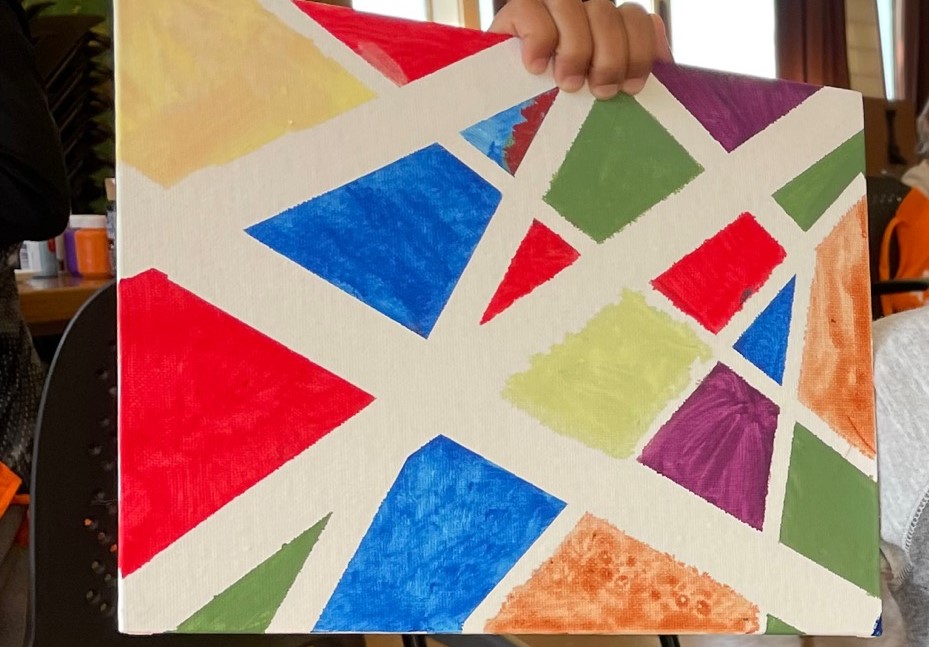
Another really simple craft involving paint and removable tape. My coworker Cloud led this one. She gave each kid a canvas and some masking tape, along with tempera paint and paintbrushes. The basic idea is to lay the tape across the page, and then paint different patches of colors in between the strips of tape. When you peel the tape away, it leaves colored shapes with sharp lines. You can also do this project with cardstock and Scotch tape, as long as the tape is easily removed.
These are just a few of the activities we have done so far. It can be a little overwhelming keeping track of the supplies needed from day to day, but it helps that we have so many staff involved, so we each only have to worry about one program a week. And we’re definitely seeing an increase in the number of kids coming to the library after school. Today, for example, we’ve had a flurry of kids I haven’t seen since we fully reopened, many of whom have been coming to the desk to ask for replacement library cards.
What are your favorite crafts or activities you have done with kids? If you work in libraries, what programs for kids have been the most successful? Please share your ideas and suggestions in the comments below.
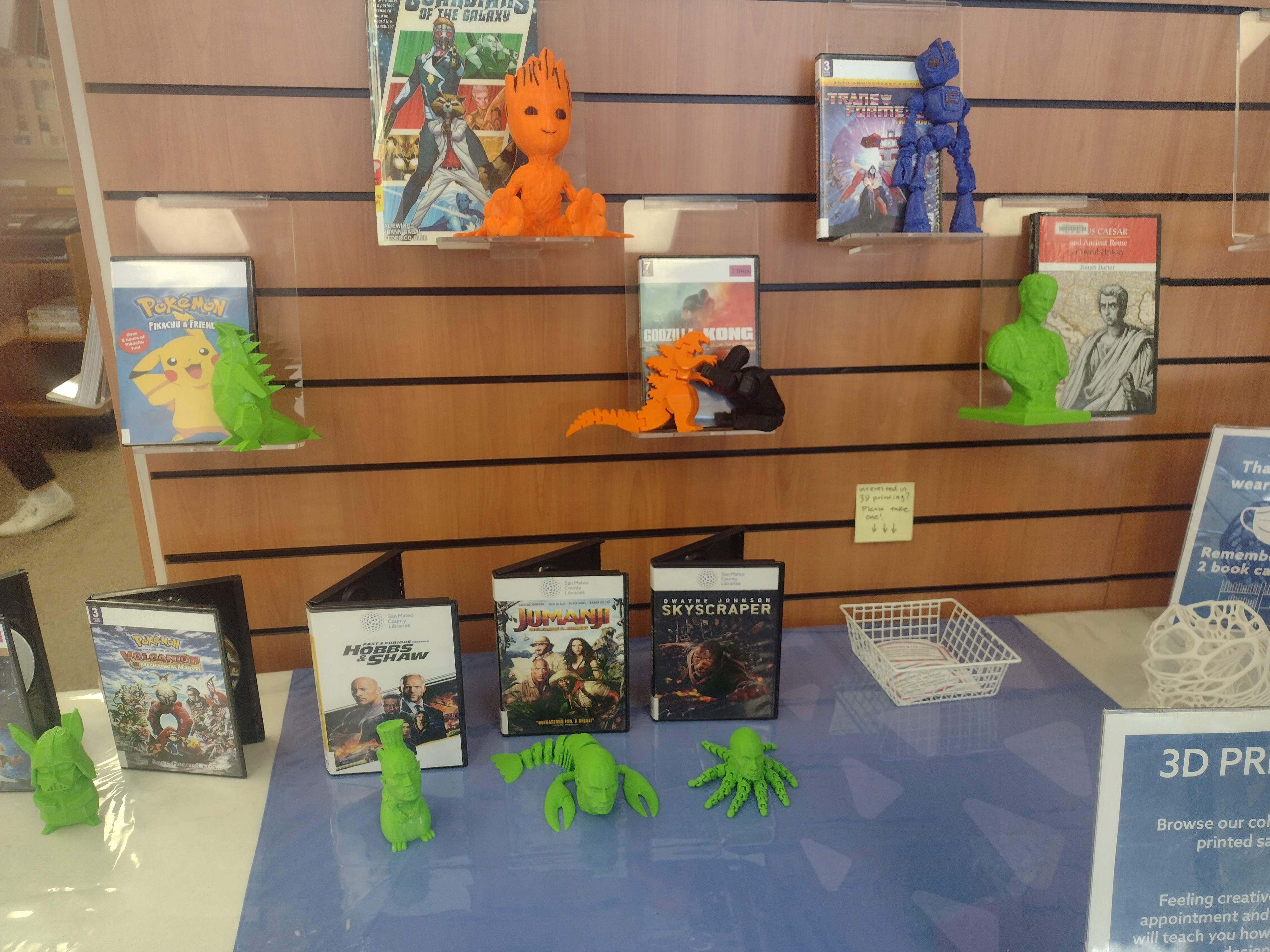
A display of DVDs and 3D-Printed objects created by my coworker, Steven Wong, to promote our library’s free 3D Printing Service.
Every time I tell my Dad over the phone that I have to go to work, he says, “Is this real work or play time?” It’s an irritating question, since it’s all “real work” to me (even though I enjoy it), but I can see how he might be a bit perplexed to see me stuffing Take and Make bags with pom-poms and yarn for kids to make into mobiles, or sewing a sample felt sloth stuffed animal for an After School STEAM Program for elementary school kids.
As a youth services librarian working primarily in small branches, my job has always been this way: tracking down historic documents for a local researcher one minute, kissing a live pig in front of a crowd of shrieking children the next. But over the past twenty years or so, the rise of digital resources has added even more complexity to my profession. Increasingly, public libraries have become the only remaining bridge across the ever-expanding digital divide. Now, on top of helping someone find the latest James Patterson novel, or helping a student locate books on Martin Luther King, Jr., we have patrons with no computer experience and no email address suddenly discovering that almost every job requires them to fill out an application online.
Then came the pandemic, when almost every aspect of library services had to be reevaluated and re-created in a new form. There was suddenly a massive demand for our e-book and e-audiobook collections, which required hours of troubleshooting with patrons via phone, text, email, and even Zoom (I now have a LOT more respect for people who work in call centers). But we also got calls from people needing help with more pressing problems, like the man whose driver’s license was about to expire, even though the DMV was closed. He called the DMV helpline, but just got a recording directing him to a web site he couldn’t access, since he had no computer.
Before the pandemic, we had offered laptops and WiFi hotspots for patrons to check out. But suddenly the demand for them far exceeded our limited supply, with everyone suddenly needing the Internet for almost everything. In the meantime, we were trying to fill the same role of promoting early-literacy that we always had, by providing storytimes, author events, book clubs, and other programs, but this time over Zoom. Instead of offering art and science workshops in the library, we bundled materials up in bags for families to pick up from our curbside table, and follow along with video instructions on YouTube.
Now that our buildings are open again, we are struggling to balance these new services with our old ones, while trying to navigate the ups and downs of the new COVID variants. We have been offering outdoor storytimes outside our libraries or in local parks, while still providing virtual ones for families who are concerned about the risk of illness, or unable to get to the branch. We are also back to in-person science workshops (also outdoors), but with limits on the number of attendees, so we are continuing to offer Take-and-Make kits to allow more kids to participate. In the meantime, virtual author programs (both for kids and adults) have become incredibly popular, because they allow us to bring in major authors we could never afford to host in person, and to accommodate much larger audiences.
For years, I’ve seen posts or heard comments about how the Internet has made libraries obsolete. I’ve even heard people say there’s no need to visit libraries because you can buy all your books on Amazon. To which I would reply, sure, if you have the money you can definitely do that, but why would you? Especially if you are a parent trying to keep your kids supplied with picture books, which they might enjoy one time for ten or fifteen minutes. Libraries also provide free access to the millions of Americans who still lack high-speed Internet access at home, as well as training on how to use the Internet resources they need for work, education, healthcare and more. And we provide training and access to other types of equipment as well, including 3D-Printers, sewing machines, bicycles, ukuleles, home energy kits, and sewing machines.
A few weeks ago, I helped a patron who was looking for market research for a product she was hoping to sell. As I showed her the different databases we had available, and how to use them, she said, “Thank you so much for helping me. There’s just too much information online, and I have no idea where to look.” That, to me, summed up the one of the primary roles of libraries in the 21st century. We’ve always been in the business of curating information, but now, in a world where typing a search term into Google will give you billions of hits (millions of which are irrelevant, false, outdated, or trying to sell you something), the library provides free access to resources that have been selected for their reliability and accuracy, and people to guide you through them.
Meanwhile, the parts of my job I enjoy the most –finding answers to questions, performing weekly storytimes, and finding books for patrons– all remain basically the same. They may be more complex, with the addition of ebooks and other technologies, but at its core, the job is still about helping people, and that’s something that hopefully will never change.
Well, here in the San Francisco Bay Area, we are in our seventh week of Sheltering in Place, and my job has changed in ways I never imagined. Last week I did my first Virtual Storytime, goofing around in front of a webcam in the corner of my bedroom, with no way of knowing who was watching or what their reaction might be. I think I was more nervous than I was the first time I did a live storytime, even though I had been practicing with coworkers for several weeks. Here are a few things I’ve learned so far:
Virtual Storytime is much more tiring than live programs. Usually when I do programs in the library, I feel energized by seeing the kids and parents singing along or enjoying the books. For this type of program, all of the energy has to come from you. Whenever I finish a virtual storytime, I’m left feeling both jittery and exhausted, and also with an unsettled feeling of not knowing how the program was received.
Anything and everything can go wrong. I think the scariest aspect of virtual programs is that so much is out of your control: your Internet can fail, software can crash, ebooks can refuse to load, the sound can be distorted, cats or kids can run through your programming space. During my first virtual storytime, I somehow clicked on the cover page of the ebook I was reading in some magical way that opened a new tab with a .jpg of the cover. It took me what felt like hours (but was really only about two minutes) to figure out what had happened, and how to get back to the book.
After watching lots of other virtual programs lately though, I know that everyone is in the same boat, and in some ways it’s these kinds of unexpected, frustrating glitches that are the most humanizing and endearing. It’s definitely not always easy to remember that in the moment. But I’m trying to make a habit of writing down a few song ideas and having a back-up book in case I run into problems with our ebook databases. For the other problems, I just have to be prepared to laugh them off and keep going.
Doing a trial run with a remote audience is key. Before I was given the green light to do my first virtual storytime, I had to do what felt like dozens of practices over Zoom in front of other library staff. This was hard for me, but it helped so much in terms of getting used to the technology, and identifying problems I never would have known about otherwise.
I learned that if I played my ukulele at my usual volume, Zoom would prioritize the strumming over the sound of my voice, making it hard for people to hear the words to the song. I learned that the lighting was better if I put the laptop next to my bedroom window, and that sounds like jiggling keys or tapping pan lids to demonstrate some homemade instrument options were painfully loud to my online audience.
The practices also taught me that ebooks showed up better on the screen than holding up physical picture books (where the illustrations sometimes looked washed out, or obscured by light glaring off the page), and that using F11 to make the pages full screen was helpful for hiding the tabs at top of my web browser, but sometimes made it harder to turn the pages when I was sharing my screen over Zoom. I’m incredibly grateful for all of the feedback I got from fellow librarians who took the time to watch my practices and give advice.
The needs of our storytime families have changed. This is something I’ve been thinking about a lot recently, especially after watching this webinar from Reaching Across Illinois Library System: https://www.railslibraries.info/events/181406. In it, Ann Santori from Lincolnwood Library talks about the importance of having a purpose behind each of the songs or activities she does. One of the things she has been doing is creating a video series called Give Me a Break, featuring easy free play activities that parents can provide to keep their young children occupied, so that they can have a few minutes to do something for themselves. So now I’m trying to incorporate something similar into my virtual storytimes. In my most recent one, I took two minutes towards the end of the program to demonstrate Flower Painting, one of my favorite process art activities, where kids can squish flowers or leaves on paper to create natural paintings without the mess of using actual paint. (Here’s a great description from No Time for Flash Cards).
The other thing to consider is that while our storytimes in the library provided parents and caregivers a chance to bond with their kids, I suspect many parents are using the virtual storytimes as a way to occupy their kids for a few minutes while they squeeze in a few uninterrupted minutes of work, or make dinner. So a lot of the cuddly, tickly, lapsit songs and rhymes I love probably won’t work for them right now.
I’m trying to focus instead on songs the kids can learn and sing and adapt for their own families (I talk about how, instead of singing about the people on the bus, they can sing about the people in their house, or the toys in their closet, etc.). I do also try to highlight our ebook collections and other resources families can use while the libraries are closed. And I try to find ways to incorporate things families have at home, to stand in for some of the things we use in storytime (wash cloths for play scarves, a cereal box for a shaker).
There are still ways to connect. The weirdest part of virtual programs is the isolated nature of them. As the weeks drag on, I miss my regular storytime families more and more, and it’s really hard to feel connected to them when I’m all alone with my laptop. But one nice thing about doing programs online is the ability to reach more and different people. Knowing my niece and nephew were watching my first storytime from Ohio, I used my last song, Freight Train by Elizabeth Cotten (with revised lyrics by Elizabeth Mitchell) to ride my imaginary train to their house. That gave me the idea of posting on one of our local parent Facebook groups to ask if anyone would like me to do a shout-out to their kids in an upcoming storytime. I’ve already gotten a few responses, both from regular and new families. It will make it much easier to stand in front of the web cam, imagining the kids’ surprise at hearing their own names, and thinking of some of my favorite families watching from home.
Those are just my preliminary thoughts, after a week of virtual storytimes. Please share any ideas, suggestions, experiences or questions you have about virtual programs in the comments. In the meantime, stay safe (and sane!).
My coworker Jessica Ormonde and I were recently asked to visit two fifth grade classes and a fourth/fifth combo class at a local elementary school to talk about Internet research skills, especially how to determine if a web site was a good source of information or not.
I searched online for any existing presentations or handouts, but most of them seemed to be directed more toward older students. Most of the ones I found used the CRAAP test for evaluating web sites. The CRAAP test was developed by Sarah Blakeslee and other librarians at California State University in Chico, and uses the acronym CRAAP, which stands for Currency, Relevance, Authority, Accuracy, and Purpose. I liked the mnemonic, which is certainly memorable and apt, but I didn’t think words like currency and authority would resonate with fifth graders.
I ended up creating my own Powerpoint presentation, framing the challenge of finding good information as being an “Internet detective.” Instead of the terms used by the CRAAP test, I used “Who, What, When, Where, and Why.” I tried to include a lot of examples of both good and bad web pages, as well as a discussion of the pros and cons of Wikipedia, and what to look for and avoid when doing a Google search.
The three class presentations were a lot of fun. I was pleasantly surprised by how much the kids already knew about the risks of using the Internet for research (viruses, misinformation, people collecting their personal information, clickbait, etc.). They actually seemed more informed and cautious than many adult patrons I’ve worked with at the library!
The link to my PowerPoint presentation is below. Feel free to use or adapt it. Here is a basic handout as well, which includes a guide to our local library resources on the second page: Just the Facts.docx
If you have ideas for other topics it would be good to cover, or any related resources to share, please let me know in the comments.
There’s a reason I call myself The Loudest Librarian. My storytimes tend to be a little loud. One patron even took the time to fill out a comment card complaining, “that librarian’s storytimes could be heard in San Francisco!” (San Francisco is only about 8 miles away, so that’s not as bad as it sounds).
It’s not so much the reading part that’s loud, although I do encourage the kids to participate as much as I can by having them make animal sounds or chime in on repeated words or phrases in the story. It’s more that I do a lot of songs. Often I open the storytime with Raffi’s Shake My Sillies Out, and when we get to the verse, “I’ve got to yawn my sleepies out,” I pretend to fall asleep, the kids yell, “Wake up!” and then I open my eyes in surprise and yell back. Yes, that’s loud, but it never seems to get old. For the kids anyway. I can’t speak for the parents, or that lady at the computer on the other side of the library.
At the end of the storytime, before the craft, I always pull out a box of shakers, drums, and other instruments and we all play along with a song on the CD player. It’s the kids’ favorite part, and I often get asked, “Is it instrument time yet?”
You might wonder what music and instruments have to do with storytime. Admittedly, a big justification for me is that the songs sometimes help younger kids, especially toddlers who may have gone off exploring during the book, a chance to refocus and come back in to the group. If it’s a song or rhyme with motions, like “No More Monkeys Jumping on the Bed,” it gives them a chance to move around. It also gives them a chance to participate, rather than just being passive listeners.
Beyond those pragmatic reasons though, there’s a great deal of research that suggests that music improves reading skills. Specifically, it helps children recognize and remember words and the sounds that words are made of (phonemes). This literature review by Jonathan Boldoc from the University of Ottawa cites numerous studies demonstrating that children who participated in a music class where they learned songs and/or played instruments did significantly better on tests of pre-reading skills than children who did not receive the music instruction. (There have been countless other studies on music education, citing benefits that include stronger language development, higher IQ, better spatial skills, and higher test scores. Music instruction may even make kids nicer, more helpful, and better at solving problems. All of which makes you wonder why music is often one of the first subjects to be cut from schools.)
If one of the primary goals of a library storytime is to help kids grow up to be better readers, it makes sense to include songs and rhymes. Nursery rhymes are especially important. In fact, Mem Fox, in her book, Reading Magic, states, “Experts in literacy and child development have discovered that if children know eight nursery rhymes by heart by the time they’re four years old, they’re usually among the best readers by the time they’re eight.” So even if you’re not comfortable singing, you can still have a tremendous impact by getting kids to clap along to Pat-a-Cake, Pat-a-Cake or Little Miss Muffet.
For years, I did all of the songs in my storytimes without an accompanying instrument. I had taken guitar lessons years ago, but I never felt confident about my playing skills, and the guitar itself seemed too big and awkward to manage with all the books and puppets I was bringing to storytime (that said, my boss, Thom Ball, does a fantastic job performing storytimes with his guitar, so I know it can be done).
Then I discovered the ukulele. The ukulele is small and light, and only has four strings. The strings are nylon, so they don’t bite into your fingers like the steel strings on an acoustic guitar. And it’s so easy to learn! At least for playing simple children’s songs. Most of the standards like The Wheels on the Bus, and The Itsy Bitsy Spider only require two or three chords. You can even get by with one chord for Row, Row, Row Your Boat and Frere Jacques. Ukuleles are also fairly inexpensive. I got my first one for around $50 at a local music shop. (You don’t want to go too cheap though, or you’ll end up with one that constantly goes out of tune).
Admittedly, it took me a while to work up the nerve to bring my ukulele to storytime. I was still struggling with chord changes, and I wasn’t sure how it would go over. But, oh, it was worth it to see the kids’ faces when I brought it out. They were so excited! I let them take turns giving it a practice strum, and they were mesmerized.
I don’t even remember what song I played that first time, although it must have been one of the three chord songs, maybe The Alphabet Song or Twinkle Twinkle or Baa, Baa, Black Sheep (it’s embarrassing how many years it took me to realize those all have the same tune). And yes, I made mistakes, but another nice thing about the ukulele is that it’s a fairly quiet instrument, and mistakes tend to be covered up by your voice, especially if the kids are singing too.
Plus the saving grace about playing for children is that they LOVE mistakes! You can usually tell a new children’s performer (especially a magician), from one whose had a few years on the library and birthday party circuit. The new magician may perform a fantastic show that moves seamlessly from one amazing trick to another. The adults are astounded. The kids are mildly intrigued. An experienced children’s performer will spend ten minutes trying to blow up a balloon: stretching it and snapping himself on the hand, dropping it on the floor, letting it go before the end is tied up. And the kids are howling with laughter. Mistakes are their own magic. But I’m not even sure my mistakes were noticed. Several parents came up afterwards to ask me how long I had been playing. I was embarrassed. “I only know three chords,” I said. But it’s so rare for people to see a live music performance of any kind nowadays. A little goes a long way.
Even today, with a few more chords under my belt, I don’t play my ukulele for every song, or even every storytime. A lot of songs, like The Itsy Bitsy Spider, have motions that require me to have my hands free. But I have a small repertoire of favorites I like to play: Old MacDonald, Twinkle Twinkle, When Ducks Get Up in the Morning, No More Monkeys Jumping on the Bed(Asheba’s version) and my favorite, Elizabeth Mitchell’s version of Freight Train. Ever since I started playing at storytime, a number of parents and caregivers have told that they’ve gotten their own ukuleles, either for themselves or their kids. So, even though I know I will never be Jake Shimabukaro or IZ, maybe one of my storytime kids will be. But in the meantime, I’m having fun.
GETTING STARTED: YOUR FIRST SONG
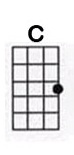
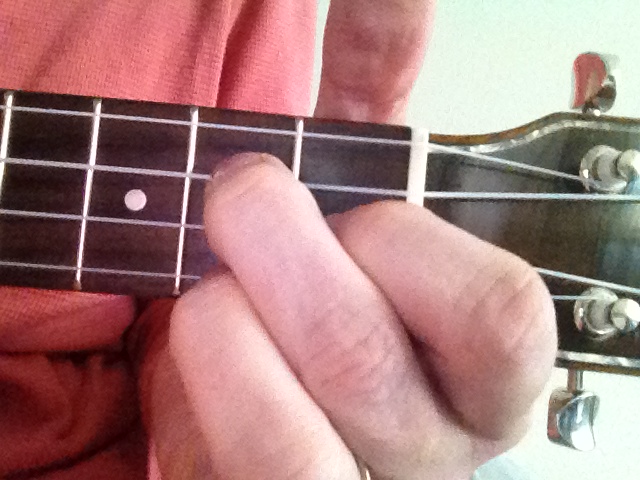
There are so many videos and resources online that can teach you everything you need to know, step by step, much more clearly than I can. For example, here’s a very basic video on how to tune your ukulele. The most important thing to learn is how to read chord charts, which are easily found online. Here’s one from a website called Ukalady.com. If you have an iPhone, there’s a great app called Guitar Toolkit, which has all the ukulele chords, and also includes a digital tuner and a metronome. Here’s a C chord on a chord chart, and here’s how it looks on the ukulele:
Imagine that the top of the chart (where the C is) is the end of the fret board, where the tuning pegs are. The four vertical lines represent the four strings. The horizontal lines represent the frets, which separate the different notes on each string. It’s a little confusing, because you have to mentally rotate the chord chart, and imagine it overlaid on the ukulele, with the right side of the chart representing the bottom string.
For the C chord, you’re going to put your finger on the bottom string at the third fret (luckily the third fret has a convenient white dot in the middle, which makes it easy to find). In order to make chord changes easier, it’s better to use your ring or middle finger, which is going to feel strange at first, but you get used to it. Then you use your right hand to strum all four strings just over the sound hole. There are lots of ways to strum. You can curl your fingers loosely, and strum with the nail side of your index, middle, ring and pinkie fingers all together (keeping your hand loose). Or you can strum with the nail side of your index finger only. Or you can strum with the fleshy side of your thumb. Find something that feels natural, and just practice strumming down across the strings, keeping an even rhythm.
Once you get the hang of this, you are ready to play Row, Row, Row Your Boat. Here’s what it sounds like:
There you go. Just one chord. And it’s a great song for almost any age group. For babies, you can have them on their parent’s lap, with their parents moving their arms like oars. For toddlers and older kids, I like to add these two verses: Rock, rock, rock your boat Gently to the shore. And if you see a lion, Don’t forget to roar! (ROAR!!!) Row, row, row your boat Gently down the stream, And if you see an alligator, Don’t forget to scream! (AAAAAAHHHHHH!!) If you want a real challenge for older kids, you can try teaching them how to sing it as a round.
So there you go. Your first song, which is fun and easy, versatile, and yes, loud! Another one chord song is Are You Sleeping? or Frere Jacques. For this one, I added an up-strum, by moving my fingers up the bottom strings briefly in between downstrokes. Here’s what it sounds like:
If you add in one more chord, a G7, you can play The Wheels on the Bus. Here’s the chord on the chord chart, and what it looks like on the ukulele:
It’s a little tricky at first to fit all your fingers on the fretboard, and even trickier to switch back and forth between the C and the G7. It’s good to just practice alternating chords evenly (C C G7 G7 C C G7 G7) until you get the hang of it. Then you’re ready for The Wheels on the Bus. It goes like this:
C C C C
The wheels on the bus go round and round
G7 G7 C C
Round and round, round and round.
C C C C
The wheels on the bus go round and round
G7 C
All over town.
And here’s what it sounds like:
The Wheels on the Bus is also a fun, versatile song. You can make the wheels go really fast, or very s-l-o-w, or backwards. You can have the kids suggest crazy things that might be on the bus: cats, ducks, cell phones, peacocks (but not elephants. I’m no good at elephant noises). My favorite is to sing, “The parents on the bus cry, ‘Waah! Waah! Waah!” then wait a few seconds for the kids to catch on.
Another two chord song I like with C and G7 is When Ducks Get Up in the Morning. Here’s how it goes:
C C C C
When ducks get up in the morning
G7 G7 C
They always say, “Good day!”
C C C C
When ducks get up in the morning
G7 G7 C
They always say, “Good day!”
C C C C
They say, “Quack! Quack! Quack! Quack!”
G7 G7 C
That is what they say.
C C C C
They say, “Quack! Quack! Quack! Quack!”
G7 G7 C
That is what they say.
You can have the kids suggest other animals. One of my coworkers begins her toddler time with this song, at a library where there are lots of stuffed toys. The kids are usually holding different animals, and those become the animals for the song. She always ends with “When kids get up in the morning,” and asks the kids what they say. (It’s usually, “I’m hungry!”)
Once you learn the basics of chord charts, you can play just about anything. My favorite ukulele book is The Daily Ukulele: 365 Songs for Better Livin’ by Jim Beloff. It’s a wonderful collection of songs, including a section of kids songs (Rainbow Connection!), but also songs by the Beatles, Irving Berlin, Hank Williams, Bob Dylan, as well as lots of folk music and holiday classics. The best part is that there’s a chord chart for every song, right at the top of the page. I love to flip through and play a song at random, and I’ve learned a lot of chords that way. There’s even a Leap Year edition, with 366 more songs, which is also great.
You can also find an impressive collection of songs with ukulele chord charts for free at DoctorUke.com. Another book I’m enjoying right now is Ukulele Exercises for Dummies. The text assumes a fair amount of comfort with reading music, although there are audio files provided online to help you understand the exercises. But it covers a wide range of ukulele skills like different types of strumming patterns, fingerpicking, playing percussively, finger rolls, slides, bends. It’s fun to just go through a couple of exercises a day.
I hope this is helpful. If you have any questions, please write them in the comments, and I’ll try my best to find an answer. If you are a uke player and have suggestions or corrections, please write those in the comments too. I can use all the help I can get! Happy playing!
Okay, so it wasn’t really Superman (although I have had a lifelong crush on 1978 Christopher Reeve). That was just a tease to hide a much more embarrassing secret: my love affair was actually with Sonic the Hedgehog, and Garfield the Cat.
Twice in the past two weeks, I’ve heard well-meaning adults say something about “REAL books, not graphic novels or comics!” In one case, it was a teacher telling me what books she lets her students check out in her school’s library. The second time, it was a parent. In both cases, I was privately horrified.
As a parent, I read to my son constantly throughout his preschool years, bringing him books on whatever his current obsession was: deep sea fish, reptiles, creepy crawly things, Star Wars. I read him all my favorite childhood picture books, and many of my favorite chapter books too. He was always an eager listener, but it was Sonic, the obnoxious speedy blue hedgehog from the planet Mobius, who made him want to READ.
My son got his first Sonic comic at Coastside Comics on Free Comic Book Day when he was six. We read it together that night. Personally, I found it challenging. There was a lot of back story I didn’t know, and the characters were mostly new to me (although I knew Sonic and Tails from the old Sega video games). But my son was hooked. He worked at reading the comic on his own until he mastered it.
It wasn’t an easy read. Comic books, on average, have about 53 rare words per 1000, as opposed to 30 rare words in a children’s chapter book (and 52 in an adult novel). That means comics challenge kids with vocabulary they may never have heard, much less seen, before. Luckily, the pictures help them decipher the meaning.
Once my son got hold of that Sonic comic, he had to have more. Soon he was reading Scooby Doo, Garfield, Calvin and Hobbes, and then racing through chapter books in school. Yes, Garfield isn’t the best role model, and we had to explain why it’s probably for the best that no one else can hear what that cat is thinking, or why we shouldn’t refer to Daddy as “Captain Obvious” (although kudos to Garfield for teaching him the word “obvious.”) I was happy when he discovered Baby Blues because they sometimes let him see things from a parents’ point of view (plus they are hilarious!).
Three years later, my son is now hooked on the newest craze in children’s publishing: the hybrid cartoon/chapter books like Diary of a Wimpy Kid, Stick Dog, and Big Nate. He still loves Garfield and Calvin and Hobbes, but he’ll read almost anything that comes his way. Meanwhile, my four-year-old daughter and I are enjoying the My Little Pony comics, and I’m happy to see the ways that comics and graphic novels are growing and changing.
At the library where I work, we now have graphic novels for every level of reader, from preschool through adult. And teachers are now exploring the benefits of using comics in the classroom, finding that they make information more memorable and easier to understand: http://www.readingwithpictures.org/2012/04/why-teach-with-comics/
Personally, I will always be grateful to comics for making my son want to read. Reading is such a powerful tool for understanding the world and other people, and finding out what you need to know. But it’s also so much fun.
When I first started as a children’s librarian in Raleigh, North Carolina, I was lucky enough to be apprenticed to a woman who patiently taught me how to do infant and toddler storytimes. I was still terrified. The hardest thing about doing storytime for this age group was that I was painfully aware that I was mostly performing for the parents, while the babies and toddlers were busy pulling books off the shelves, chewing on their friends’ toys, crying over a lost binky, and basically anything but listening to me. At first this was so frightening that I would find myself forgetting the words to “Twinkle Twinkle Little Star.” I started writing my favorite rhymes and songs down on index cards, which would inevitably wander off and get chewed on, but they were still very helpful in those early years. Here are some of my favorites:
CUCKOO CLOCK
Tick Tock, Tick Tock (rocking side to side)
I’m a little cuckoo clock
Tick Tock, Tick Tock
Now I’m striking one o’clock…
Cuckoo! (lift baby up, or have toddler jump up in the air)
(Repeat for two and three o’clock)
THEY JUMPED IN THE BOAT
(Don’t ask me why the kids love this so much, but they do)
They jumped in the boat, and the boat tipped o-ver! (Lean baby far to the right)
They jumped in the boat, and the boat tipped o-ver! (Lean baby far to the left)
They jumped in the boat, and the boat tipped o-ver! (Lean baby far to the right)
Ten little boys and girls (bounce baby on lap)
GIDDY-UP!
(A bouncing rhyme, to the tune of the Lone Ranger part of “The William Tell Overture”)
Inside the space shuttle (hold baby on lap, or have toddler crouch down)
Just enough room (hug baby or show toddler how to hug knees)
Here comes the countdown (holding up five fingers)
5-4-3-2-1
Blast-off! (Raise baby in the air, or have toddler jump up)
ZOOM! ZOOM! ZOOM!
(Similar to Inside the Space Shuttle, start with baby on lap or toddler crouching)
Zoom! Zoom! Zoom! (rub hands together on each “zoom”)
I’m off to the moon!
10-9-8-7-6-5-4-3-2-1
Blast off!!!
TEN CANDLES ON A BIRTHDAY CAKE
Ten candles on a birthday cake (hold up ten fingers)
All lit up for me! (point to yourself)
I’ll make a wish, and blow them out
Watch and you will see! (blow on fingers and quickly make hands into fists)
MY BALLOON
This is the way I blow my balloon (hold hands in front of your face in the shape of a balloon)
Blow! (blow air, and bring hands apart)
Blow! (blow air, and spread hands wider)
Blow! (blow air, and spread hands very wide)
This is the way I break my balloon
Oh, oh NO! (clap hands together)
SLOWLY, SLOWLY
Slowly, slowly, very slowly goes the garden snail (walk fingers slowly up baby’s arm, or have toddler walk very slowly in place)
Slowly, slowly, very slowly up the garden rail
Quickly, quickly, quickly, quickly
Goes the Little Mouse (run fingers up to baby’s chin, or have toddler run in place)
Quickly, quickly, quickly, quickly
All around the house!
HERE IS THE BEEHIVE
Here is the beehive (make a fist)
Where are the bees?
Hiding away where nobody sees.
Watch, and they’ll all come out of their hive
1-2-3-4-5 (open up fingers one at a time)
They’re alive! (tickle baby or toddler)
DOWN BY THE BANKS OF THE HANKY PANKY
(hold baby or toddler on lap and bounce them from leg to leg)
Down by the Banks of the Hanky Panky
Where the bullfrogs jump from bank to banky
With a hip, hop, a hippity hop
Jump off the lily pad (lift baby up)
And kerplop! (lower baby back down)
THE ELEVATOR
(To the tune of “Bouncing Up and Down in My Little Red Wagon”)
Riding up and down in an elevator (lift baby up and down, or have toddler stand and crouch)
Riding up and down in an elevator
Riding up and down in an elevator
First floor
Second floor (lift baby up, or have toddler stand)
Third floor (lift baby higher, or have toddler stretch up high)
DOWN! (lower baby, or have toddler crouch back down)
MERRY-GO-ROUND
(To the tune of “This Old Man”)
Merry Go Round (lift baby up and down, or put her on your knees and bend and straighten them)
Merry Go Round
We all ride on the merry-go-round
Now we’re UP
And now we’re DOWN!
We all ride on the merry-go-round.
Down to town, down to town
We go riding down to town
Better be careful you don’t fall DOWN (lean baby far to the right)
We go riding down to town.
RAISIN BREAD
(Have baby or toddler lie on her back on the floor)
How do you make raisin bread?
You roll it (roll baby gently to one side)
And roll it (roll baby to the other side)
And roll it
And roll it
And then you put the raisins in (gently poke baby’s stomach in several places)
SEE MY PONY
(a bouncing rhyme; thanks to Laura Siegel)
See my pony, jet black pony
I ride him each day
When I give him oats to eat
Clippity clappaty go his little feet!
See my pony, jet black pony
I ride him each (long pause holding tension)
day (simultaneously open knees and child drops down- while holding on of course)
I HAVE A CAT
I have a cat (stroke imaginary cat on lap)
My cat lies flat! (clap one hand on top of the other)
I have a cat (stroke cat)
He wears a hat (pat the top of your head)
I have a cat
He caught a rat (clap your hands together quickly in the air)
I have a cat (stroke cat)
Purrrrrrr….Purrrr…..
ME-OWWWW!
THE HIPPOPOTAMUS
(pat hands on lap in time to the rhyme)
The hip-, the hip-, the hippopotamus
Got on, got on, got on the city bus
And all, and all, and all the people said
You’re squishing us! (put your hands on the sides of your face and squish your cheeks forward)







 The Loudest Librarian!