We are halfway through the alphabet in our storytime series about letters. I’m still enjoying the challenge, and the kids seem to like the weekly letter themes too.
As usual, today at Outdoor Musical Storytime I asked the kids to suggest words that start with the Letter M. They suggested Mommy, monkey, and mouse. Then we drew the letter M in the air together.
UPDATE: I did a slightly expanded version of the storytime below tonight for Family Storytime, so I’ve added in the additional book and song that we did.
Here’s the rest of what we did:
Books:
Mouse was Mad by Linda Urban; illustrated by Henry Cole
Adorable book about handling big emotions. Mouse is so mad that he hops and stomps and screams and rolls around on the ground, but he can’t do any of these things as well as his friends Hare, Bear, Bobcat, and Hedgehog, and he keeps ending up in mucky mud puddles. Finally, he tries standing still and just breathing, and finds that he isn’t mad anymore.
The Mitten by Jim Aylesworth; illustrated by Barbara McClintock
I decided to do this longer version of the classic story about a lost mitten that becomes a refuge for a bunch of cold animals, rather than the more well-known one by Jan Brett (which I also love!), because the illustrations are a bit larger and easier for the kids to see in our outdoor setting. It also has a cute, repeated refrain that each animal says as they ask to be allowed to squeeze into the crowded mitten for warmth. This was a much longer book than I usually read, but the kids really seemed to like it.
This is one of my long-time favorites: one of the Moonbear series by Frank Asch. In this one, Bear wonders what the Moon tastes like, so he builds a rocket, but falls asleep while counting down to lift off. He wakes up on a snowy day (something he’s never seen before), and thinking he is on the Moon, makes and eats a little Mooncake (made out of snow) and explores until he is frightened by strange footprints (his own). He gets back in the rocket, but again falls asleep, waking up when it is Spring again. The kids enjoyed joining in on the countdowns.
Hilarious rhyming book about a house that is suddenly full of mysterious moose tracks. The twist at the end is the best!
Songs:
If You’re Happy and You Know It
I did this one to go along with the book Mouse Was Mad, since it’s all about feelings. I added in verses about other emotions:
[C] If you’re happy and you know it, clap your [G7] hands! (clap, clap) If you’re happy and you know it, clap your [C] hands! (clap, clap) If you’re [F] happy and you know it, and you [C] really want to show it, If you’re [G7] happy and you know it, clap your [C] hands! (clap, clap)
If you’re sad and you know it, cry, “Boo hoo!”…
If you’re angry and you know it, say, “I’m mad!”… (stomp feet while saying, “I’m mad!”)
If you’re shy and you know it, hide your face… (cover your eyes, and then uncover them and say, “Peek-a-boo!”
If you’re sleepy and you know it, yawn and stretch…
If you’re happy and you know it, shout, “Hooray!”…
Mitten Song
Really simple but cute song about mittens. This video from HeadHz includes an additional verse that I haven’t used before. I just do the chorus:
Thumb in the thumb’s place, (wiggle your thumb) Fingers all together, (squeeze your other fingers together) This is the song we sing in mitten weather.
Hickory, Dickory, Dock
For our parachute activity, I brought out a mouse puppet and tossed it into the middle of parachute as we sang this song. Here’s a video from Super Simple Songs, in case you aren’t familiar with the tune:
Hickory dickory dock, (shake theparachute) The mouse ran up the clock. (lift the parachute in the air) The clock struck one, The mouse ran down. (lower the parachute) Hickory, dickory, dock. (shake the parachute)
Zoom! Zoom! Zoom!
We actually do this one every week with the parachute (it’s a shorter version of the traditional Zoom, Zoom, Zoom song). The kids LOVE running underneath when we raise the chute in the air.
Zoom! Zoom! Zoom! We’re going to the moon! (shake the parachute in rhythm) Zoom! Zoom! Zoom! We’re be there very soon! (shake the parachute in rhythm) 10-9-8-7-6-5-4-3-2-1 (shake the parachute for each number) Blast Off! (raise or throw the parachute as high as you can, then let it fall back down).
Mairzy Doats by Milton Drake, Al Hoffman and Jerry Livingston
I loved this song when I was a kid, so I was happy to have an excuse to use it for an instrument play-along at the end of storytime. Here’s a link to the ukulele chords with chord charts from Doctor Uke, which is a wonderful site for learning how to play the ukulele, and finding the chords to popular songs.
[C] Oh, mairzy doats and [Cmaj7] dozy doats and [C6] liddle lambsy [C#dim] divey. A [Dm7] kiddley divey, [G7] too. Wouldn’t [C] you? [C] Oh, mairzy doats and [Cmaj7] dozy doats and [C6] liddle lambsy [C#dim] divey. A [Dm7] kiddley divey, [G7] too. Wouldn’t [C] you?
If the [Gm7] words sound [C7] queer and [Gm7] funny to your [C7] ear, A [F] little bit jumbled and [F6] jivey. Sing, [Am7] “Mares eat [D7] oats and [Am7] does eat [D7] oats and [G7] little [F] lambs eat [Em7] i-[G7sus] vy.”
[C] Oh, mairzy doats and [Cmaj7] dozy doats and [C6] liddle lambsy [C#dim] divey. A [Dm7] kiddley divey, [G7] too. Wouldn’t [C] you? [C] Oh, mairzy doats and [Cmaj7] dozy doats and [C6] liddle lambsy [C#dim] divey. A [Dm7] kiddley divey, [G7] too. Wouldn’t [C] you?
Stay & Play: Paper Mittens
This was a really easy craft, but the kids had a lot of fun with it. I just put out paper in different colors, along with markers and dot markers. They needed a grown-up’s help to trace their hands to make a mitten shape, but then they spent a lot of time decorating their mittens.
Do you have any favorite books or songs featuring the letter M? Please share them in the comments below.
When I started my series of letter-themed storytimes, I didn’t really take the time to figure out which letter would fall on which week. So it was purely by accident that we ended up featuring the Letter H on Halloween!
For both my Outdoor Musical and Family Storytimes, I started by asking the kids to call out any words they could think of that started with the letter H, so that I could write them on my white board. They came up with hot, hat, hippo, and happy. I had also brought a harmonica, which the kids seemed fascinated by.
Here’s a combination of the books and songs I used for both storytimes:
Very cute story about a bat who wants a hat so badly that he takes one from a baby. Naturally, the baby cries, and eventually, Mr. Bat feels so guilty that he returns the hat, and is given some pink socks as a reward. For my family storytime group, I had given out play scarves before I read this, and I had the kids pretend the scarves were bats whenever Mr. Bat swooped down.
Skeleton Hiccups by Margery Cuyler; illustrated by S. D. Schindler
This is such a simple and hilariously-illustrated book about a common problem: Hiccups! I also read it to a special needs preschool class today, and one little guy laughed out loud every time I read the “Hic! Hic! Hic!” (Protip: I used to always space the “hic’s” out, but the kids seem to find it much funnier when I read them fast and all-together: hic-hic-hic!”)
Adorable story about Oscar, a dachshund who is often called “Wiener Dog” by the other dogs in his class. Things get even worse when his mother buys him a hot dog costume for Halloween. But when the other dogs are frightened into a pond by a scary monster, Oscar saves the day by revealing that it is really just a couple of cats in a costume. He paddles out to help the other dogs to shore, and earns a new nickname: Hero Sandwich!
This is my new favorite book! It features a little girl in a spooky old house saying that she has heard the house is haunted, but she has never seen a ghost. In between the regular pages, which show the girl in different parts of the house, are white filmy pages with pictures of adorable ghosts on them. When you flip these pages so that they cover the regular paper pages, it looks like the ghosts are in the room with the girl, lurking on the staircase, hiding under the table, bouncing on the bed, etc. I also read this to two second grade classes, who were completely enthralled by finding and counting all the ghosts.
Songs:
My Hat, It Has Three Corners
This is an old camp song, where you start by doing motions to accompany each word, and then gradually leave the words out and only do the motions. It’s a fun challenge that gets harder and harder each time, and usually leaves the kids laughing. I use the ASL sign for hat, instead of the motion shown in this YouTube video by Miss Nina:
The motions are:
My: point to yourself Hat: pat your head Three: hold up three fingers Corners: point to your elbow
The first time through, sing the whole song with both the words and the motions:
My hat, it has three corners. Three corners has my hat. And had it not three corners, It would not be my hat.
The second time through, leave out the word “My,” and only do the motion (pointing to yourself). The third time through, leave out the word “My” and “Hat,” and only do the motions. The third time through, leave out “My,” “Hat” and “Three,” and the fourth time through, leave out “My,” “hat,” “three,” and “corners.”
On Halloween
This is a fun, easy Halloween song set to the tune of The Wheels on the Bus. For each verse, I asked the kids for suggestions of Halloween things they might see in the house. We had pumpkins, mummies, cats, bats, and witches. I always end with “The kids at the door say, ‘Trick or Treat!’”
[C]The ghosts in the house say, “Boo! Boo! Boo!” [G7] “Boo! Boo! Boo! C] Boo! Boo! Boo!” The ghosts in the house say “Boo! Boo! Boo!” On Hallo-[C]ween!
Oh, A-Haunting We Will Go
For our instrument play-along, we did a Halloween version of “A-Hunting We Will Go!” I asked the kids for things that we might catch, and then we came up with rhymes on the spot. They came up with “we’ll catch a dinosaur and put it in a store,” and “we’ll catch a ghost and put it on some toast.” Here’s a Lingokids video with the original song, which is also a favorite of mine.
Oh, [C] a-haunting we will go! A-[F]haunting we will go! We’ll [G7] catch a witch and put her in a ditch, And then we’ll let her [C] go!
Stay & Play: Paper Shape Halloween Houses
Before the storytimes, I cut a bunch of colored paper squares (about 5″ x 5″) for the house base, and large triangles for the roof. I also cut some 4″ squares out of white paper, and folded them in half lengthwise, to make small doors, and some 3″ x 5″ rectangles out of white paper, which I folded in half widthwise to make windows.
For the Stay & Play, I put out white cardstock, glue sticks, the colored paper squares and triangles, the white paper windows and doors, and some markers, googly eyes, and Halloween stickers (with ghosts, cats, vampires, etc.). I showed the kids how to glue the triangles and colored squares on their cardstock to make a house, and then glue half of their white paper doors and windows on so that they would open like a “lift-the-flap.” Then they decorated their houses with markers, googly eyes, and the stickers.
What are your favorite books or songs for Halloween or other words that start with the letter H? Please share them in the comments below.
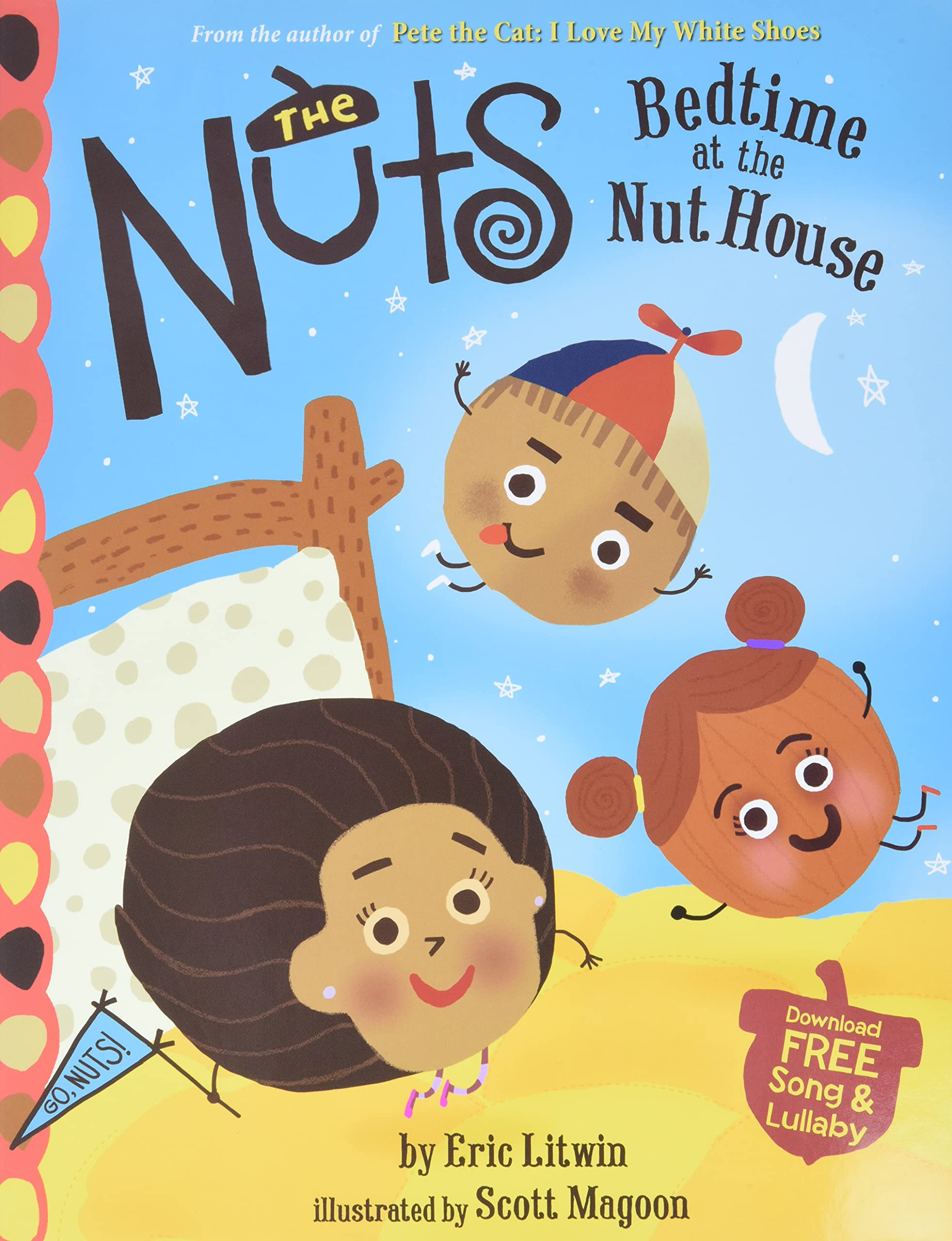
I had never read this one aloud before, but it was a big hit! Simple story about Wally and Hazel Nut, who are too busy singing their song (“We’re Nuts! We’re Nuts! We’re Nuts!”) to hear their mother’s repeated refrain, “All little Nuts need to go up to bed!” Most of the kids and grown-ups were singing along by the end.
Rattletrap Car by Phyllis Root; illustrated by Jill Barton
This book is so much fun to read aloud, and I was able to borrow a Big Book version from another library, which made it even better for storytime. When Junie, Jakie, and the Baby beg to go to the lake on a hot, hot day, their Poppa worries that their rattletrap car won’t be able to survive the trip. Sure enough, they are met with one disaster after another: a flat tire, a missing floorboard, a detached gas tank, and finally a missing engine! Luckily, with some quick thinking, and their supply of chocolate raspberry fudge delight, they are able to make the journey. The joy of the book is in the sound effects: fizzelly sizzelly, wappity bappity, lumpety bumpety, etc.
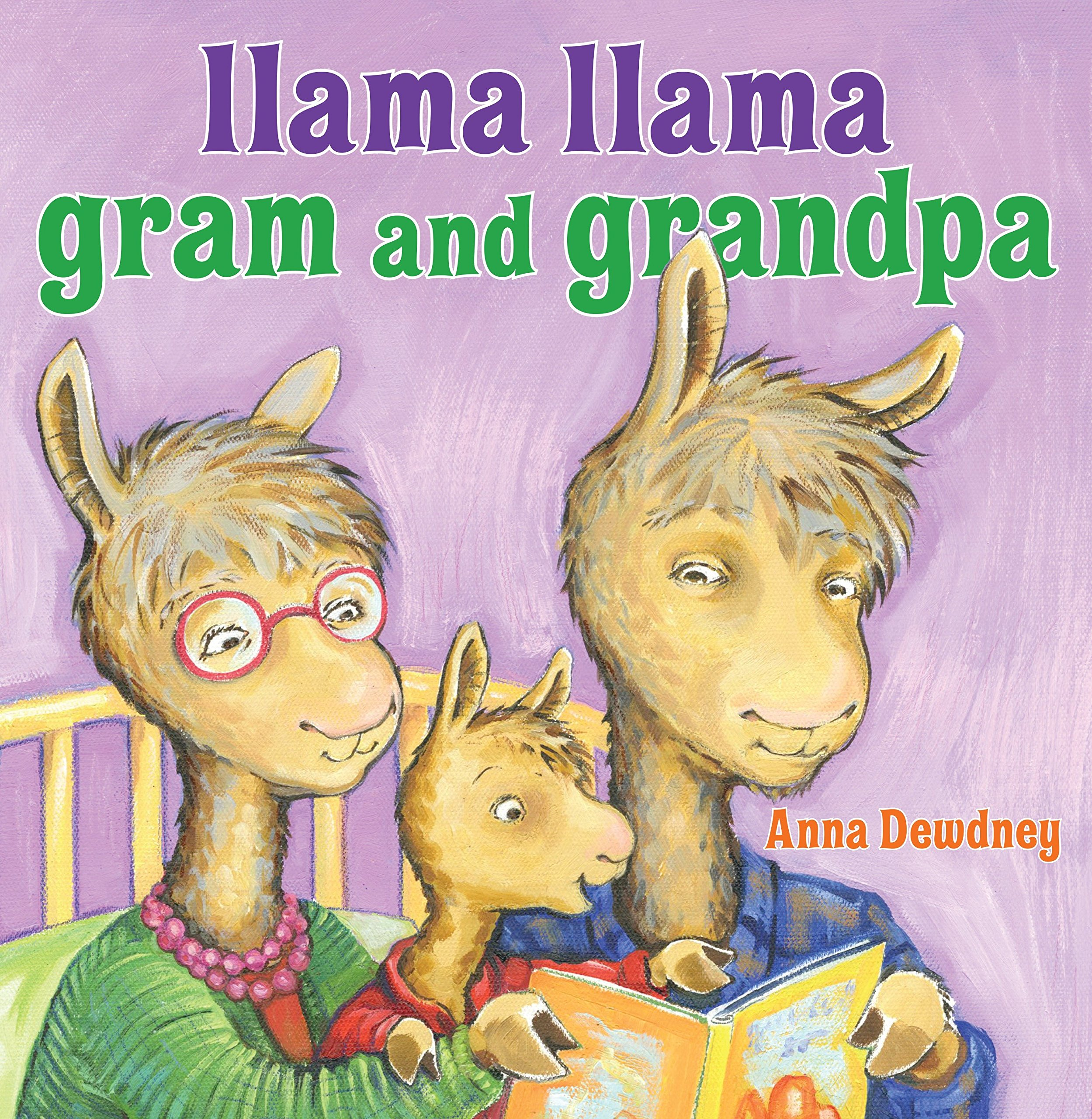
I wanted to include grandparents in my family theme, and this Llama Llama book is so sweet! When Llama Llama goes for his first overnight alone at his grandparents’ house, he enjoys getting to try new things, like building a chair for his Little Llama stuffie. But he can’t stop thinking about Little Llama, who he has accidentally left at home. He is especially upset at bedtime, until Grandpa shares the special toy that HE had when he was a young llama.
Songs:
No More Monkeys
I love this lively, musical version of the traditional Five Little Monkeys rhyme, written and performed by Caribbean singer-songwriter Asheba. The kids really enjoyed all of the jumping up and down!
[C] Five monkeys were playing on the bed. One fell off and bumped his [G7] head. Mama called the doctor, and [F] the doctor said, [C] “No more monkeys [G7] jumping on the [C] bed!” [C] “No more monkeys jumping on the bed! No more monkeys [G7] jumping on the bed! [C] No more monkeys [F] jumping on the bed!” [C] That is what the [G7] doctor [C] said.
Four monkeys were jumping on the bed… (Repeat, counting down to one…)
One monkey was playing on the bed, She fell off and bumped her head. Mama called the children, and the children said, “YES! More monkeys jumping on the bed!” “Yes! More monkeys jumping on the bed! Yes! More monkeys jumping on the bed! Yes! More monkeys jumping on the bed!” That is what the children said.
The Wheels on the Bus (with parachute)
My coworker, Rachel, recently surprised me with a 20 foot parachute, which I was excited to try with our Outdoor Musical Storytime group. We did The Wheels on the Bus, which was a nice follow-up to Rattletrap Car, and gave us lots of opportunities to move the parachute in different ways. Some kids wanted to hold the handles, while others just wanted to run underneath, but they all had fun:
[C]The wheels on the bus go round and round. (Walk the parachute around in a circle)
[G7]Round and round, [C] Round and round.
The wheels on the bus go round and round,
[G7]All over [C] town.
The doors on the bus go open and shut… (Step in towards the middle of the parachute, then out again)
The windows on the bus go up and down… (Raise the parachute up in the air, then lower it)
The people on the bus go bumpety bump… (Shake the parachute).
Baby Shark
I couldn’t resist throwing in the quintessential preschool ear-worm, about a family a sharks. We did it as our instrument play-along at the end:
C] Baby shark, doo doo doo doo doo doo
[F] Baby shark, doo doo doo doo doo doo
[Am] Baby shark, doo doo doo doo doo doo
[G] Baby shark!
Mommy shark…
Daddy shark…
Grandma Shark…
Grandpa Shark…
Let’s go hunt!…
Run Away…
Safe at last…
That’s the end…
Stay & Play: Craft Stick Families
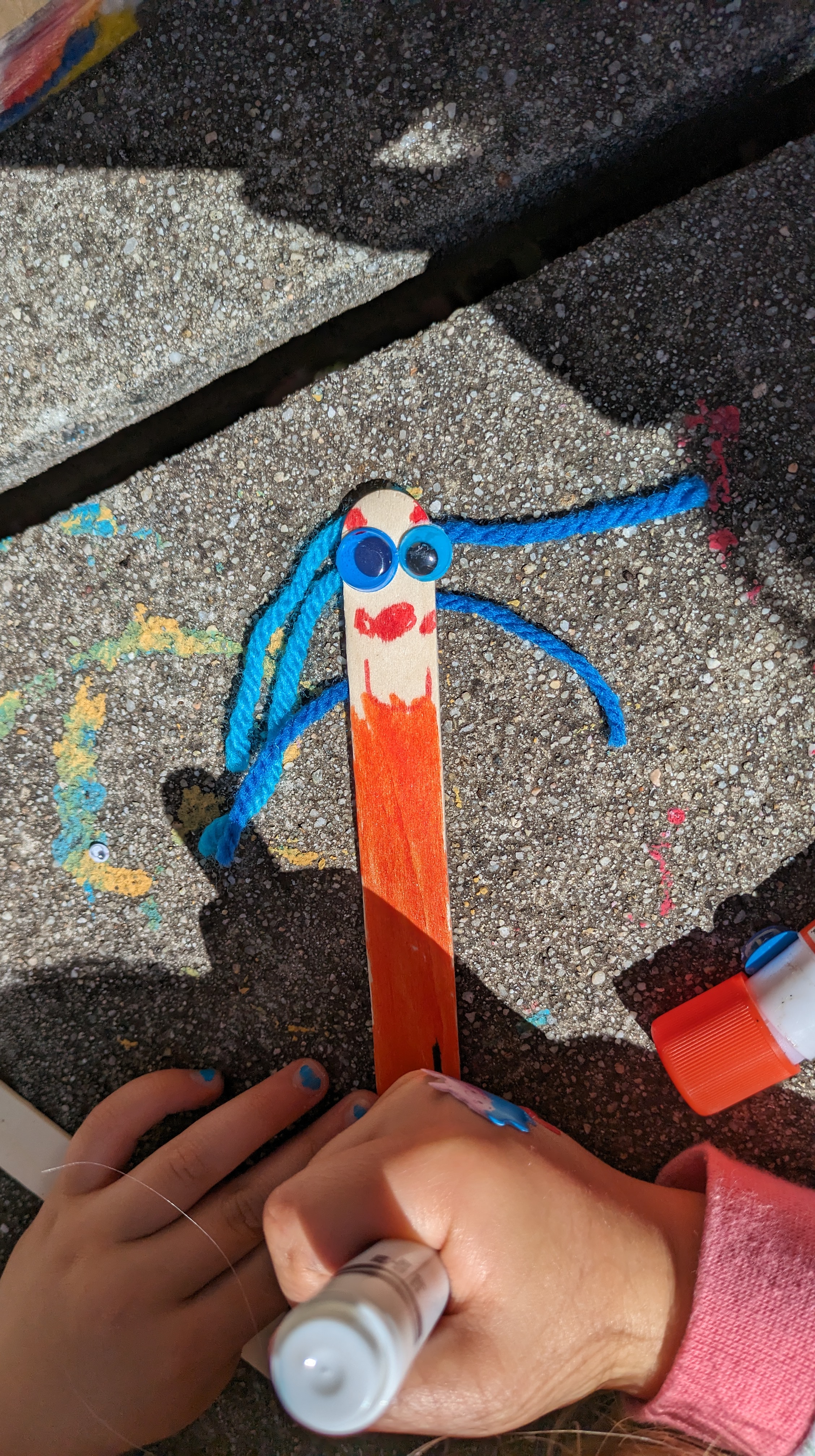
For the Stay & Play, we put out jumbo craft sticks, pieces of yarn in different colors, glue sticks, googly eyes, and markers, for the kids to make families (their own, or one they invented). Some of them were very determined to make sure every member of their family was represented.
Do you have favorite books about families having fun together? Please share them in the comments below.
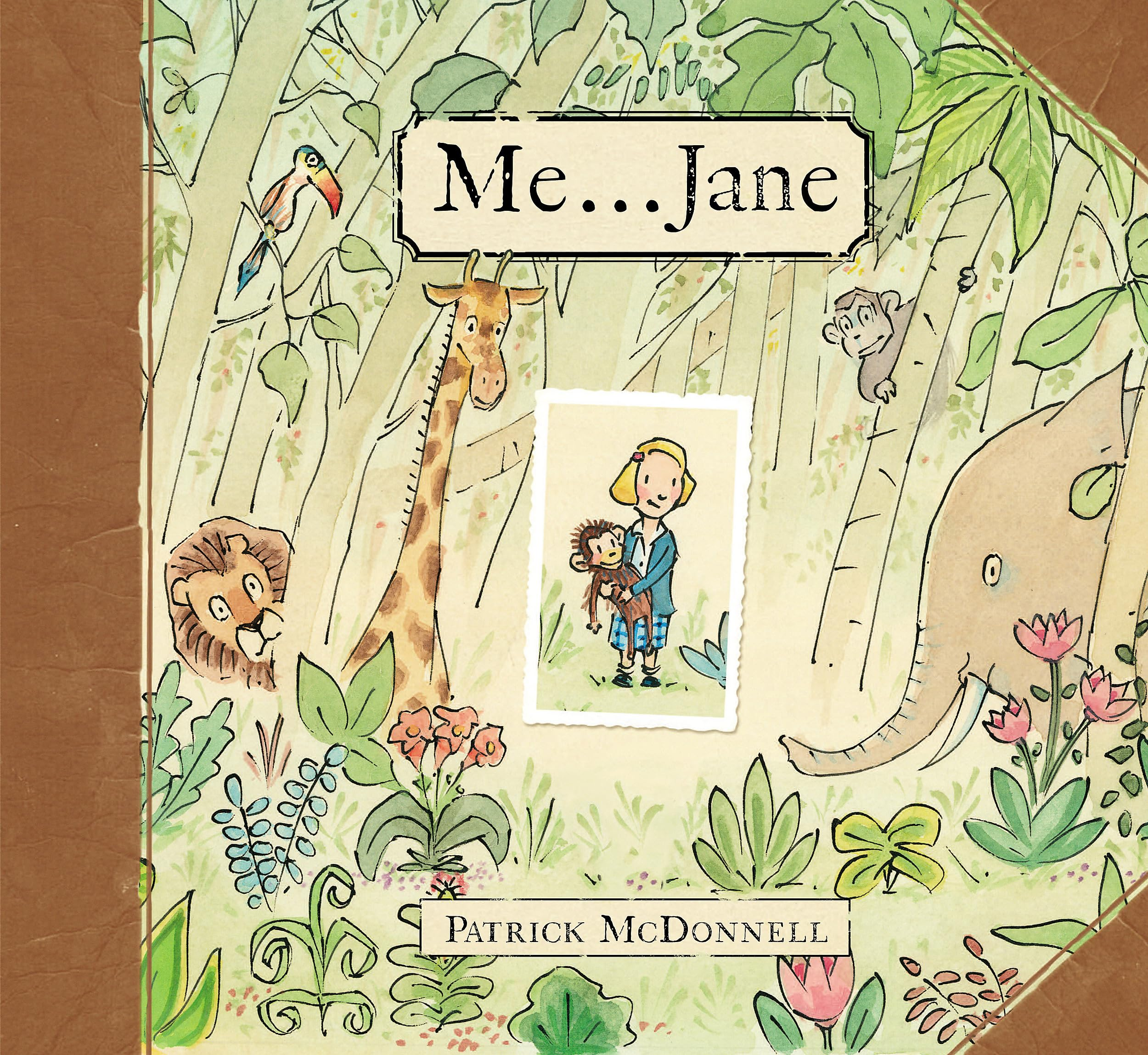
I love picture book biographies, and this is one of the few that is short enough to read with preschoolers. It tells the story of Jane Goodall, who dreamed of living with wild animals when she was a young child, and grew up to see her dream come true.
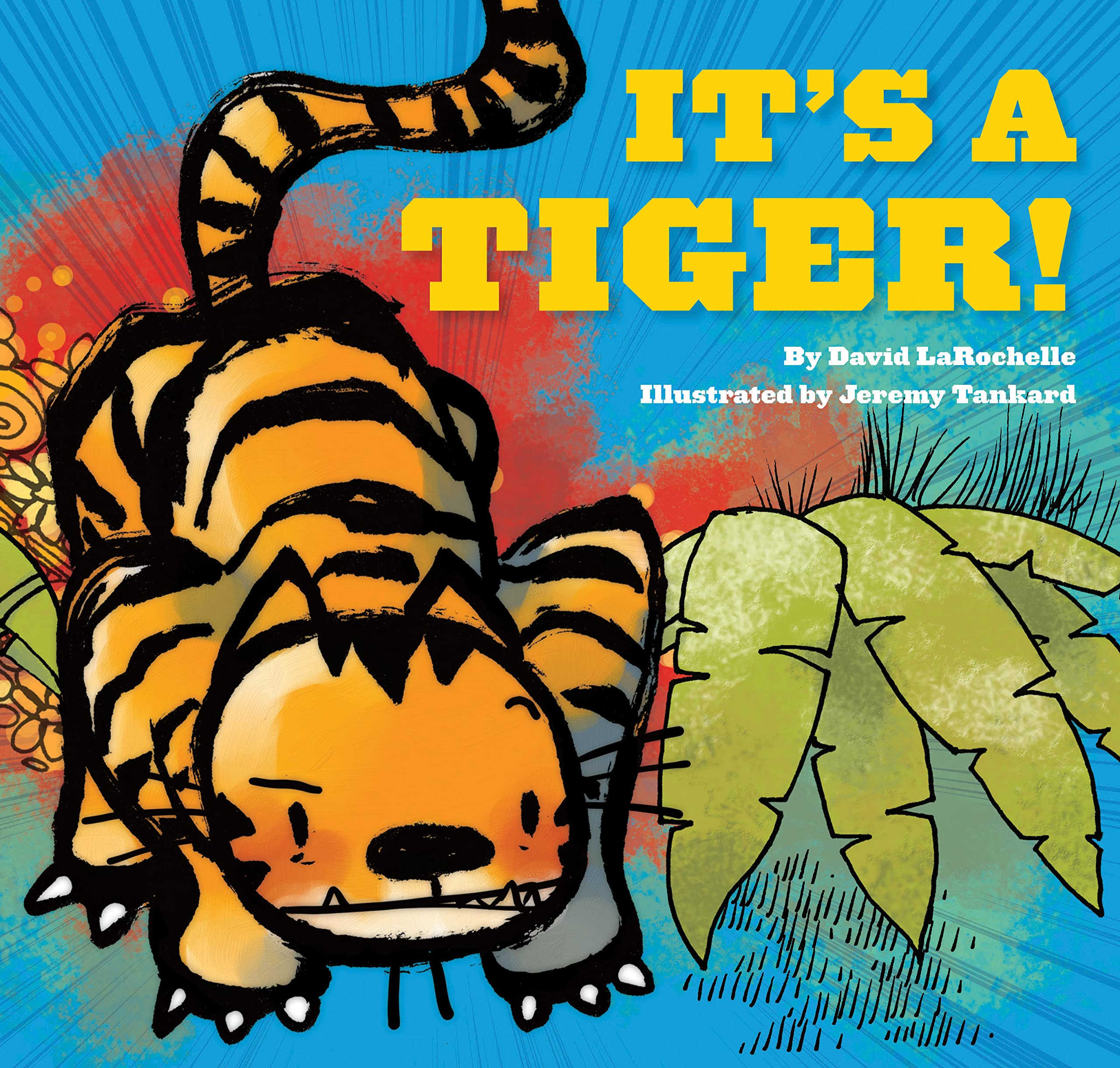
It’s a Tiger! by David LaRochelle; illustrated by Jeremy Tankard
Fun, colorful adventure that imagines a journey into the jungle, where the narrator is constantly being surprised by a tiger (RUN!). After several narrow escapes, the tiger is discovered to be friendly. This one was a big hit with the kids.
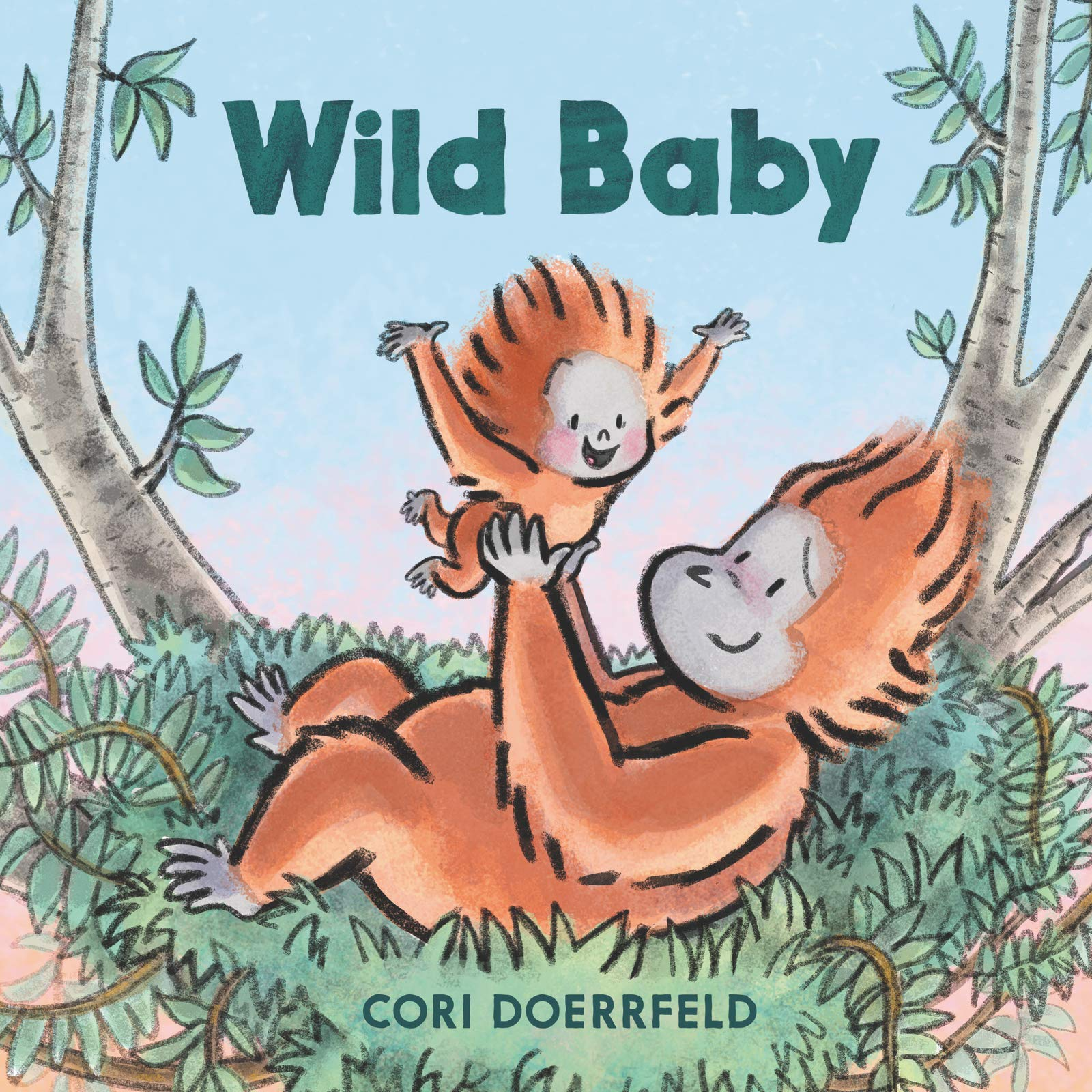
Very cute rhyming story about a baby orangutan who wanders off after a blue butterfly.
Rhymes & Songs:
Monkey See and Monkey Do
When you clap, clap, clap your hands,
The monkey clap, clap, claps his hands,
Monkey see, and monkey do,
The monkey does the same as you!
Repeat with other motions: jump up and down; make a funny face; turn yourself around; and sit back on the ground.
Five Little Monkeys Sitting in a Tree
Five little monkeys sitting in a tree,
Teasing Mr. Alligator,
“Can’t catch me!
You can’t catch me!”
Along comes Mr. Alligator
Quiet as can be, and…SNAP
That monkey right off the tree!
Kids LOVE this fingerplay rhyme for some reason. I like to do it with the Monkee Mitt and an alligator puppet. Whenever the alligator chomps a monkey off the tree, I have it spit it out into the crowd and say, “Yuck! That monkey tastes terrible!” which always gets big laughs. The kids enjoy gathering up the monkeys and putting them back on the mitt at the end.
Going on a Tiger Hunt
Instead of the usual bear hunt, we went on a tiger hunt. This is a great way to give the kids a chance to move around in between books. I like to ham it up by pretending to get a grasshopper stuck in my shirt, wiping the mud off my feet, and shaking myself dry from the lake. There are lots of variations, but this the script I use, with the kids repeating every line:
We’re going on a tiger hunt! (We’re going on a tiger hunt!) It’s a beautiful day! (It’s a beautiful day!) We’re not scared! (We’re not scared!)
We’re coming to some grass. (We’re coming to some grass). Can’t go over it. (Can’t go over it.) Can’t go under it. (Can’t go under it.) Have to go through it. (Have to go through it.) Swish! Swish! Swish! Swish! (Rubbing hands together)
We’re coming to some mud. (We’re coming to some mud.) Can’t go over it. (Can’t go over it.) Can’t go under it. (Can’t go under it.) Have to go through it. (Have to go through it). Squilch! Squelch! Squilch! Squelch! (Clapping hands together).
We’re coming to a lake. (We’re coming to a lake.) Can’t go over it. (Can’t go over it.) Can’t go under it. (Can’t go under it.) Have to swim across it. (Have to swim across it.) Splish! Splash! Splish! Splash!
We’re coming to a cave. (We’re coming to a cave.) Can’t go over it. (Can’t go over it.) Can’t go under it. (Can’t go under it.) Have to go inside. (Have to go inside.) Tiptoe…tiptoe…tiptoe…tiptoe… It’s dark in here… (It’s dark in here…) It’s cold in here… (It’s cold in here…) Two yellow eyes…it’s a tiger!
Run! Swim across the lake! Run through the mud! Run through the grass! Into the house! Slam the door! Lock it! We’re never going on a tiger hunt again!
The Lion Sleeps Tonight
The Lion Sleeps Tonight by Solomon Linda
We did this as our instrument play-along at the end. Here’s a YouTube link to the version by The Tokens if you’re not familiar with the tune (there are lots of variations):
[C] Wee-ee-ee-ee ee [F] ee-ee-ee-ee [C] wee-oh weem a-[G7]way. [C] Wee-ee-ee-ee ee [F] ee-ee-ee-ee [C] wee-oh weem a-[G7]way.
[C] In the jungle, the [F] mighty jungle, The [C] lion sleeps to- [G7]night. In the [C] jungle the [F] quiet jungle, The [C] lion sleeps to-[G7]night.
[C] Wee-ee-ee-ee ee [F] ee-ee-ee-ee [C] wee-oh weem a-[G7]way. [C] Wee-ee-ee-ee ee [F] ee-ee-ee-ee [C] wee-oh weem a-[G7]way.
Near the [C] village, the [F] peaceful village, The [C] lion sleeps tonight. Near the [C] village, the [F] quiet village, The [C] lion sleeps to-[G7]night.
[C] Wee-ee-ee-ee ee [F] ee-ee-ee-ee [C] wee-oh weem a-[G7]way. [C] Wee-ee-ee-ee ee [F] ee-ee-ee-ee [C] wee-oh weem a-[G7]way.
Hush, my [C] darling, don’t [F] fear, my darling, The [C] lion sleeps to-[G7]night. Hush, my [C] darling, don’t [F] fear, my darling, The [C] lion sleeps to-[G7]night.
[C] Wee-ee-ee-ee ee [F] ee-ee-ee-ee [C] wee-oh weem a-[G7]way. [C] Wee-ee-ee-ee ee [F] ee-ee-ee-ee [C] wee-oh weem a-[G7]way.
Stay & Play: Paper Plate Pythons
I found this craft on Craftymornings.com, although I did it slightly differently. It was messy, but a big hit, and several adults commented on how much they liked it.
Before the storytime, I cut paper plates into spiral snake shapes, and cut squares of bubble wrap roughly 6″ x 6″.
For the Stay & Play, I put out the paper plates snakes, the bubble wrap squares, Tempera paint, glue sticks, googly eyes, and some strips of red paper for the tongues.
For each child, I helped them put a small blob of two different colors of paint on the bubble wrap. Then I showed them how to fold the bubble wrap square in half and squish the paint around before opening it up and stamping it on their paper plate snake. In most cases, the paint was wet enough to hold the googly eyes and paper tongue, but I provided glue sticks just in case.
What are your favorite books or songs about rainforest animals? Please share them in the comments below.
We had a very special guest at our Outdoor Musical Storytime today–a wild turkey! It was fitting for a storytime at the beginning of November, and also because our theme was an ancient ancestor of the turkey: dinosaurs!
We almost cancelled today, because it had been raining overnight and the ground was still a bit damp. But since the skies were clearning, we decided to give it a try. I posted a picture of the picnic area on a couple of Facebook groups for local families, explaining that we were still holding storytime, but to be sure to bring a towel or blanket to sit on. I also mentioned our Dinosaur theme, so one little boy showed up with his prized dinosaur collection!
Crunch, the Dinosaur, is very shy, and likely to hide if you say “Hello” too loudly. This is a fun, interactive book that asks the kids to sing “Happy Birthday,” shout their names, and say “Goodnight,” as Crunch slowly warms up to them. This was a great way to get my shy group talking.
Groovy Joe is a lot like Pete the Cat, especially since the books are written by the author of the first few Pete books. In this one, Groovy Joe is preparing to enjoy his favorite ice cream, and singing his song “Love My Doggy Ice Cream!,” but he keeps getting interrupted by hungry dinosaurs. But that’s okay because, as Joe says, “It’s awesome to share!” The kids loved chiming in on the ROARs, and the families were singing along with the song every time.
I love to throw in pop-up books whenever I can, because the kids are always mesmerized by them. In this colorful, rhyming picture book the dinosaurs pop off the page in surprising ways. It was fun to ask the kids to name some of the more recognizable dinosaurs.
SONGS:
If You’re Happy and You Know It
This one fit well with Crunch, the Shy Dinosaur, because we sang about lots of different emotions: If you’re sad and you know it, cry “Boo hoo!”; If you’re angry and you know it, say “I’m mad!”; If you’re shy and you know it, hide your face…peek-a-boo!
The chords are:
If you’re happy [C] and you know it, clap your [G7].
If you’re happy and you know it, clap your [C].
If you’re [F] happy and you know it,
And you [C] really want to show it,
If you’re [G7] happy and you know it, clap your [C] hands.
IfAll the Raindrops
The perfect song for our recent weather, and as a follow-up to Ice Cream and Dinosaurs. I asked for suggestions of favorite foods, so we made the rain into gummy bears and pasta, and pizza and grapes. Here’s an old video I made for the tune:
[C] If all the raindrops were [G7] lemon drops and [C] gum drops,
Oh, what a rain it would [G7] be.
[C] I’d stand out- [G7] side with my [C] mouth open [G7] wide,
For our Stay and Play activity, we gave the kids paper plates and small handfuls of Crayola Air Dry Clay, and showed them how to flatten their clay into a small disc on the plate. Then we gave them toy dinosaurs, so they could press the footprints into the clay, or lay them on their sides to make a full body print. We also encouraged them to decorate their clay with leaves from around the park. This turned out to be a lot of fun! Thank you to Big Happy House for this idea. You can also do this craft with Salt Dough, which is cheap and easy to make.
What are your favorite dinosaur books or songs? Please let me know in the comments.
I haven’t done a storytime write-up in a while, but the kids really enjoyed this one. There have been a number of fun picture books about knitting and yarn published over the past few years, and, with my Family Storytime group now including several elementary school-aged kids, I thought I would give them a try. Here’s what we read:
This is a simple, but adorable story about a cat whose owner brings home a new “friend,” named Yarn. Cat enjoys playing with Yarn very much, until one day his owner transforms Yarn into an unpleasant new shape, a sweater she expects Cat to wear. The illustrations made the kids laugh out loud.
Extra Yarn by Mac Barnett; illustrated by Jon Klassen
This is one of my favorite books to read aloud, because the kids are always held spellbound by the story. When Annabelle finds a box of yarn, she knits sweaters for everyone in her family, her class, and her entire town, but mysteriously still has extra yarn, until a devious archduke steals her magic yarn box. The colorful illustrations by Jon Klassen are whimsical and funny, and the text builds suspense until the end.
Sweet story about two penguins looking for love, until their animal friends hatch a plan to help them find their missing yarn, and each others. The kids got a kick out of the illustrations, especially the whale in a sweater.
A funny, rhyming book about a herd of sheep who go looking for the wool Farmer Brown has taken from them, and are shocked at the various ways it gets transformed. This is a clever way to teach kids the steps involved in turning wool into yarn, with hilarious illustrations. The kids loved the illustration of the sheep in their colorful sweaters.
CRAFT: Pulled String Art/Finger Knitting
I had planned to have the kids do Pulled String Art, based on this post from Artful Parent: https://artfulparent.com/pulled-string-art-is-mesmerizing-and-addictive/ . But since I’ve been having some second and third graders at my Family Storytimes lately, I thought I would also demonstrate some Finger Knitting, a favorite activity of my daughter’s (there are lots of online videos and instructions, but this one simplifies it a bit: https://www.thecrafttrain.com/finger-knitting-for-kids/). To my surprise, all the kids except for one toddler wanted to try their hand (literally) at finger knitting, with varying degrees of success. The all LOVED trying though, even if their finished product looked more like a ball than a scarf. I think I’ll bring the Pulled String Art back another time though, because it is also a lot of fun, if a lot messier than finger knitting.
Deliciously wry and beautifully illustrated story of a princess whose father keeps her locked away in a tower to keep her safe. When she is given a mysterious box of yarn for her birthday, she knits herself a red wolf suit and transforms into a red wolf herself, bursting from the castle to have a wide time out in the world. But when the suit unravels, she is captured and returned to her tower, where she knits her father a pair of rather mousy pajamas. Reminiscent of Maurice Sendak, but with a style all its own.
I couldn’t get by without mentioning this classic picture book by Jan Brett, about a lost mitten that serves as a shelter for an astounding variety of animals of different sizes. Kids love the pictures along the side, revealing which animal will appear on the next page. Jan Brett also has a wonderful web site (http://www.janbrett.com/index.html), full of activities and information for kids.
Do you have any other favorite books about knitting? Please share them in the comments.
Very sweet picture book about a bear who opens a box and decides that he has found a perfect gift for his friend Mouse. But the other animals who look inside are not impressed. Spoiler alert: The box is actually empty, but it turns out to be exactly the right size to be a cozy spot for Mouse. This one got lots of “Awww’s” from the group (especially the parents).
Sadly this book appears to be out of print, which is a shame because it has a lot of kid appeal. After her new vacuum arrives, Mom receives a new delivery on the doorstep, with something very special inside. The book features large flaps for kids to open as the contents of the box are slowly revealed. I love this book because my daughter used to love to hide inside boxes to surprise me.
This is actually an easy reader, but one that works well as a read-aloud. The tricks Fox plays on his good friend Pig all end up back-firing in painful ways. A funny book, told in rhymed verse.
The companion to Not a Stick, this picture-driven book shows all of the different ways a box is transformed by a rabbit’s imagination. The kids always like guessing what the box will turn into next: a rocket, a pirate’s ship, a mountain, etc.
CRAFT: Paper Box
Paper Box by Brandon
There are lots of templates online for making paper boxes. I used this one from Pinterest. I cut the template out ahead of time and gave the kids markers to decorate them before gluing them together with glue sticks (the parents helped with assembly). The kids were really happy to have their own little boxes.
When Spencer’s Mom orders him to get rid of some of his many, many toys, they are both in for a long day of negotiations. But then Spencer discovers the best toy of all…
I’m sad that this book is out of print, because it’s always been a hit with my storytime families. A young girl wishes she could package herself up and send herself to her loved one who is far away. Sweet, rhyming book with beautiful illustrations.
In honor of April Fool’s Day, for this week’s Family Storytime, we read books about jokes and tricks. This was a fun theme, and all the books were snatched up and checked out at the end. Here’s what we read:
A great introduction to knock knock jokes for toddlers and preschoolers, with comical animal illustrations. I love to read this book at storytimes because it’s so interactive. Even the parents enjoy saying “Who’s There?”
I first heard this book read by a children’s librarian named Mary Ann Schlitz when I was just starting out doing storytimes, and I was struck by how well she did the voices for each character. It’s been one of my favorite read-alouds ever since. When a little mouse warns a frog that “Big Bro is Coming!” it starts a panic that spreads throughout the jungle. Each animal makes Big Bro out to be rougher and bigger, until they are all cowering in terror. When Big Bro finally appears, he turns out to be…a mouse! The big, colorful illustrations and dramatic story make this book perfect for just about any age. I usually have the kids stretch their arms out every time a character says “THIS BIG!”
Yet another terrific Gerald and Piggie book, and one that worked perfectly for this theme. When Gerald and Piggie see two squirrels playing a game where they try to scare each other, they decide to try it on each other. This book always gets big laughs, especially on the page where Gerald and Piggie jump out at the same time and scream in terror.
Bob Shea is another favorite picture book author of mine. I learned about this new title of his from my friend Kerri’s blog, MLReads.com. Buddy the monster really wants to eat the adorable little white bunnies, but somehow the bunnies always manage to divert him onto something else: making cupcakes, going swimming, or going to the fair. Hilarious read-aloud that always gets groans and laughs at the punchline.
SONGS:
There were a number of wandering toddlers at storytime this week, so I ended up doing songs after each book to keep them engaged:
Shake My Sillies Out: My standard opening song. I always pretend to fall asleep in the “Yawn my sleepies out” verse, and the kids yell, “Wake up!” Here’s a video of the original version by Raffi.
Aiken Drum: I had the kids suggest different foods to make the parts of Aiken Drum’s face. Here are the lyrics with the uke chords in parentheses (If this key is too high, you can also play it in C with C, F, and G7). Click on the triangle below to hear the tune:
(D) There was a man lived (G) in the moon (D) In the moon, (A) in the moon.
There (D) was a man lived (G) in the moon,
And his (D) name was (A) Aiken (D) Drum.
Chorus:
And he played upon a ladle, a ladle, a ladle,
He played upon a ladle, and his name was Aiken Drum.
His eyes were made of meatballs, meatballs, meatballs,
His eyes were made of meatballs, and his name was Aiken Drum
His nose was made of cheese….
His hair was made of spaghetti… etc.
There’s a Spider on the Floor: I have a big spider puppet that I brought out for this one, and I carried it around to put lightly on each kid’s leg, neck, head, etc. I’ve changed the verses a little from the Raffi version. Instead of “There’s a spider on your stomach,” I do “There’s a spider on your tummy, on your tummy…Oh, you look so very funny, with that spider on your tummy.” And instead of “I wish that I were dead, I’ve got a spider on my head,” I sing, “Oh, it fills my heart with dread to see that spider on your head…” But otherwise I keep it the same.
Little Bunny FooFoo: Great song for getting the kids on their feet and jumping around. Here’s an animated video by Hannah Heller with the lyrics.
An incredibly simple craft based on the French tradition of sticking paper fish on people’s backs on April First as a joke (Poisson d’Avril). You can read more about the history on FranceTravelGuide.com. For the fish, I printed out a basic template from AllKidsNetwork.com, and gave the kids markers and crayons to decorate it, and tape to make it sticky. They had the best time trying to stick the fish on each other and on all the grown-ups.
One of the best examples of a trickster tale, featuring Anansi the Spider, the mischievous West African god. When Anansi discovers that a certain rock in the jungle knocks people unconscious when they say, “Isn’t this a strange moss-covered rock?”, he uses it to trick all the other animals and steal their food. But all the time, Little Bush Deer is hiding and watching, and planning a trick of her own. This is a terrific read-aloud. Kids love joining in on the “KPOM!’s” whenever an animal falls for the trick. Plus Janet Stevens has cleverly hidden Little Bush Deer on almost every page for kids to find.
A clever and hilarious parody of traditional riddle books. Each page uses rhymes, clues, and silhouettes to lead readers to an obvious answer, only to surprise them with something completely random. For example: Who’s furry, scurries, and has fleas?/Who climbs our counters and eats our cheese?/We’ve set up traps throughout the house/But still can’t catch that pesky…Viking!”
The classic classroom story about sweet Miss Nelson, who is mysteriously replaced by the evil Miss Viola Swamp. The best thing about this book is the way it leaves it up to the reader to solve the mystery. I also love that James Marshall based his depiction of Miss Viola Swamp on his own horrible second grade teacher who laughed at his drawings (you can read about it in this Horn Book interview). I have also read that Marshall gave up drawing for years afterwards. Thank goodness he regained his confidence as an adult! He certainly had the last laugh.
What are your favorite picture books about jokes and tricks?
This year, Chinese New Year begins on January 31, and it’s the year of the Horse (you can find a list of all the animal signs and dates on TravelChinaGuide.com).
I didn’t know much about Chinese New Year until we moved to the Bay Area, but it’s such a fun and colorful celebration. At my son’s school, each Kindergartner decorates a box in bright colors, with holes in the front so they can wear the box on their heads and still see out. One of the teachers wears a big dragon’s head, and the kids line up behind her, making a huge 60-person dragon that winds around the play-yard, while the first graders pop big sheets of bubblewrap behind them. It’s something the whole school looks forward to every year.
For storytime this week, I read books about horses and Chinese New Year.
This one was new to me, but the kids always love Lift-the-Flaps (although they argue over who is going to get to open them). It’s a simple rhyming book that explains the different parts of the New Year celebration: sweeping away the old year, buying fish and flowers at the market, getting red envelopes, and of course, enjoying the big dragon parade. The illustrations are warm and colorful. A good introduction to the holiday for toddlers on up.
This is actually a board book, and unfortunately out of print, but it’s a great horse book, especially for younger kids (I read it again today to both a preschool class, and a toddler storytime, and they all loved it). Mr. Horse offers a cat, a dog, a pig and a duck a ride on his back, but when he gallops too fast, and then stops suddenly, they all fly off into a haystack. The kids enjoy saying the repeated, “Clip Clop! Clippety Clop” lines.
Okay, I know unicorns are not horses, but I thought the kids would love this one, and they did. It was the clear favorite of the evening, for the 5 year-olds especially. Goat is jealous of Unicorn, and why wouldn’t he be? Not only can Unicorn fly, he makes it rain cupcakes! But when Goat finally meets Unicorn, he finds that he’s got some special talents of his own that Unicorn admires, and to Goat’s surprise, they end up becoming friends. I love all of Bob Shea’s books, especially I’m a Shark and Oh, Daddy!
This is the book for little girls who love horses. I would have been all over it as a kid. The little girl in this story wants a pony more than anything else in the world, but her parents say a pony is too expensive, and they don’t have room for it. So she draws a pony instead, a beautiful dapple-gray she calls Silver, and together they fly through the sky and meet lots of other ponies. The illustrations are gorgeous.
SONGS:
Giddy-up!
I do this one often as a bouncing rhyme for babies and toddlers. This time I had the kids gallop in a line around one of the bookshelves. They especially liked the sudden “Whoa!” when we would all stop short. You sing it to the tune of The William Tell Overture:
I adapted this craft from AHC Arts & Crafts, which has a tremendous number of craft ideas. I printed their template, but since I wanted the kids to be able to color their rocking horses however they liked, I traced the template onto white card stock and cut it out (I had to redraw the lines for the base). I folded the paper in half before I cut it, so it would make a mirror image of the horse. Then I folded it over, so the two horse shapes lined up.
I gave each child a pre-folded horse to color in with markers on both sides, and a paperclip to put on the back, clipping the two horse shapes together. If you bend the bottom of the two horses slightly apart, it will stand up. If you touch the tail lightly, it will rock just like a real rocking horse.
This is the book I usually read for Chinese New Year, and I still love it. It’s shows a family preparing for the New Year by sweeping their house, making get-rich dumplings, getting haircuts, and looking forward to seeing the dragon, which is presented on pages that fold out into a big spread at the end. In the past, I’ve brought bubblewrap for the kids to pop on the page with the firecrackers. Simple enough to work for toddlers as well as preschoolers and older kids.
I didn’t get this book in time for my storytime, but it’s a good one. A Chinese-Korean boy shares what the New Year means to him and his friends from other cultural backgrounds. I like that the story gives a sense of having a fresh start: a chance to clear away all the mistakes of the past and look forward to the future. A little too lengthy for toddlers, but I think this would work well for preschoolers and elementary school kids.
Sapphira writes, “Our daughter is a dragon, but this book describes a child who has a good trait from each of the signs. Then at the end it says how lucky the reader is to have this particular baby, and there’s a heart-shaped mirror on the last page, which is always a big hit.”
When Roy gets a saddle for his birthday, he sets out to find a horse. The problem is, he doesn’t know what a horse looks like. Kids like shouting out the names of the other animals he thinks might be a horse, including a snake, a crab, a lion, and a zebra. Plus it has a funny surprise ending.
What are your favorite horse or Chinese New Year picture books?
Every January, I try to do a series of storytimes related to the upcoming announcement of the newest winner of the Caldecott Medal. This year’s winner will be announced on Monday, January 27 at the Midwinter Meeting of the American Library Association.
This week, I read some of my favorite Caldecott Medal Winners from previous years, both for my Family Storytime, and to two classes of second graders. But before I get to those, it occurred to me that I had never thought to wonder who Randolph Caldecott was, and how the award came to be named after him. So I looked him up.
According to the Randolph Caldecott Society UK web page, Caldecott was a British artist, who lived from 1846-1886, and was known for his children’s book illustrations. Every year, he would select or write a collection of stories and rhymes, which he would illustrate and publish at Christmastime. The books were enormously popular, and brought him international fame. Like many of the best children’s authors and illustrators (Dr. Seuss, Maurice Sendak, Margaret Wise Brown, and Beatrix Potter to name a few), Caldecott never had children of his own. Sadly, he suffered from heart problems and gastritis, and died a few weeks before his 40th birthday, while traveling in St. Augustine, Florida.
I haven’t been able to find an explanation for why the American Library Association in 1937 decided to name the medal after Randolph Caldecott. After all, according to the guidelines, the award-winning artist “must be a citizen or resident of the United States,” and Caldecott was British. Why not name it after an American illustrator like Johnny Gruelle, Wanda Gág or N.C. Wyeth? My only guess is that it had to do with the quality of Caldecott’s illustrations, and the seamless way he integrated them with the text. Maurice Sendak is quoted as saying, “Caldecott’s work heralds the beginning of the modern picture book. He devised an ingenious juxtaposition of picture and word, a counterpoint that never happened before. Words are left out—but the picture says it. Pictures are left out—but the word says it.” And that is the quality that defines the best picture books.
I just learned about a new book by Leonard Marcus entitled Randolph Caldecott: The Man Who Could Not Stop Drawing. I will have to check it out to find out more, especially after reading this intriguing conversation between Leonard Marcus and Brian Selznick, winner of the 2008 Caldecott Medal (I love to show kids Selznick’s book The Invention of Hugo Cabret, which is not a picture book, but a 533 page heavily illustrated novel). In the meantime, you can see samples of some of Caldecott’s illustrations on the Randolph Caldecott Society web site.
But now, back to the storytime. After I explained the Caldecott Medal to the kids, and showed them the seal on the covers of the winning books, I read these:
It amazing the range of reactions I get whenever I read this book aloud. I remember sharing it with some second grade classes last year where some of the kids were very nervous. In one class, every time the little fish bragged about his certainty that the big fish whose hat he stole would never find him, this one boy would say, “No! Don’t say that! He’s going to eat you!” This year, though, all the second graders laughed. The Kindergartners at storytime, however, looked concerned. The fish is so shockingly naughty and brazen (although, of course, most of the best and most memorable children’s book heroes are naughty). The beauty of the book, though, is that the ending is unspoken. Klassen leaves you with the image of the big fish wearing his hat, and leaves the rest to your imagination. So when I asked my storytime group what happened at the end, they said, “The big fish got his hat back.” The second graders, on the other hand, said, “The little fish got eaten.”
I think about this book every time I stand on a swivel chair, which I do often, in spite of this being in part a cautionary tale about that very thing. My only complaint about this book is that it’s really one you want to sit down with and pore over by yourself, to enjoy all the humor in the illustrations, and some of that gets lost in a storytime setting. But the kids love it anyway. At my family storytime, many of them exclaimed over it when they first saw me pull it out of the stack, so clearly they had heard it before (and hopefully had a chance to look at it up close). Officer Buckle’s safety speeches suddenly become a big hit at schools when he is partnered up with a new police dog named Gloria, until Officer Buckle discovers why. This is a wonderful story about a friendship and the importance of working together, and it has great safety tips besides.
I remember being surprised the first time I saw this book, because the style was so drastically different from Henkes’ other books like Chysanthemum and Lilly’s Purple Plastic Purse. But since then, this has become one of my favorite read-alouds (along with A Good Day, which is perfect for toddlers). The language in this book is so simple, and compelling: ”It was Kitten’s first full moon. When she saw it, she thought, there’s a little bowl of milk in the sky. And she wanted it.” The story is funny because of all of Kitten’s mistakes and accidents, but you also feel her frustration, so it is deeply satisfying when she comes home wet and exhausted to find her own bowl of milk on the porch. There was a little tussle over who was going to get to check this one out after I read it.
I’ll admit, I hadn’t ever noticed the mouse and the red balloon that appear several times throughout this book, until one of the second graders pointed them out. And then I was instantly transported back to reading Goodnight, Gorilla by Peggy Rathmann with my son when he was small, and trying to find the red balloon and mouse on every page. It’s a subtle reference, but I loved it. The kids loved the pictures of the zoo animals packed into the bus to visit their sick zookeeper friend, and the idea of the owl being afraid of the dark.
SONGS:
1,2,3,4,5, I Caught I Fish Alive
B-I-N-G-O To go along with Officer Buckle and Gloria, I brought out the library’s St. Bernard hand puppet (who likes to lick people’s faces), and we barked the missing letters.
INSTRUMENT PLAY WITH A CD:Old MacDonald Had a Farm by Rufus Thomas from Sing Along with Putumayo (Amazon.com link) This rock-and-roll version of Old MacDonald is always fun.
CRAFT: This is Not My Hat Collage
For this craft, I cut out pieces for the kids to color and assemble the little fish from This is Not My Hat, and brought some plants from my yard for them to glue down.
I originally had a crazy idea for taping the fish to a piece of yarn, and cutting a slit in the paper, so it would look like the fish was disappearing behind the plants when you pulled the yarn. But I would have needed thicker paper, and it seemed to complicated for the short time the kids had to assemble the craft. Still, I mocked it up with my daughter, and even though we tried it with construction paper, which is flimsy, she still had a lot of fun playing with it.
I drew the fish shapes freehand, and they’re not great, but if you’d like the template, you can print it out here: fishtemplate
OTHER BOOKS:
Along with A Sick Day for Amos McGee and This is Not My Hat, I read these four books to some second grade classes this week:
This is one of my absolutely favorite Caldecott winners to read aloud, although I usually share it with older kids. In 1974, Philippe Petit walked, danced, ran, and lay on a tightrope across the Twin Towers. It was an illegal act, so he and some friends disguised themselves as construction workers, then carried the 400 pound cable up the elevator, and then up ten flights of stairs to the roof. Getting the wire across the gap was a harrowing experience all its own, and at one point, the cable fell, pulling Petit’s friends in the other tower to the edge of the roof. And then he stepped out onto the wire, a quarter of a mile above the ground. The illustrations in this book are dizzying. The kids are always transfixed. And even though Petit broke the law (yes, another naughty character, but a real one!), he did so ready to face the consequences. After he stepped off the wire, he held out his hands for the cuffs. He was sentenced to perform in Central Park for free. There is one line at the end of the book that says, “Now the towers are gone,” and always, always the kids ask why. The first year I read it, I wasn’t prepared, and in the pause while I tried to frame my answer, I could hear a bunch of kids exclaiming to each other the bits of information they knew. Fortunately, I knew that this year on September 11 the principal at the school had spoken to all of the classes in the school, explaining about the tragedy, and telling the kids that they should “remember the heroes.” So this time, when the question came, I was able to remind them of that, and, while I’m sure they still had questions, they seemed to accept that. That question is the only reason I haven’t read this book at my regular storytime, since I’m not sure how comfortable my storytime parents will be with whatever explanation I give, and the inevitable questions that will follow. But otherwise, this is an exhilarating book, and one of the best examples of a nonfiction picture book I know.
I shared this book with the second grade because I wanted to show them that they all knew at least one Caldecott winner. This book is so much a part of our popular children’s culture now (most of the kids had seen the movie too), but I also wanted them to stop and think about how revolutionary the book and the art were when it first came out. Max is the ultimate naughty character, fulfilling that fantasy all kids probably have of running away and going wild. I like to mention how controversial this story was, even down to the last line. In an interview, Sendak once talked about an argument he had with his editor, Ursula Nordstrom, “One of the fights I had with Ursula—and her whole office—though it seems silly now, was with the last line of the book [about Max’s dinner]: “and it was still hot.” It bothered a lot of people, and they wanted me to change it to “and it was still warm.” Warm doesn’t burn your tongue. There is something dangerous in “hot.” It does burn your tongue. Hot is the trouble you can get into. But I won.” We were lucky Sendak was always a bit like Max.
This was one of my favorite books as a child, and I still love it. Sylvester the donkey is thrilled to find a pebble that makes wishes come true, until he has a run-in with a dangerous lion, and accidentally wishes he were a rock. Steig really draws out the drama of Sylvester, helpless and alone on the hill as the seasons pass, while his parents worry and mourn. Of course, it has a joyfully happy ending, where the family is reunited, and they decide to lock the magic pebble away, at least for a while, realizing that now that they were together again, “they all had all that they wanted.” Before I read this book, I usually tell the kids that William Steig wrote the picture book Shrek, which, oddly, most of them have never seen, although most of them have seen the movies.
I made the mistake of reading this book last to one of the classes, and it was a bit too long. Still, it’s a fun collection of facts about the presidents, both the traits that many of them shared, as well as the things that made each one unique. The illustrations by David Small are colorful and funny, and there are some great quotes scattered throughout the text. My favorite is from Ulysses S. Grant, about his own musical ability, “I know only two tunes: one of them is Yankee Doodle, and the other isn’t.” This is a great book to share on President’s Day or around Election time.
You can find the complete list of Caldecott Medal winners here. Please tell me your favorites, and more importantly, who do you think will win this year?