Opposite Day: A Storytime About Opposites

This was a fun theme, and one I don’t think I’ve done before. Here’s what we did:

BOOKS:

Good News, Bad News by Jeff Mack

I love Jeff Mack’s books for their humor and simplicity. In this one, a rabbit and mouse are going for a picnic on a beautiful sunny day. “Good News!” the rabbit says, holding up the basket. Oh, but “Bad News!” the mouse replies, as it begins to rain. The book continues in this vein through ever worsening “Bad News,” situations: bees in the cake, a lightning storm, an angry bear. But the rabbit always finds some “Good News” to be happy about. The families enjoyed chiming in on the “Good News” and “Bad News.”

Big Bear, Small Mouse by Karma Wilson; illustrated by Jane Chapman

Very sweet addition to Karma Wilson’s Bear series. This rhyming book follows a group of animal friends through a series of opposites: Big Bear, Small Mouse; High Owl, Low Wren; Slow Badger, Fast Hair, etc. culminating in a cozy Warm Lair on a Cold Night. This one worked beautifully for our theme, and the kids loved joining in on the “Big Bear” at the end of each refrain.

Dinosaur Roar by Paul and Henrietta Stickland

Colorful, simple rhyming book about different types of dinosaurs, with opportunities for the kids to “ROAR!” Always a hit.

SONGS:

A lot of standard nursery rhymes work well for this theme including:

HICKORY DICKORY DOCK

I did this one with a mouse puppet, which I walked around the group to say hi to the kids before we sang the song:

Hickory Dickory Dock (clap hands in rhythm)
The mouse ran up the clock (run fingers up arm)
The clock struck one: BONG!
The mouse ran down (run fingers down arm)
Hickory Dickory Dock (clap hands)

…the clock struck two: BONG! BONG!
The mouse went “boo!” (cover eyes with hands, then peekaboo)

…the clock struck three: BONG! BONG! BONG!
The mouse went “whee!” (slide fingers down body)

TWO LITTLE BLACKBIRDS

Two little blackbirds sitting on a hill, (Hold up both thumbs)
One named Jack, and the other named Jill.
Fly away, Jack! (Put one thumb behind your back)
Fly away, Jill! (Put the other thumb behind your back)
Come back, Jack! (Bring the first thumb out in front).
Come back, Jill! (Bring the second thumb out in the front).

Two little blackbirds sitting on a cloud,
One was quiet, and the other was loud (I make my voice as loud and obnoxious as possible each time I sing the word “Loud!”)
Fly away, Quiet!
Fly away, Loud!
Come back, Quiet!
Come back, Loud!

Two little blackbirds sitting in the snow.
One flew fast!
And the other f-l-e-w s-l-o-w!…

Two little blackbirds sitting on a gate.
One was early,
And the other was…late!…  (I like to drag the pauses out as long as possible before saying “Late!” until the kids are all yelling it out.)

THE NOBLE DUKE OF YORK

I love this song because it works well for both toddlers/preschoolers, who can follow along on their own, and as a lapsit song for babies, whose parents can lift them up and down:

The noble Duke of York,
He had ten thousand men.
He marched them all to the top of the hill, (stretch up high)
And he marched them down again. (crouch down low)
And when you’re up, you’re up. (stretch up high)
And when you’re down, you’re down. (crouch down low)
And when you’re only halfway up,
You’re neither up, nor down. (stretch up high, then quickly crouch down)

He marched them to the left,
He marched them to the right,
He marched them all around and round,
Oh, what a silly sight!

STAY AND PLAY: Texture Collage

This was a simple activity, but both the kids and the caregivers got really into it. The idea was to explore textures that were opposites: sand (rough), paper (smooth), feathers (soft), and acorn caps, or other found objects from the park (hard). I put out gluesticks, play sand, and feathers. These were two examples where the caregivers drew out “surprises” in glue for the kids to discover when they poured the sand on their paper. Some of the older kids did elaborate patterns of their own.

What are your favorite books about opposites? Please share them in the comments.

Love Stories: A Storytime for Valentine’s Day

We had a fun Valentine’s Day storytime this morning at the park. Here’s what we did:

Books:

Love Monster and the Last Chocolate by Rachel Bright

Although this isn’t specifically a Valentine’s story, it is a funny, sweet friendship story that revolves around chocolate. When Love Monster arrives home from vacation, he is thrilled to find a box of chocolate waiting on his front doorstep. Before he opens it though, he wonders if he should share the chocolates with his friends. This leads him to worry about what would happen if there weren’t enough chocolates for everyone, or if someone else might eat his favorite chocolate, and he almost decides not to share them. In the end, he rushes out to share with his friends before he can change his mind, only to learn that they have already shared the chocolates from the box, and saved Love Monster’s favorite one just for him.

Click, Clack, Moo, I Love You! by Doreen Cronin; illustrated by Betsy Lewin

In this cute addition to the Click, Clack, Moo series, the animals on the farm are getting ready for the big Valentine’s Dance. Little Duck has decorated with streamers, and balloons, and made Valentine’s for everyone. When Little Fox follows the decorations down the hill to the party, all the animals stop dancing…until Little Duck gives Little Fox a Valentine, and they all dance together. Full of lots of opportunities for kids to join in on the “quack, quack, quack’s” and “yip, yip, yips.” Plus, the mice do The Hustle several times, so I invited the kids to join me for a few seconds of the Travolta Move while we sang part of The Hustle.

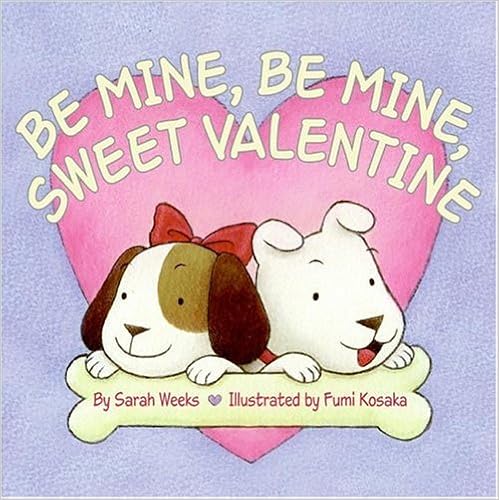
Be Mine, Be Mine, Sweet Valentine by Sarah Weeks; illustrated by Fumi Kosaka

Very cute rhyming Valentine’s book, which invites the kids to guess which Valentine gift would be best for each animal, with flaps that open to reveal the answer. The dog gets a bone, the cat gets cream, etc. The kids had fun guessing.

Songs:

If All the Raindrops

We sang this song after reading Love Monster and the Last Chocolate. After singing the first verse together, I asked the kids to suggest favorite foods to sing about for the next two verses. We sang “If all the raindrops were pizza and mac and cheese,” and “If all the raindrops were chocolate and ice cream.” Here are the lyrics and chords, and a YouTube link for the melody:

[C] If all the raindrops were [G7] lemon drops and [C] gum drops,

Oh, what a rain it would [G7] be.

[C] I’d stand out- [G7] side with my [C] mouth open [G7] wide,

[C] “Ah, Ah, Ah, [G7] Ah, Ah, Ah, [C] Ah, Ah, Ah, [G7] Ah!”

[C] If all the raindrops were [G7] lemon drops and [C] gum drops,

Oh, what a [G7] rain it would [C] be!

Skiddamarink-A-Dink-A-Dink

This song is always a favorite with both kids and caregivers. I go over the sign language for “I Love You” before we sing the song together. Here’s a link to a YouTube video from Super Simple Songs with the tune:

Skidamarink a-dink, a-dink
Skidamarink a-doo
I love you.
Skidamarink a-dink, a-dink
Skidamarink a-doo
I love you.
I love you in the morning
And in the afternoon.
I love you in the evening
And underneath the moon.
Oh, skidamarink a-dink, a-dink
Skidamarink a-doo
I love you.

Six Little Ducks

I sang this one after we read Click, Clack, Moo, I Love You, which featured lots of quacking. I invited the kids to waddle and quack with me. Click on the triangle below for the tune:

C                                  G7
Six little ducks that I once knew,
C
Fat ones, skinny ones, fair ones too.
G7
But the one little duck with the feather on his back.
C
He led the others with his “Quack! Quack! Quack!”

Chorus:
G7                                         C
“Quack! Quack! Quack! Quack! Quack! Quack!”
G7                                              C
He led the others with his “Quack! Quack! Quack!”

Down to the river they would go,
Wibble-wobble, wibble-wobble, to and fro.
But the one little duck with the feather on his back,
He led the others with his “Quack! Quack! Quack!”

Chorus

Home from the river they would come,
Wibble-wobble, wibble-wobble, ho hum hum.
But the one little duck with the feather on his back,
He led the others with his “Quack! Quack! Quack!”

Chorus

Old MacDonald

Claire held up the Monkey Mitt with the Old MacDonald animal set while we all sang the song together:

[C] Old MacDonald [F] had a [C] farm,

E-I- [G7] E-I- [C] O!

And on that farm he [F] had a [C] chicken,

E-I- [G7] E-I- [C] O!

With a cluck-cluck here, and a cluck-cluck there,

Here a cluck, there a cluck,

Everywhere a cluck-cluck.

[C] Old MacDonald [F] had a [C] farm,

E-I- [G7] E-I- [C] O!

Stay and Play: Dot Resist Hearts

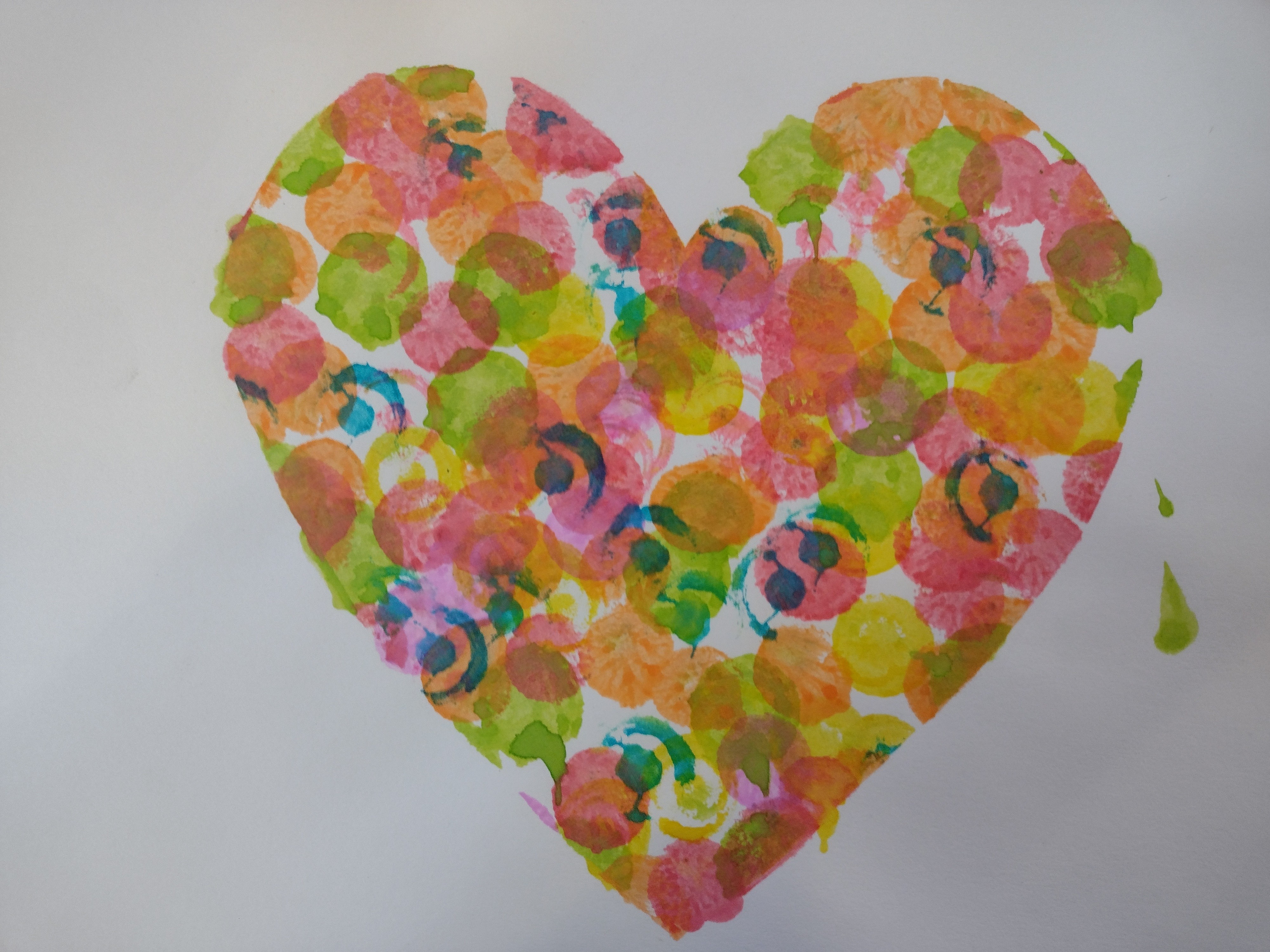
Paper heart taped onto blank cardstock, then decorated with Dot Markers

This was such an easy, fun activity. I adapted it from this Thumbprint Craft from A Dab of Glue Will Do, only instead of using thumbprints, we gave the kids Dot Markers. I cut hearts out of cardstock ahead of time, then taped them with removable tape onto blank cardstock. For some kids, I taped the outline of the heart to the paper instead.

The kids loved covering the pages with colored dots, and then peeling the top layer off to reveal the heart underneath.

What are your favorite picture books, songs, or crafts for Valentine’s Day? Please share them in the comments below.

Gung Hay Fat Choy: A Storytime for Lunar New Year

A beautiful Chinese dog marionette my coworker Angela loaned to me for storytime

It was a beautiful day in the park today, and also the first day of the Lunar New Year. Since 2022 is the Year of the Tiger, we did a mix of stories and activities about tigers and New Year’s celebrations.

Here’s what we did:

Books:

Bringing in the New Year by Grace Lin

I started by introducing the idea of Lunar New Year, and explaining about how it celebrated in many Asian countries on the first new moon of their calendar year. I held up a picture of a new moon, so the kids could see what it looked like. I also explained very briefly about the different animals that make up the Chinese zodiac, and that this is the Year of the Tiger. Before we read the book, we handed out small squares of bubble wrap, and told the kids to listen for the page that talks about firecrackers. The book is colorful and simple, and does a beautiful job of capturing the excitement of the New Year celebration, while describing several of the common traditions (sweeping, getting a hair cut, watching the parade). When we got to the firecracker page, we told the kids to pop their bubble wrap. They had a great time!

When a Tiger Comes to Dinner by Jessica Olien

This funny, interactive story provides advice on what to do when a tiger is coming to dinner: roar hello, hold up your claws and bare your teeth, and be sure to serve peanut butter sandwiches. The problem: all of the roaring scares your tiger guest. Luckily she likes the peanut butter sandwiches. The kids loved joining in on all of the roaring.

Little Tigers by Jo Weaver

Beautifully illustrated story about a mother tiger and her two cubs, who are looking for a safe place to live. They try a spot behind a waterfall (too wet), and at the top of a tree (too high), find a hole that’s already home to a python, and a cave full of biting insects, before they finally find a new home in an abandoned temple. The kids and adults both exclaimed over the illustrations.

Songs & Rhymes:

Going on a Tiger Hunt

I did a tiger version of the Going on a Bear Hunt chant, asking the families to repeat each line after me:

We’re going on a tiger hunt!
(We’re going on a tiger hunt!)
It’s a beautiful day!
(It’s a beautiful day!)
We’re not scared!
(We’re not scared!)

We’re coming to some grass.
(We’re coming to some grass).
Can’t go over it.
(Can’t go over it.)
Can’t go under it.
(Can’t go under it.)
Have to go through it.
(Have to go through it.)
Swish! Swish! Swish! Swish! (Rubbing hands together)

We’re coming to some mud.
(We’re coming to some mud.)
Can’t go over it.
(Can’t go over it.)
Can’t go under it.
(Can’t go under it.)
Have to go through it.
(Have to go through it).
Squilch! Squelch! Squilch! Squelch! (Clapping hands together).

We’re coming to a lake.
(We’re coming to a lake.)
Can’t go over it.
(Can’t go over it.)
Can’t go under it.
(Can’t go under it.)
Have to swim across it.
(Have to swim across it.)
Splish! Splash! Splish! Splash!

We’re coming to a cave.
(We’re coming to a cave.)
Can’t go over it.
(Can’t go over it.)
Can’t go under it.
(Can’t go under it.)
Have to go inside.
(Have to go inside.)
Tiptoe…tiptoe…tiptoe…tiptoe…
It’s dark in here…
(It’s dark in here…)
It’s cold in here…
(It’s cold in here…)
Two yellow eyes…it’s a tiger!

Run!
Swim across the lake!
Run through the mud!
Run through the grass!
Into the house!
Slam the door!
Lock it!
We’re never going on a tiger hunt again!

Five Green Dragons

I explained that dragons are a symbol of good luck. Then my coworker Claire held up five green paper dragons on popsicle sticks, while the rest of us did the rhyme with our fingers:

Five green dragons making such a roar.
One danced away and then there were four.
Four green dragons dancing around a tree.
One danced away and then there were three.
Three green dragons dancing around you.
One danced away and then there were two.
Two green dragons dancing in the sun.
One danced away and then there was one.
One green dragon having lots of fun
She danced away and then there were none.

Dragon Dance

I adapted this song from PerpetualPreschool.com. We did it as an instrument play-along, and Claire did the motions the dog marionette pictured above. The song is to the tune of Mary Had a Little Lamb:

[C] See the dragon hop, hop, hop,

[G7] Hop, hop, hop, [C] hop, hop, hop.

See the dragon hop, hop, hop,

[G7] On New Year’s [C] Day!

See the dragon shake its tail…

See the dragon dance around…

See the dragon stomp its feet…

See the dragon jump up and down…

See the dragon go to sleep…

Stay and Play: Painted Dragons

I found this activity on Learning and Exploring Through Play, and it was so much fun! We gave the kids cardstock, which the parents helped them fold in half, then passed out tempera paint and brushes. They could either paint with brushes or just squirt the paint on one half of the paper, then fold it in half to spread the paint onto the other side, making a symmetrical shape. I also put out googly eyes and gluesticks. Some of the paintings looked more like dragons than others (some looked like moose or butterflies), but it was a great process art activity, and fun to watch as the kids opened up their papers to reveal the designs.

On the Go: A Storytime About Vehicles

At the end of last week’s storytime at the park, we were startled when two deer came running towards our picnic area, followed by a garbage truck. The kids were briefly excited by the deer, but they were absolutely enthralled by the garbage truck, and sat spellbound as it picked up a dumpster and emptied it. So this week, I decided to do a storytime about trucks.

Here’s what we did:

Books:

No Honking Allowed by Stephanie Calmenson; illustrated by AntonGionata Ferrari

I was originally planning to read Trashy Town by Andrea Zimmerman, but I couldn’t get hold of a second copy (since the families are spread out pretty far apart, we usually try to have a second copy to hold up, to make sure all the kids can see the pictures). This book was a fun alternative. Rex, the dinosaur, really wants to honk his car horn, and keeps trying to find excuses to do it, but his friend points out the sign that says “No Honking Allowed…Except for Safety.” Finally, an opportunity arises: a fire truck can’t get through the traffic. Rex eagerly honks to let the other cars know. Still, he can’t resist honking just a bit more. The kids enjoyed joining in on all of the “Honks!”

Bulldozer’s Big Day by Candace Fleming; illustrated by Eric Rohman

It’s Bulldozer’s birthday, but no one seems to remember or even be interested, until suddenly all his friends start making noise, and pull out an enormous cake. This book features lots of popular construction vehicles, and opportunities for the kids to join in on the motions: scooping, lifting, etc. Always a hit!

The Mixed-Up Truck by Stephen Savage

Short and sweet (literally!), this is a cute story about a cement mixer that keeps mixing up the wrong white powder. He mixes flour into a giant cake, and sugar into frosting before he finally gets it right.

Songs:

Five Dinosaurs by Nancy Stewart

This is a really fun song I learned from another librarian years ago, and it fit perfectly with No Honking Allowed. Here’s a YouTube video with the tune:

[C] There were five dinosaurs, [F] driving in cars,
[C] Having a really good [G7] time.
They said, [C] “We’ll step on the gas, and [F] go really fast!”
And they [C] did…until one [G7] had a flat [C] tire.
Ka-thunk! Ka-thunk! Ka-thunk! Ka-thunk!
She said, “Go on without me!”

Then there were four dinosaurs…

Repeat, until the last dinosaur has a flat tire, then say,

“She said, ‘I know! I’ll fix the tire! and then I’ll pick up all my friends!”

Then there were five dinosaurs,
Riding in a car, having a really good time.
They said, “Step on the gas, and go really fast!”
And they did, and down the road they went flying.

ROAR!!

Hurry, Hurry, Drive the Fire Truck!

This one is always a lot of fun, especially if you have time to repeat the whole song and sing it faster. I usually have the kids pretend to put on their fire fighter gear, and then we slide down the pole before climbing into the truck. There are lots of different versions, but these are the words I use. Here’s a video from Kiboomers with the tune.

Hurry, Hurry, Drive the fire truck!
Ding, Ding, Ding, Ding, Ding!

Hurry, Hurry, Spray the water…

Hurry, Hurry, Climb the ladder…

Hurry, Hurry, Save the kitty cat…

Hurry, Hurry, Back to the station…

My Garbage Truck

I wrote this one to use as an instrument play-along at the end, but you can also just sing it and come up with your own motions. You can also invent your own verses with your favorite vehicles.

[C] Don’t you want to drive my garbage truck,
My [G7] garbage truck, my [C] garbage truck?
We’ll drive around town and collect the muck,
And [G7] come back home for [C] tea.

Don’t you want to drive my concrete mixer,
Concrete mixer, concrete mixer?
If the sidewalk’s cracked, we’ll be there to fix her,
And come back home for tea.

CHORUS:
Don’t you want to ride in a [C] big machine,
With the [G7] biggest wheels that you’ve [C] ever seen,
We’ll build new roads, and keep [C] them clean,
And [G7] come back home for [C] tea.

Don’t you want to drive my excavator,
Excavator, excavator?
Dig a hole in the ground like a great big crater,
And come back home for tea.

Don’t you want to drive my giant crane,
My giant crane, my giant crane?
We’ll lift beams high as an aeroplane,
And come back home for tea.

Don’t you want to ride in a big machine,
With the biggest wheels that you’ve ever seen?
We’ll build new walls, and keep streets clean,
And come back home for tea.

Don’t you want to drive my fire engine,
Fire engine, fire engine?
We’ll rush to fires with our loud siren
Until it’s time for tea.

Don’t you want to drive my big tow truck,
My big tow truck, My big tow truck?
We’ll help people out when their cars get stuck,
And come back home for tea?

Don’t you want to ride in a big machine,
With the biggest wheels that you’ve ever seen?
We keep you safe, and make streets clean,
And come back home for tea.

Stay and Play: Paper Plate Cars

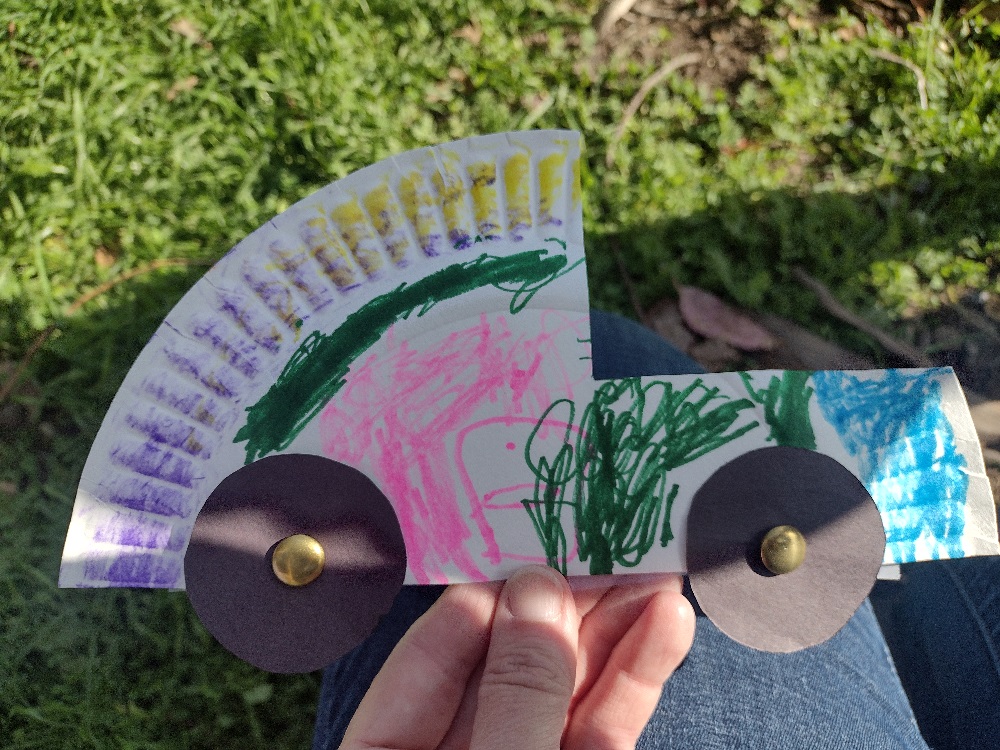
I got this idea from Glued to My Crafts, who made theirs a Garbage Truck. Basically, you cut a paper plate in half, then cut off the top right corner to make a car or truck shape. I also cut out wheels from construction paper and hole-punched them ahead of time, then provided brass fasteners to hold them on (I provided tape to tape down the ends of the fasteners, so they wouldn’t poke the kids while they were playing with them). The kids had a great time decorating them, and love the spinning wheels.

Double-Booked: The Challenge of Modern Libraries

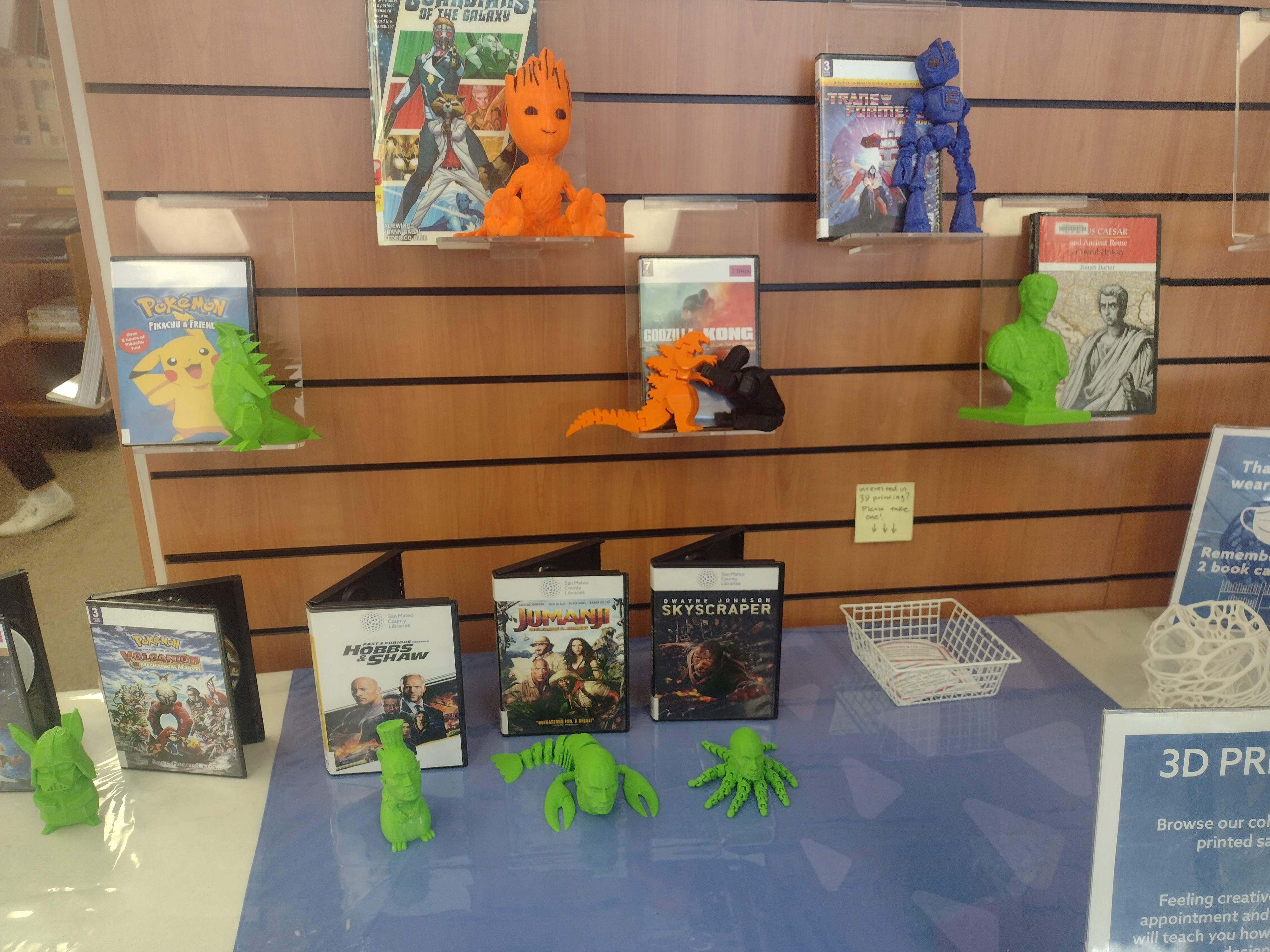
A display of DVDs and 3D-Printed objects created by my coworker, Steven Wong, to promote our library’s free 3D Printing Service.

Every time I tell my Dad over the phone that I have to go to work, he says, “Is this real work or play time?” It’s an irritating question, since it’s all “real work” to me (even though I enjoy it), but I can see how he might be a bit perplexed to see me stuffing Take and Make bags with pom-poms and yarn for kids to make into mobiles, or sewing a sample felt sloth stuffed animal for an After School STEAM Program for elementary school kids.

As a youth services librarian working primarily in small branches, my job has always been this way: tracking down historic documents for a local researcher one minute, kissing a live pig in front of a crowd of shrieking children the next. But over the past twenty years or so, the rise of digital resources has added even more complexity to my profession. Increasingly, public libraries have become the only remaining bridge across the ever-expanding digital divide. Now, on top of helping someone find the latest James Patterson novel, or helping a student locate books on Martin Luther King, Jr., we have patrons with no computer experience and no email address suddenly discovering that almost every job requires them to fill out an application online.

Then came the pandemic, when almost every aspect of library services had to be reevaluated and re-created in a new form. There was suddenly a massive demand for our e-book and e-audiobook collections, which required hours of troubleshooting with patrons via phone, text, email, and even Zoom (I now have a LOT more respect for people who work in call centers). But we also got calls from people needing help with more pressing problems, like the man whose driver’s license was about to expire, even though the DMV was closed. He called the DMV helpline, but just got a recording directing him to a web site he couldn’t access, since he had no computer.

Before the pandemic, we had offered laptops and WiFi hotspots for patrons to check out. But suddenly the demand for them far exceeded our limited supply, with everyone suddenly needing the Internet for almost everything. In the meantime, we were trying to fill the same role of promoting early-literacy that we always had, by providing storytimes, author events, book clubs, and other programs, but this time over Zoom. Instead of offering art and science workshops in the library, we bundled materials up in bags for families to pick up from our curbside table, and follow along with video instructions on YouTube.

Now that our buildings are open again, we are struggling to balance these new services with our old ones, while trying to navigate the ups and downs of the new COVID variants. We have been offering outdoor storytimes outside our libraries or in local parks, while still providing virtual ones for families who are concerned about the risk of illness, or unable to get to the branch. We are also back to in-person science workshops (also outdoors), but with limits on the number of attendees, so we are continuing to offer Take-and-Make kits to allow more kids to participate. In the meantime, virtual author programs (both for kids and adults) have become incredibly popular, because they allow us to bring in major authors we could never afford to host in person, and to accommodate much larger audiences.

We also struggle to balance the ever-growing digital realm with our traditional offerings. Our web site provides patrons with a dizzying variety of resources: e-books; audiobooks; movies and TV episodes; downloadable music and comedy albums; online courses; journal, magazine, and newspaper articles; language-learning software; museum and zoo passes; genealogy databases, and live homework help. In the tech-driven Bay Area, these resources do get lots of use, but we have many patrons who still depend on our books on CD, CDs, and DVDs, and physical copies of books, magazines and newspapers. And these patrons are often our most regular visitors to the library, while we may never see the ones who exclusively rely on e-media.

For years, I’ve seen posts or heard comments about how the Internet has made libraries obsolete. I’ve even heard people say there’s no need to visit libraries because you can buy all your books on Amazon. To which I would reply, sure, if you have the money you can definitely do that, but why would you? Especially if you are a parent trying to keep your kids supplied with picture books, which they might enjoy one time for ten or fifteen minutes. Libraries also provide free access to the millions of Americans who still lack high-speed Internet access at home, as well as training on how to use the Internet resources they need for work, education, healthcare and more. And we provide training and access to other types of equipment as well, including 3D-Printers, sewing machines, bicycles, ukuleles, home energy kits, and sewing machines.

A few weeks ago, I helped a patron who was looking for market research for a product she was hoping to sell. As I showed her the different databases we had available, and how to use them, she said, “Thank you so much for helping me. There’s just too much information online, and I have no idea where to look.” That, to me, summed up the one of the primary roles of libraries in the 21st century. We’ve always been in the business of curating information, but now, in a world where typing a search term into Google will give you billions of hits (millions of which are irrelevant, false, outdated, or trying to sell you something), the library provides free access to resources that have been selected for their reliability and accuracy, and people to guide you through them.

Meanwhile, the parts of my job I enjoy the most –finding answers to questions, performing weekly storytimes, and finding books for patrons– all remain basically the same. They may be more complex, with the addition of ebooks and other technologies, but at its core, the job is still about helping people, and that’s something that hopefully will never change.

Everyone Counts: A Musical Storytime about Numbers

COVID cases are rising in the Bay Area due to Omicron, so last week our library administration made the painful decision to cancel indoor programs, including our toddler storytimes. I was happy to still be able to hold our Outdoor Musical Storytime today, especially since the weather was beautiful at San Pedro Valley Park. It all felt pretty safe, with families doing a great job of social distancing and masking, and we made an effort to spread the craft supplies out across many different picnic tables for the Stay and Play. It’s such a surreal time to be working in libraries right now, or really anywhere, but it was great to see my regular families for the first time since the holidays (we had to cancel last week due to rain).

Today I did a counting theme, which was a lot of fun. Here’s what we did:

BOOKS:

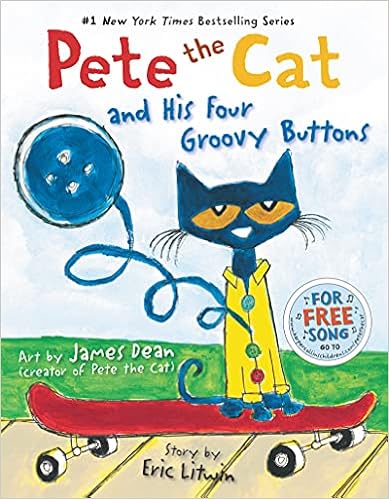
Pete the Cat and His Four Groovy Buttons by Eric Litwin; illustrated by James Dean

This is my second favorite Pete the Cat book, after I Love My White Shoes. Pete loves his shirt with the four colorful, groovy buttons so much that he has to sing about it. The trouble is, the buttons keep popping off and rolling away. But not to worry, when all the buttons are gone, Pete has one button he can always count on: his belly button! I only had one copy of the book today, so I made a Pete the Cat out of paper, with big paper buttons that my coworker, Claire, could remove as she followed along with the story. The kids loved it!

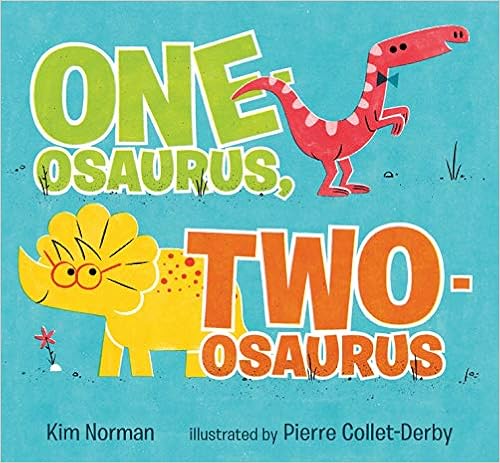
One-osaurus, Two-osaurus by Kim Norman; illustrated by Pierre Collet-Derby

This is such a cute book! Nine dinosaurs are playing hide-and-seek, until Ten-osaurus Rex comes looking for them. The kids loved the ROAR! midway through, and the surprise at the end, when Ten-osaurus Rex turns out to be just a small yellow dinosaur. The book ends with the dinosaurs playing Simon Says, so I followed up the book with a quick round of Simon Says with the kids.

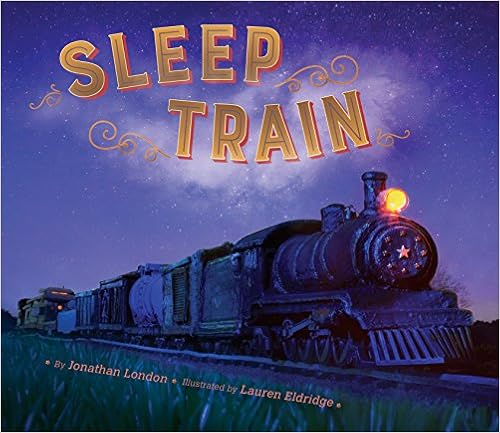
Sleep Train by Jonathan London; illustrated by Lauren Eldridge

This is a beautiful book about a young boy counting cars on a train to help him get to sleep. The kids especially liked the cattle car, and the “Mooooo-Mooooo! Chooooo-Choooooo!” page.

SONGS:

PUT YOUR FINGER IN THE AIR by Woody Guthrie

As usual, this was my opening song, but it worked especially well with the theme. I always do a verse that goes “Put your finger on your knee…Now can you count to three?” We count to three in English, and then I ask the participants what other languages they can count to three in. It’s always amazing how many different languages we get. Today we had Thai, Hindi, Cantonese, Italian, Russian, and Spanish. Here’s a link to a version performed by Miss Nina, which uses different lyrics, but the same tune. These are the lyrics I use:

[C] Put your finger in the air, in the air,
Put your finger in the air, in the [G7] air,
Put your [C] finger in the air,
And now [F] hide it in your hair,
[C] Put your finger in the [G7] air, in the [C] air.

Put your finger on your nose…
And now see how long it grows!…(mime making your nose grow long, and then short again)

Put your finger on your knee…
And now can you count to three?…1,2,3 (uno, dos, tres; un, deux, trois, etc.)

Point your finger at the ground…
And now make a spooky sound!…

Put your fingers all together, all together… (clap)
We we will all be friends forever!

¡CHOCOLATÉ!

This is a wonderful, easy song in Spanish about making hot chocolate. I usually do it two or three times, and we take time to pour the hot chocolate, add whipped cream or marshmallows, and then blow on it to cool it down (I usually make a big show about accidentally blowing whipped cream on one of the kids, which they think it hilarious). Here’s a YouTube video from Babelzone with the tune:

Uno, dos, tres, cho;
uno, dos, tres, co;
uno, dos, tres, la;
uno, dos, tres, te.
¡Chocolate! ¡Chocolate!

¡Bate! ¡Bate! ¡El chocolate!

FIVE LITTLE DUCKS

I did this one with the Monkey Mitt, which came with five bright yellow ducks that stick to the glove with Velcro. The ducks got a big “Awww!” when I pulled them out. Most of the families already knew this song. I do the Raffi version, which you can find here.

FREIGHT TRAIN

I used this one as an instrument play-along, after reading Sleep Train. This is one of my favorite storytime songs, because I love hearing the kids’ suggestions about where they want to go. Today we went to Mexico, Disneyland, the zoo, and Granny’s house. The song (by Elizabeth Cotten) has an amazing history, although I do the more kid-friendly Elizabeth Mitchell version. Here are the lyrics and uke chords I use:

[C] Freight train, freight train, [G7] going so fast.

[G7] Freight train, freight train, [C] going so fast.

[E7]Please don’t tell what [F] train I’m on,

So they [C] won’t know [G7] where I’ve [C] gone.

Going to Mexico, going so fast!

Going to Mexico, going so fast!

Please don’t tell what train I’m on,

So they won’t know where I’ve gone.

STAY AND PLAY: SNOWMEN

For the Stay and Play, I printed out blank snowmen (template below) on cardstock, then put out markers, gluesticks, buttons, and googly eyes, for the kids to decorate (and hopefully count their buttons at home). This was a big hit, with parents as well as kids. Who doesn’t love buttons?

What are your favorite counting books or songs? Please share them in the comments.
STEAM Team at the Library: An Afterschool Program for Kids

Over the past few months, all of the San Mateo County Libraries have been offering a series of afterschool workshops for kids in grades 2-5 once a month. Each one has focused on a different element of STEAM (Science, Technology, Engineering, Art, and Math).

For Science, we made Bath Fizzers (the instruction sheet is posted below). For Technology, we made Bobble Bots (basically a simple circuit with a vibrating motor inside of a plastic capsule). This week, for Engineering, we did one of my favorite activities: the Design-a-Latch challenge.

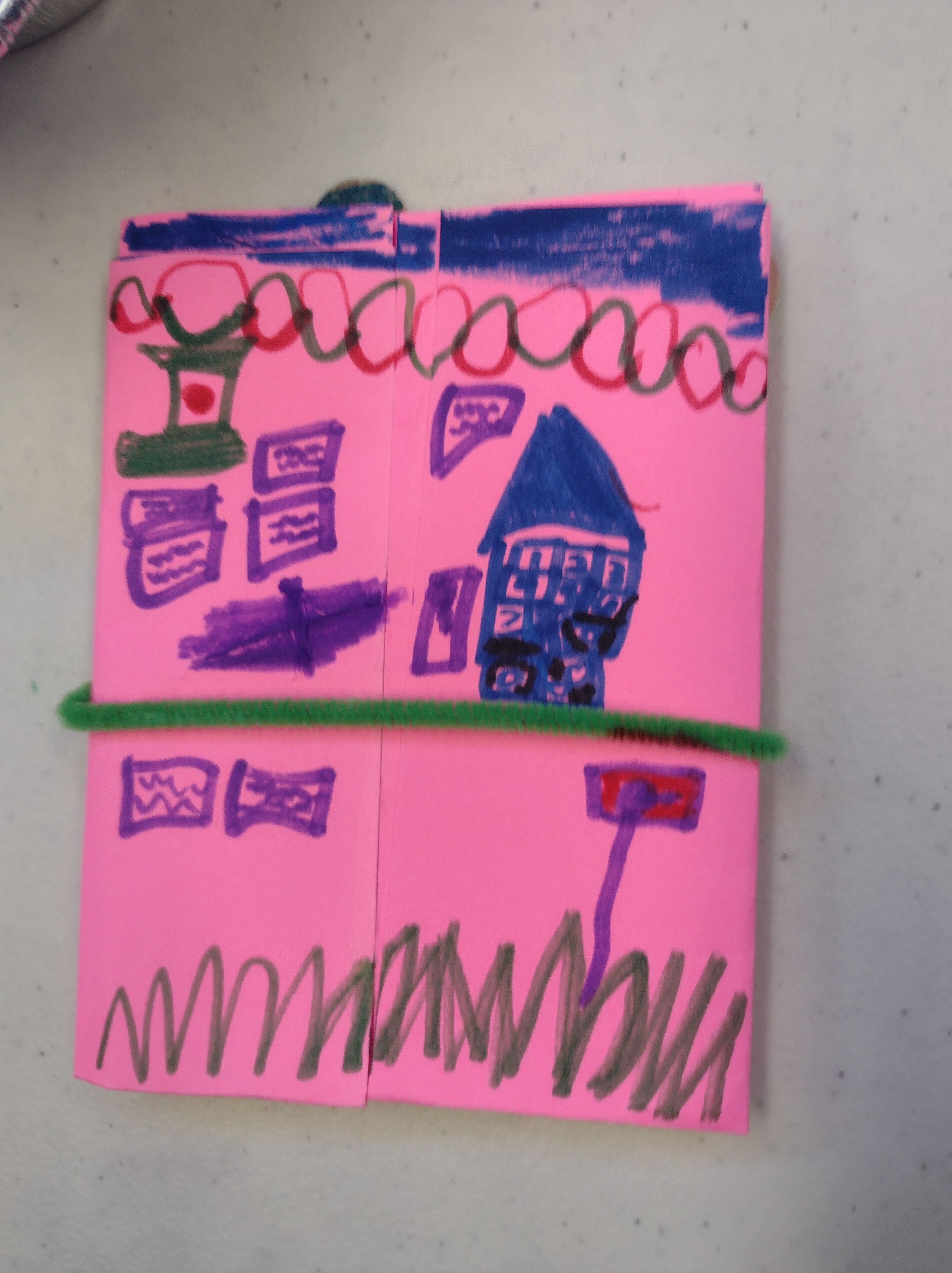
The concept of the challenge is very simple, and based on the story of Goldilocks and the Three Bears (I asked the kids to give a quick summary of the story before I explained the project). Each participant is given a piece of card stock to make into a “door,” by folding each side of the paper into the middle. I started by asking the kids to fold their paper in half “hamburger style,” and then fold each end of the paper so that the edge touched the center fold. Some library branches gave the kids small cardboard boxes instead, and challenged them to create a latch to keep them closed.

A Paper “Door” (a piece of cardstock with each of the ends folded into the middle). Students are challenged to create a “latch” out of everyday materials that would prevent Goldilocks from opening the door to the Three Bears’ house.

Once the kids made their paper doors, we explained that their challenge was to create a latch that would prevent Goldilocks from getting into the Three Bears’ house, while still allowing the Bears themselves to go in and out. We put several bins of everyday materials out for them to work with: rubber bands, craft sticks, pipe cleaners, paper clips, toothpicks, pompoms, yarn, glue sticks, and markers.

I briefly talked about the Engineering process, using the Bay Area Discovery Museum’s three step model: Think, Make, Try. The main point I emphasized is that once you try your first design, you often have to go back and think how you can make it better. Sometimes you have to do the whole process several times until you get a design that works the way you want it to. (When I do engineering programs with younger kids, we usually sing this song to the tune of The Wheels on the Bus, using the ASL signs for Think, Make, and Try: We are engineers, so we Think, Make, Try,/Think, Make, Try/Think Make, Try./We are engineers, so we Think, Make, Try,/That’s how we design.)

After this very quick introduction, the kids were on their own to complete the challenge. It was amazing how engaged and animated they were. For our previous STEAM programs, most of the kids were finished within 30 minutes, but for this one, many of kids stayed for over an hour, adding to their latches and sharing ideas. Two second grade girls designed intricate locks out of pipe-cleaners and toothpicks, and then added a small door for Baby Bear. Several kids drew alarms and security keypads next to their latches. A very animated group of fifth grade boys made several different doors, adding warning signs, and even rick-rolling anyone who got their doors open.

Here are some of their latch designs:

Back of a paper door design
Front of the door, showing two latches made of yarn and pipe cleaners
Action shot of door-decorating in progress. This latch is made with an intricate pipe cleaner “lock” held together with toothpicks, on top of a craft stick.
A paper clip and pipe cleaner latch with warning sign, security keypad, and alarm system.
This fifth grader invited me to open his paper door, where I was instantly “rick-rolled!”

This was such a fun, easy, and inexpensive afterschool program. I highly recommend it! For our branches that were unable to host a live version, we made Take and Make Kits with the supplies, and included a link to a YouTube video made by Foster City librarian Adrienne Gass during the lockdown.

Here are the instruction sheets for our previous STEAM programs (we don’t have the instructions for Art or Math yet, but we are planning to do Felt Stuffies for Art and Lunar New Year Origami–to tie in with Geometry–for Math).

Have you done any fun STEAM workshops at your library or school? Please share them in the comments.

If You’re Happy and You Know It: A Storytime about Feelings

Emotions are a storytime theme that I do fairly regularly, because I think it’s so important for kids (and adults!) to learn how to recognize and name their feelings. And I’ve heard a number of news stories recently about how in the aftermath of the past year and a half, schools are seeing a lot more kids struggling to express their emotions in healthy ways. So for this storytime, I pulled out three of my favorite books about feelings for a fun (if chilly) storytime at San Pedro Valley Park.

Here are the books and songs that we did:

BOOKS:

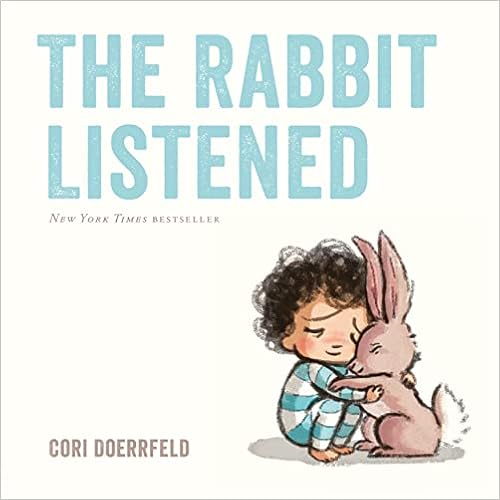
The Rabbit Listened by Cori Doerrfeld

This is one of those books that I feel is just as instructive for the parent or caregiver reading the story, as it is for the child listening to it. When a flock of crows knocks down Taylor’s block tower, all of the animals rush in to offer advice. The chicken wants to talk about it, the bear wants to yell about it, the snake wants knock down someone else’s tower. But Taylor doesn’t want to do any of those things. Finally, a rabbit creeps up to just sit quietly and listen to all of Taylor’s sadness and anger, until Taylor is ready to build a new tower. This book does such a wonderful job of describing all of the impulses that strong feelings can evoke, and it’s also a great reminder to grown-ups that sometimes it’s best to just be there with your kids while they are working through those feelings (something I definitely struggle to remember as a parent). It’s also just a fun read-aloud.

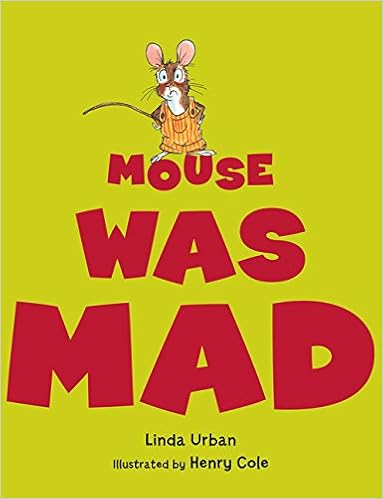
Mouse Was Mad by Linda Urban and Henry Cole

When Mouse gets mad, he tries out lots of different ways to express his feeling: hopping, screaming, stomping, rolling on the ground. But the other animals always want to tell him how to do things better: Bobcat is an expert at screaming; Bear can make the ground shake with his powerful stomps; and Hedgehog can roll up into a perfect sphere. Even worse, every time Mouse tries to copy them, he ends up falling into a mud puddle. Finally, Mouse just stands still and breathes, something he can do better than any other animal, and, in the end, he feels better. For this book, my coworker Angela used a mouse puppet to act out the different motions while I read, and we encouraged the kids to stomp, scream, hop, and breathe along with Mouse.

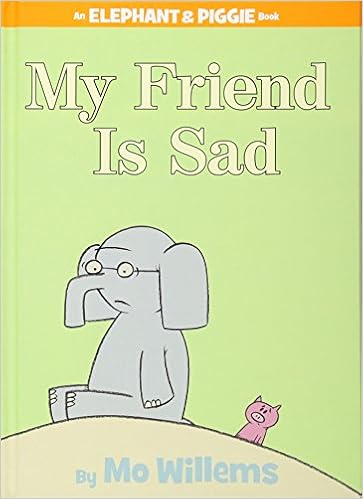
My Friend is Sad by Mo Willems

This was one of the first Elephant and Piggie books, and I think it’s still my favorite. When Piggie sees that her friend, Gerald, is sad, she tries to cheer him up by dressing as a cowboy, a clown, and a robot. But this makes Gerald sadder than ever. Why? Because his best friend isn’t there to see these amazing things with him. Angela and I each read a different character, which is one of my favorite ways to share the books in this series.

SONGS AND RHYMES:

Did You Ever See a Rabbit?

Angela used a rabbit puppet to act out the motions to this version of Did You Ever See a Lassie? while the kids and I pretended to be rabbits. For the different verses, we leaned left and right, stretched up and crouched down, and made little rabbit ears with our fingers which we moved in a circle clockwise, and then counter-clockwise. This is a really versatile action song for storytime, since you can sing it about any animal:

Did you ever see a rabbit, a rabbit, a rabbit?

Did you ever see a rabbit go this way (lean to the left) and that? (lean to the right)

Go this way (lean left) and that way, (lean right)

And this way (lean left) and that way, (lean right)

Did you ever see a rabbit go this way (lean left) and that? (lean right)

If You’re Happy and You Know It

Naturally, I had to include this song, and my favorite way to do it is to add in different emotions for each verse. This time we did: If you’re happy and you know it, clap your hands; If you’re sad and you know it, cry “Boo-hoo!”; If you’re angry and you know it, say “I’m mad!” If you’re sleepy and you know it, yawn and stretch; If you’re shy and you know it, hide your face… peek-a-boo!; If you’re cold and you know it, snuggle close (hug yourself or your grown-up); and If you’re happy and you know it, shout “Hooray!” Here are the chords for guitar or ukulele:

[C] If you’re happy and you know it, clap your [G7] hands (clap, clap)

If you’re happy and you know it, clap your [C] hands (clap, clap)

If you’re [F] happy and you know it, and you [C] really want to show it,

If you’re [G7] happy and you know it, clap your [C] hands! (clap, clap)

Happy Face, Happy Face, What Do You See?

Angela led this rhyme, using paper plates with drawings depicting different emotions. You can also sing this to the tune of Twinkle, Twinkle Little Star.

Happy Face, Happy Face, what do you see?

I see a Sad Face, looking at me!

Sad Face, Sad Face, what do you see?

I see an Angry Face looking at me!

Angry Face, Angry Face, what do you see?

I see a Surprised Face looking at me!

Surprised Face, Surprised Face, what do you see?

I see a Sleepy Face looking at me!

Sleepy Face, Sleepy Face, what do you see?

I see a Happy Face looking at me!

Breathing Colors

We did this easy breathing exercise to go along with Mouse Was Mad. I learned it from the Library Explorer camps our library system offered this past summer, which always opened with a series of mindfulness activities. I use this one all the time as a stretching break, especially for elementary school kids.

The first time I demonstrate it, I stretch my arms out to either side and then lift them up as I take a deep breath in. Once my hands are over my head, I clap them together, and then bring them down in front of my face as I breathe out. We usually do this together at least once.

The second time, I tell the kids to picture a great big bubble full of their favorite color that stretches out to their fingertips. When they clap their hands, I tell them to picture their favorite color spilling down onto their heads. Then I have them picture their second favorite color as we stretch and breathe together again. It’s a great way to refocus your group, especially after a really active song.

STAY AND PLAY: DOT PAINTING

If this had been an indoor storytime, I would have loved to do watercolor painting along with different types of music, and asked the kids to paint the way the music makes them feel. But since watercolor painting requires a lot of supplies and set-up, I gave them Dot Markers instead. These are always a huge hit, especially with toddlers, who can move them smoothly across the page to make colorful lines, or bang them repeatedly on the paper to make colorful dots. The grown-ups enjoyed them too. The only hard thing was gathering up the supplies when it was time to go back to the branch, because some of the toddlers had very strong feelings about putting their markers back in the box!

What are your favorite songs or books about Emotions? Please share them in the comments.
Music in the Air: An Outdoor Musical Storytime

This week at Outdoor Musical Storytime, our theme was Making Music. Here are the books and songs that we shared:

Books:

Let’s Sing a Lullaby with the Brave Cowboy by Jan Thomas

Jan Thomas writes so many fun, interactive storytime books, and this is one of my favorites. A cowboy is singing his cows to sleep with a sweet lullaby, but EEK!!! Is that a spider? “No, Cowboy” his cows say. “It’s a just a flower.” More misconceptions follow: a stick that looks like a snake, a cow that looks like a bear, until finally the little group is confronted with an actual threat: a wolf who loves lullabies. The kids loved joining in on the “EEKs!,” which provide a great opportunity to help them make the connection between the written and spoken word. For the lullaby, I use a tune that a coworker of mine made up, but it also works to the tune of Bringing Home a Baby Bumblebee.

The Nuts: Sing and Dance in Your Polka Dot Pants by Eric Litwin; illustrated by Scott Magoon

Hazel Nut has written a song to celebrate her polka dot pants. The problem is that everyone in her family is too busy to sing and dance with her. Luckily, Grandma Nut shows up to save the day. I came up with my own tune (similar to Twinkle, Twinkle, Little Star) for the “Polka Dot Pants” song that Hazel sings. There’s a YouTube video for the song featured the end of the book.

Kat Writes a Song by Greg Foley

Kat is very proud of her new song, and when she sings it, good things seem to happen. Is her song magic? This is a really sweet friendship story, and the kids loved singing the “Meow Meow Meow Meow Meow” song.

SONGS:

The Cowboy Pokey:

A cowboy-themed version of The Hokey Pokey, to go with Let’s Sing a Lullaby with the Brave Cowboy:

You put your left lasso in (move your right arm in circles in front of you)

You put your left lasso out (move your left arm behind you)

You put your left lasso in (move your right arm in circles in front of you)

And you shake it all around (shake your left arm)

You do the cowboy pokey and you turn yourself around (turn in a circle)

That’s what it’s all about! (clap as you sing each word)

You put your right lasso in…

You put your left spur in… (put your left foot in front of you)

You put your right spur out… (put your right foot in front of you)

You put your hat in… (tilt your head down)…

Giddy-Up!

This is one of my all-time favorite baby/toddler storytime songs. It’s to the tune of the William Tell Overture (Lone Ranger Theme):

Giddy-up, Giddy-up, Giddy-UP-UP-UP! (bounce baby or toddler, or have older kids “gallop” in place)

Giddy-up, Giddy-up, Giddy-UP-UP-UP!

Giddy-up, Giddy-up, Giddy-UP-UP-UP!

WHOA, Horsey! (Lean back with baby/toddler, or have older kids stop and put their hands out)

If Your Clothes Have any Red

We sang this one after Sing and Dance in Your Polka Dot Pants. It’s to the tune of If You’re Happy and You Know It. It’s fun to come up with your own verses:

If your clothes have any red, any red,

If your clothes have any red, any red,

If your clothes have any red,

Put your finger on your head!

If your clothes have any red, any red.

If your clothes have any blue…put your finger on your shoe…

If your clothes have any green…make believe you can’t be seen… (cover your eyes with your hands, and then say, “Peekaboo!”

If your clothes have any black…put your finger on your back…

Dance Like You’ve Got Ants in Your Pants by Eric Herman

This is such a fun song. I play it on the ukulele (chords below). Each time we spray our imaginary spray, I usually say, “And the ants (bees, bears) say, ‘Ewww! Ewww! Ewww!” and run away!

[C] Dance like you’ve got [G7] ants in your pants.

[F] Dance like you’ve got [G7] ants in your pants.

[C] Dance like you’ve got [G7] ants in your pants,

Now [F] STOP! And spray some ant spray!

[C] Dance like you’ve got [G7] bees on your knees.

[F] Dance like you’ve got [G7] bees on your knees.

[C] Dance like you’ve got [G7] bees on your knees,

Now [F] STOP! And spray some bee spray!

[C] Dance like you’ve got a [G7] bear in your hair.

[F] Dance like you’ve got a [G7] bear in your hair.

[C] Dance like you’ve got a [G7] bear in your hair,

Now [F] STOP! And spray some bear spray!

[G7] Bop! Bop! Bop! [F] Until you [C]drop!

[G7] Hula, Hula, Hula! [F] Until you [C] drool-a!

[C] Jump like you got [G7] bumped on your rump.

[F] Jump like you got [G7] bumped on your rump.

[C] Jump like you got [G7] bumped on your rump,

Now [F] STOP!

[G7] Dance anyway, [F] Dance any [C] how,

[G7] Dance any night and day.

[F] Keep on dancing [C] now.

[G7] Dance any way you want to.

[F] Dance any way you [C] can.

[G7] Dance like you got ants [F] in your pants a- [C] gain!

[C] Dance like you’ve got [G7] ants in your pants.

[F] Dance like you’ve got [G7] ants in your pants.

[C] Dance like you’ve got [G7] bees on your knees.

[F] Dance like you’ve got [G7] bees on your knees.

[C] Dance like you’ve got a [G7] bear in your hair.

[F] Dance like you’ve got a [G7] bear in your hair.

[C] Jump like you got [G7] bumped on your rump.

[F] Jump like you got [G7] bumped on your rump.

[G7] Bop! Bop! Bop! [F] Until you [C]drop!

[G7] Dance, Dance, Dance, [F] don’t ever [C] STOP!

STAY AND PLAY: EGG SHAKERS

While looking through our craft closet (which is always an adventure), I found a whole bag of plastic eggs, and a couple of bags of dried beans. Why? Who knows! But it made for a fantastic follow-up activity for after storytime. We put out lots of different stickers for the kids to decorate their eggs after they filled them with beans. (In retrospect, I wish I had brought tape, so that the families could tape their eggs closed, but many of them just put stickers along the seam to hold them together). Super easy, and the kids had a blast!

What are your favorite books about music? Please share them in the comments.

Right As Rain: An Outdoor Storytime About the Weather

I had a fun time at our Toddler Outdoor Storytime yesterday. Lately, the weather here in the Bay Area has been interesting, to say the least. On top of the usual fog and rain, we now have bomb cyclones and atmospheric rivers. So it seemed like the perfect time to do a Weather theme.

Here are the books and songs that I did:

BOOKS:

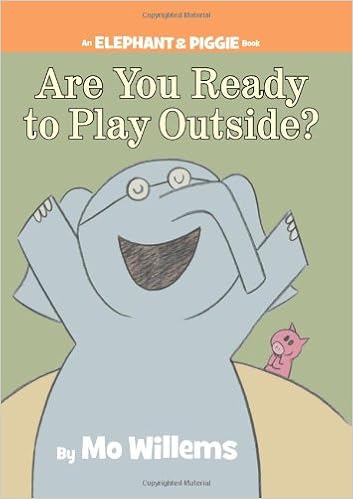
Are You Ready to Play Outside? by Mo Willems

This Elephant and Piggie book worked really well for my theme. Piggie is excited to play outside with Gerald, until it starts to rain. But a pair of playful worms convince the two friends that they can still have just as much fun in the rain. Some of the kids joined in on the running and jumping parts, and as a special surprise, I sprayed a tiny bit of water into the crowd with a water sprayer in the part of the book where the rain started.

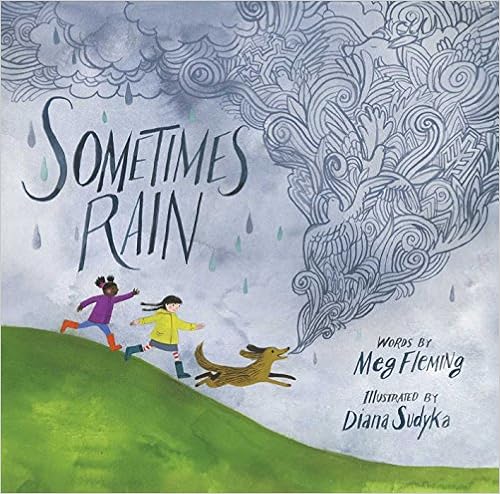
Sometimes Rain by Meg Fleming; illustrated by Diana Sudyka

This simple rhyming book describes different types of weather and activities that sometimes happen as the seasons change (playing on the beach in the summer, jumping in leaves in the fall, etc.). I wish I had thought to bring some actual fall leaves to give out or scatter into the crowd. Unfortunately, my coworker who usually walks around with a second copy of the book was out sick, so it was a bit hard for the kids to see the illustrations, which are beautiful, but a little small for an outdoor setting.

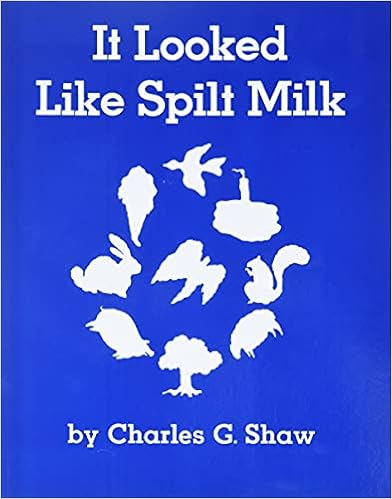
It Looked Like Spilled Milk by Charles G. Shaw

I had the big book version of this wonderful book about cloud shapes. It was so much fun to read. For each page, I asked the kids what they saw, and got some really interesting answers (a boat instead of a birthday cake, a bat instead of an angel). I incorporated their ideas into the text, saying “But it wasn’t a boat OR a birthday cake,” etc.

SONGS AND RHYMES:

For this storytime, I usually open with Open and Shut Them and close with The More We Get Together (with sign language).

If All the Raindrops:

I did this one earlier this week for Musical Storytime, but I had to include it in my weather theme. Once again, I asked for the kids to tell me their favorite foods, and we sang it several times, with verses like “If all the raindrops were M&M’s and Ice Cream,” and “If all the raindrops were peanut butter and jam.”

[C] If all the raindrops were [G7] lemon drops and [C] gum drops,

Oh, what a rain it would [G7] be.

[C] I’d stand out- [G7] side with my [C] mouth open [G7] wide,

[C] “Ah, Ah, Ah, [G7] Ah, Ah, Ah, [C] Ah, Ah, Ah, [G7] Ah!”

[C] If all the raindrops were [G7] lemon drops and [C] gum drops,

Oh, what a [G7] rain it would [C] be!

Way Up High in the Apple Tree:

A simple, fun rhyme to go with the apple picking in Sometimes Rain. I asked the kids to suggest other fruits to pick from the tree, and we repeated it several times:

Way up high in the apple tree (stretch arms high in the air)

Two little apples smiled at me! (make circles with your index fingers and thumbs)

I shook that tree as hard as I could! (mime shaking the tree with your hands)

Down came the apples! Mmmm, they were good (lower arms, and rub tummy)

Five Little Snowmen:

One of my favorite storytime songs. After the first verse, I asked the kids what other things they could make out of snow, so we sang about four little snow kitties, and three little snow bunnies, two little snow giraffes, and (my favorite!) one little snow skunk:

Five little snowmen standing in a row, (hold up five fingers)
Each with a hat (touch head), and a brightly colored bow (adjust imaginary bowtie).
Five little snowmen dressed up all for show.
Now they are ready,`
Where will they go?

Wait! (hold out hands in a “Stop!” motion) Till the sun shines. (move hands in a circle)
Wait! Till the sun shines.
Then they will go
Down through the fields
With the melting, melting snow (“melt” all the way down to the floor, then pop up for the next four snowmen).

Rainbow ‘Round Me:

Another storytime favorite, composed by Ruth Pelham. I asked the kids for suggestions of things they might see outside their windows. By the end, we had purple unicorn, a white flag, and a green mountain lion.

When I [C] look outside my [G7] window,
There’s a world of color I [C] see.
Fiddle-dee-dee, [F] outside my [C] window 
There’s a [G7] world of color I [C] see.

CHORUS:
[F] Rainbow, [C] rainbow, [G7] rainbow ’round [C] me. 
[F] Rainbow, [C] rainbow, [G7] rainbow ’round [C] me. 

And the sky outside my window,
Is as blue as blue can be.
Fiddle-dee-dee, outside my window
It’s as blue as blue can be.

Chorus

And the grass outside my window,
Is as green as green can be.
Fiddle-dee-dee, outside my window
It’s as green and green can be,
And the sky is blue as blue can be.

Chorus

And the flowers outside my window,
Are as yellow as yellow can be.
Fiddle-dee-dee, outside my window
They’re as yellow as yellow can be.
And the grass is green as green can be.
And the sky is blue as blue can be.

Chorus

STAY AND PLAY: COTTON BALL CLOUDS AND CLOUD VIEWERS

Cotton Ball Clouds

For our Stay and Play activity, I put out cotton balls, blue paper, and glue sticks for the kids to make their own clouds. They could glue the cotton balls as they were, or stretch them out to make thinner clouds. The kids really enjoyed playing with the cotton balls, and sticking them to the page. I also gave them a cloud viewer to use in the park and at home.

I got the idea for the cloud viewer from The UCAR Center for Science Education, which offers a more detailed version here: https://scied.ucar.edu/activity/cloud-viewer. Basically, you cut out the center square so that kids can look through the hole and compare the clouds they see with the ones in the pictures. For my toddler storytime crowd, I wasn’t as worried about providing the names of the different types of clouds (although I included them for the caregivers). Mostly, I just wanted to offer families some ideas for ways to talk about clouds together, by describing their shapes and colors and textures, etc.

One of the programs our library system offers is LENA Start, which emphasizes the importance of talking with babies and toddlers. Each family is given a special recorder that tracks how many words the child hears throughout the day (without documenting what the actual words are), and how many times a caregiver responds to sounds and words the child says. Each week, the family receives a graph charting how many back and forth exchanges they’ve had with their child, even if it’s just naming something in the environment (a dog, a tree, etc.) and then reacting when the baby or child responds. The weekly classes provide topics for daily conversation (food, bathtime, etc.), and time to brainstorm how to talk with young children about them. This cloud viewer activity was intended to generate the same kind of inspiration by suggesting questions caregivers might ask, or things they might point out as they look at the sky together. (To learn more about LENA and the importance of early talk, you can visit the LENA website. Before the pandemic, I had the opportunity to lead a series of LENA Start classes for two different sets of families, many of whom are now regular attendees at my storytimes. It’s a fascinating program, and extremely rewarding.)

Here is the simplified cloud viewer I used:

What are your favorite books or songs about weather? Please share them in the comments below.