Rhyme Time: A Storytime About Rhyming

Early Literacy Tip: Pointing out rhyming words and playing rhyming games with kids is a great way to develop their phonemic awareness (their understanding of the different sounds that make up words), which will make it easier for them to learn to read in elementary school.

I’ve been continuing my series of storytimes based on early literacy tips, which has been helping me get more comfortable sharing early literacy strategies with caregivers. It’s also been a fun challenge to select picture books that support each strategy.

This week, we focused on the idea of rhyming words. I started out by talking about rhymes, and asking the kids to think of words that rhymed with “cat.” They suggested “hat” and “bat.” I then explained that playing with rhymes is a great way to practice the skills that will help them become strong readers later on.

Books:

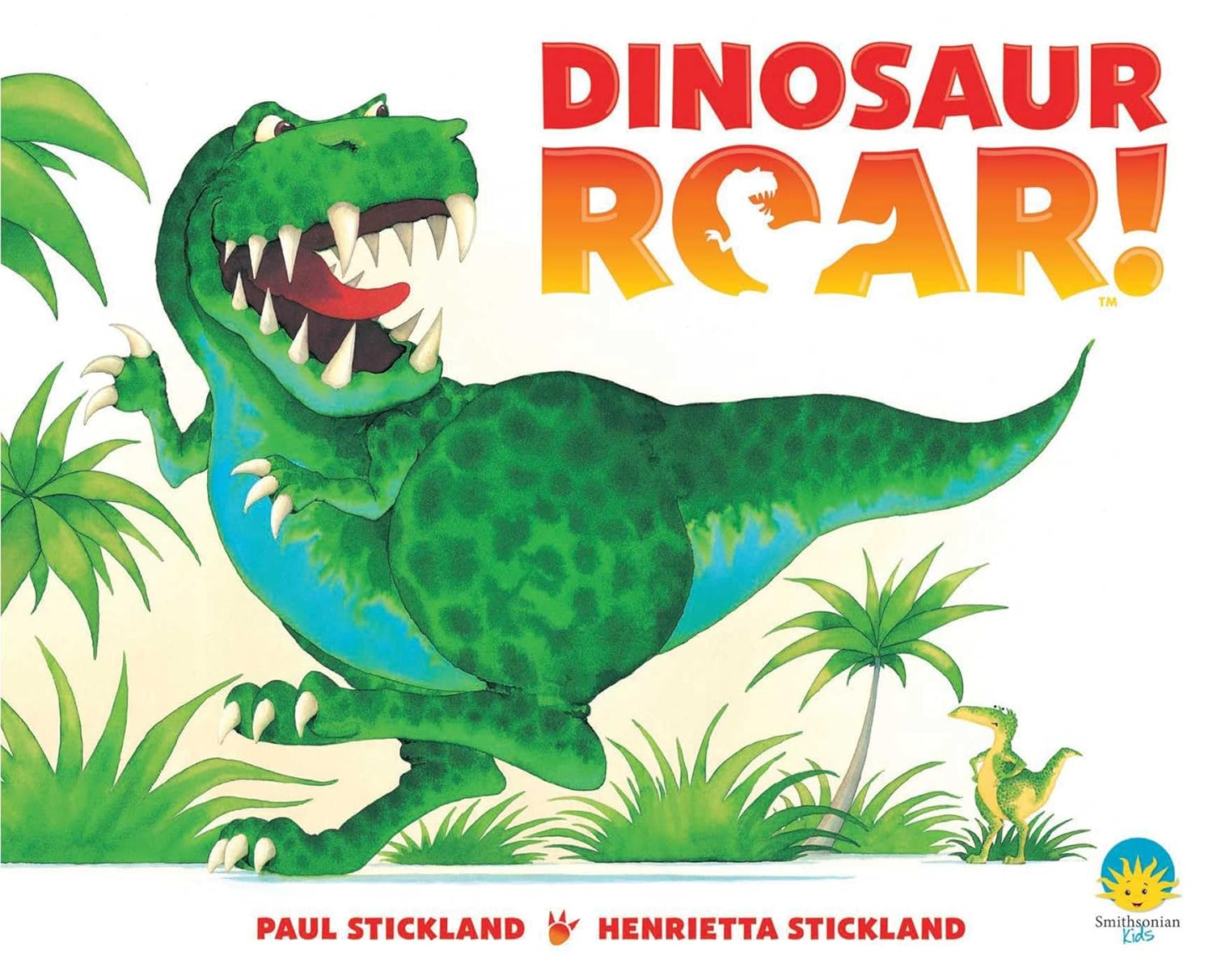
Dinosaur Roar by Paul Stickland & Henrietta Stickland

This was a favorite of my own kids, and several of the storytime families were excited to see it. It’s basically a rhyming book of opposites, featuring large, colorful dinosaurs, and it’s great for having the kids try to guess the rhyming word at the end of each couplet.

Rhyming Dust Bunnies by Jan Thomas

Jan Thomas is one of my favorite storytime authors, and I have especially enjoyed sharing this book, which fit the theme perfectly. I had to explain what dust bunnies were, since most of the kids didn’t know (I explained that in real life, they are not as cute or colorful as the ones in the book). In this story, four dust bunnies play a game to come up with rhyming words, but the blue one (named Bob) keeps saying things that don’t rhyme, like “Look out!” The rest of the dust bunnies soon discover that Bob is trying to warn them about a monster with a broom. The kids love the last page, when the dust bunnies end up inside a vacuum cleaner. This is a fun book to read aloud, especially if you like doing different voices.

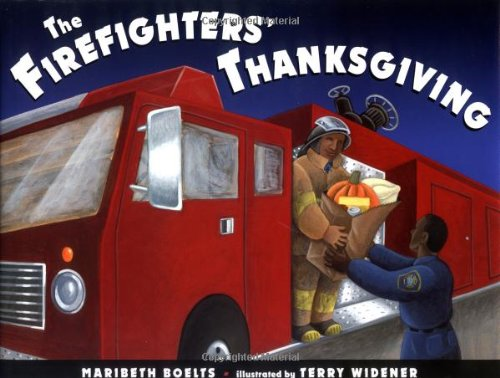
The Firefighter’s Thanksgiving by Maribeth Boelts; illustrated by Terry Widener

I chose this book more because it’s close to Thanksgiving, although it is also a rhyming book. It’s one of the few Thanksgiving books that I actually like, about a group of firefighters who are too busy putting out fires to cook and eat their Thanksgiving dinner. In the end, people in the community bring them a Thanksgiving feast, which they share with an injured firefighter who had to go to the hospital. Often when I read this book, the kids get into a discussion about different ways a firefighter might get hurt on the job: climbing through broken glass, breathing in smoke, getting hit by something falling. I’ve been really impressed by how they think through the different things a firefighter might have to do, and the risks they would entail.

See You Later, Alligator by Sally Hopgood; illustrated by Emma Levey

This is a cute book about a tortoise who is leaving the zoo, but wants to say goodbye to all of his animal friends first, each time using a rhyme like “Toodaloo, Kangaroo.” The kids enjoyed calling out the names of each animal.

Songs:

We Are the Dinosaurs

We sang this to go along with Dinosaur, Roar. Always a hit!

[Dm] We are the [C] dinosaurs marching, marching.
[Dm] We are the dinosaurs. [A] Whaddaya think of that?
[Dm] We are the dinosaurs [C] marching, marching.
[Dm] We are the [A] dinosaurs. [Dm] We make the [C] earth [Dm] flat.
We make the [C] earth [Dm] flat.

[F] We stop and eat our [C] food, [F] when we’re in the [C] mood.
[F] Stop and eat our [C] food on the [Dm] ground.
[F] We stop and eat our [C] food, [F] when we’re in the [C] mood.
[F] Stop and eat our [C] food, and [Dm] then we march [A] around.

[Dm] We are the [C] dinosaurs marching, marching.
[Dm] We are the dinosaurs. [A] Whaddaya think of that?
[Dm] We are the dinosaurs [C] marching, marching.
[Dm] We are the [A] dinosaurs. [Dm] We make the [C] earth [Dm] flat.
We make the [C] earth [Dm] flat.

[F] We stop and take a [C] rest, [F] over in our [C] nest.
[F] Stop and take a [C] rest at the end of the [Dm] day.
[F] We stop and take a [C] rest, [F] over in our [C] nest.
[F] Stop and take a [C] rest, and [Dm] then you’ll hear us [A] say…

[Dm] We are the [C] dinosaurs marching, marching.
[Dm] We are the dinosaurs. [A] Whaddaya think of that?
[Dm] We are the dinosaurs [C] marching, marching.
[Dm] We are the [A] dinosaurs. [Dm] We make the [C] earth [Dm] flat.
We make the [C] earth [Dm] flat.

[A] And then we RO-AR-OAR!
[A] Because [Dm] we [C] are the [Dm]dino-[D]saurs!

A Hunting We Will Go

We sang this with the parachute at Outdoor Musical Storytime. I brought some small stuffed animals (a pig, a dog, and a mouse) and each time we sang it, I asked the kids to suggest rhymes for each one. Then I threw it on the parachute, and we sang the song, shaking the parachute to the beat. We had “we’ll catch a pig and give it a twig,” “we’ll catch a dog and let him meet a hog,” and “we’ll catch a mouse and put it in a house.”

Oh, [C] a-hunting we will go!
A-[F]hunting we will go!
We’ll [G7] catch a fox and put it in a box,
And then we’ll let it [C] go!

Hurry, Hurry, Drive The Firetruck

We sang this to go along with The Firefighter’s Thanksgiving for Family Storytime. We sang the whole thing three times. I always put out puppets for the kids to sit with, so when we got to the “Hurry, Hurry, Save the kitty cat” line, I substituted one of the puppets (a porcupine, a unicorn, etc.) for the cat.

Hurry, Hurry, Drive the fire truck!
Ding, Ding, Ding, Ding, Ding!

Hurry, Hurry, Spray the water…

Hurry, Hurry, Climb the ladder…

Hurry, Hurry, Save the kitty cat…

Slowly, Slowly, Back to the station…

I’ll See You Later, Alligator

We sang this song for our instrument play-along at the end, after reading See You Later, Alligator. It’s one I wrote a few years ago, after a storytime discussion about the differences between crocodiles and alligators.

[C] If you see something in the water
With [F] scales and lots of teeth,
[G7] Looking like a floating log
With [C] four legs underneath.
[C] You can tell that it must be a type
Of [F] dangerous reptile.
But is it an alli[C]-gator
Or a [G7] hungry croco[C]-dile?

I’ll see you [F] later, Alligator, (wave)
With your [G7] mouth shaped like a [C] U, (make a u-shape with your hands)
But [F] Crocodile, with the V-shaped [G7] smile, (make a v-shape with your hands)
It’ll be a while
‘Till I see [C] you. (point)

[C] Alligators like to live in swamps,
While [F] crocs prefer a river.
No [G7] matter where you find them,
They’re sure to make you [C] shiver.
On crocs you see their bottom teeth,
On [F] gators just the top.
If you’re able to see [C] either,
You’re [G7] way too close, so [C] STOP!

I’ll see you [F] later, Alligator,
With your [G7] mouth shaped like a [C] U,
But [F] Crocodile, with the V-shaped [G7] smile,
It’ll be a while
‘Till I see [C] you.

[C] crocodile has lighter skin,
While [F] gator’s skin is dark,
To [G7] help them hide out in the mud
Waiting to [C] catch their mark.
Learning of their differences
Can [F] be a lot of fun,
But one thing they have in [C] common,
If you [G7] see one you should [C] run!

I’ll see you [F] later, Alligator,
With your [G7] mouth shaped like a [C] U,
But [F] Crocodile, with the V-shaped [G7] smile,
It’ll be a while
‘Till I see [C] you.

Stay & Play: Coffee Filter Dust Bunnies

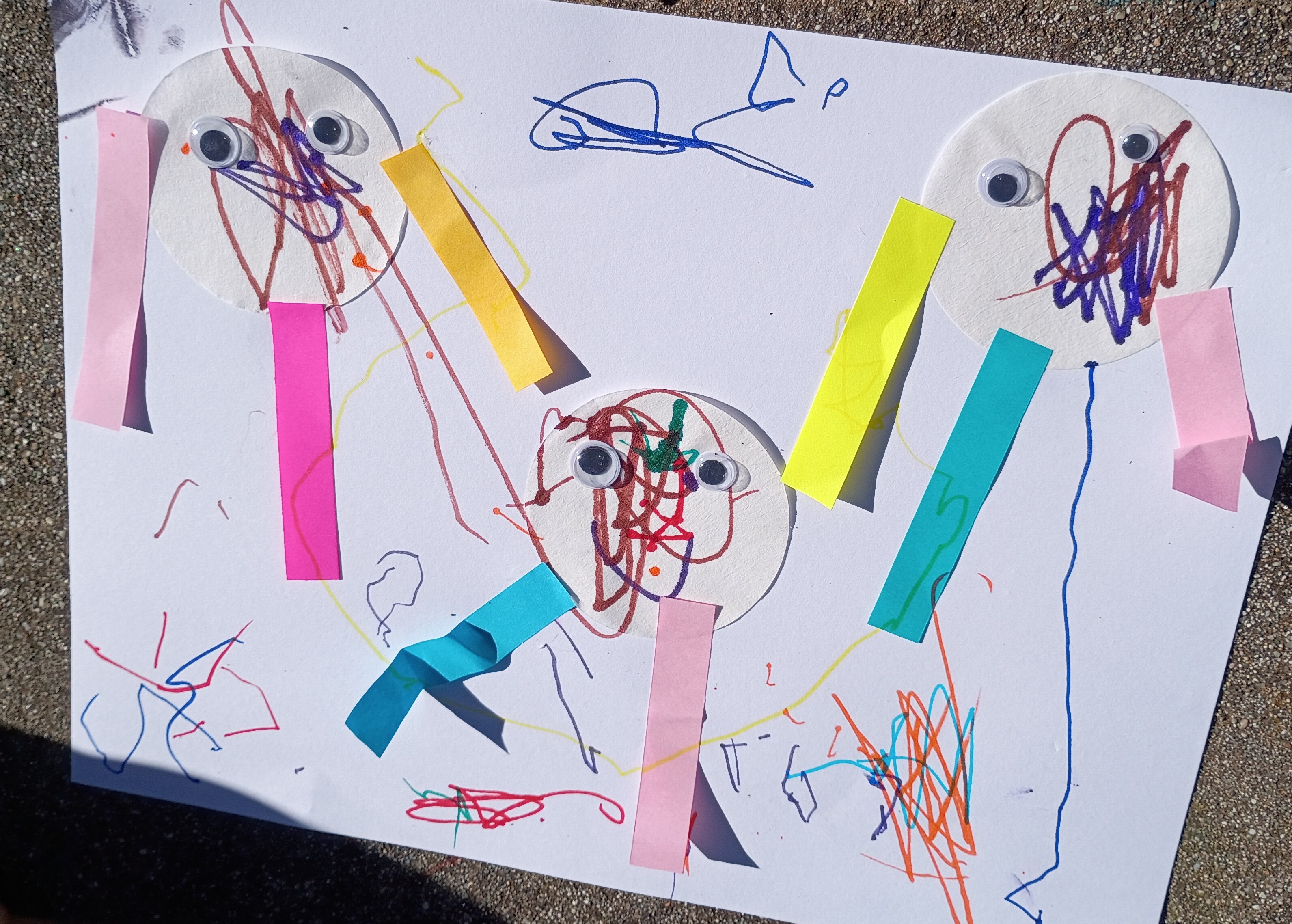
This Stay & Play was based on Rhyming Dust Bunnies. Before the storytime, I cut out small strips of colored paper for the arms and legs. For the Stay & Play, I put out glue sticks, markers, the colored paper strips, googly eyes, and small coffee filters (the kind you use for an Aeropress, although you could also use regular sized ones). The kids really enjoyed assembling and decorating their dust bunnies.

Do you have favorite rhyming books? Please share them in the comments below.

The Big Picture: A Storytime About the Word “Big”

Early Literacy Tip: Point out common words in books to help young kids build their sight word vocabulary and print awareness.

I’ve been continuing my new approach of building my storytimes around an early literacy tip. This past week, I focused on the word “BIG,” which appears in a lot of picture books.

I started by explaining that a great way to help children become strong readers later on is to point out common words in books. This not only helps build their sight word vocabulary (the words that they can read automatically, without having to sound them out), but can also become a kind of game to make them excited to start paying attention to the words on the pages of books. For each of the books I shared in the storytime, I pointed out the word “BIG.”

Books:

Clifford, the Big Red Dog by Norman Bridwell

I chose this book, not only because it is a classic, but because we have rented a Clifford, the Big Red Dog costume for our upcoming Noon Year’s Eve program, and I wanted to let the families know that they would have a chance to meet Clifford in December. This was also one of my favorite childhood books, and it was fun to see the humor in the illustrations still holds up for kids today: Clifford taking a bath in the swimming pool, catching a car, or trying unsuccessfully to play hide and seek.

Bulldozer’s Big Day by Candace Fleming & Eric Rohmann

Cute story about a Bulldozer who is disappointed that none of his construction vehicle friends seem to care that it’s his birthday, until they surprise him with a giant cake. It was funny to see some of my most distractible toddlers latch on to the pictures of big machines. One boy came right up to me to point to and “talk” about the bulldozer.

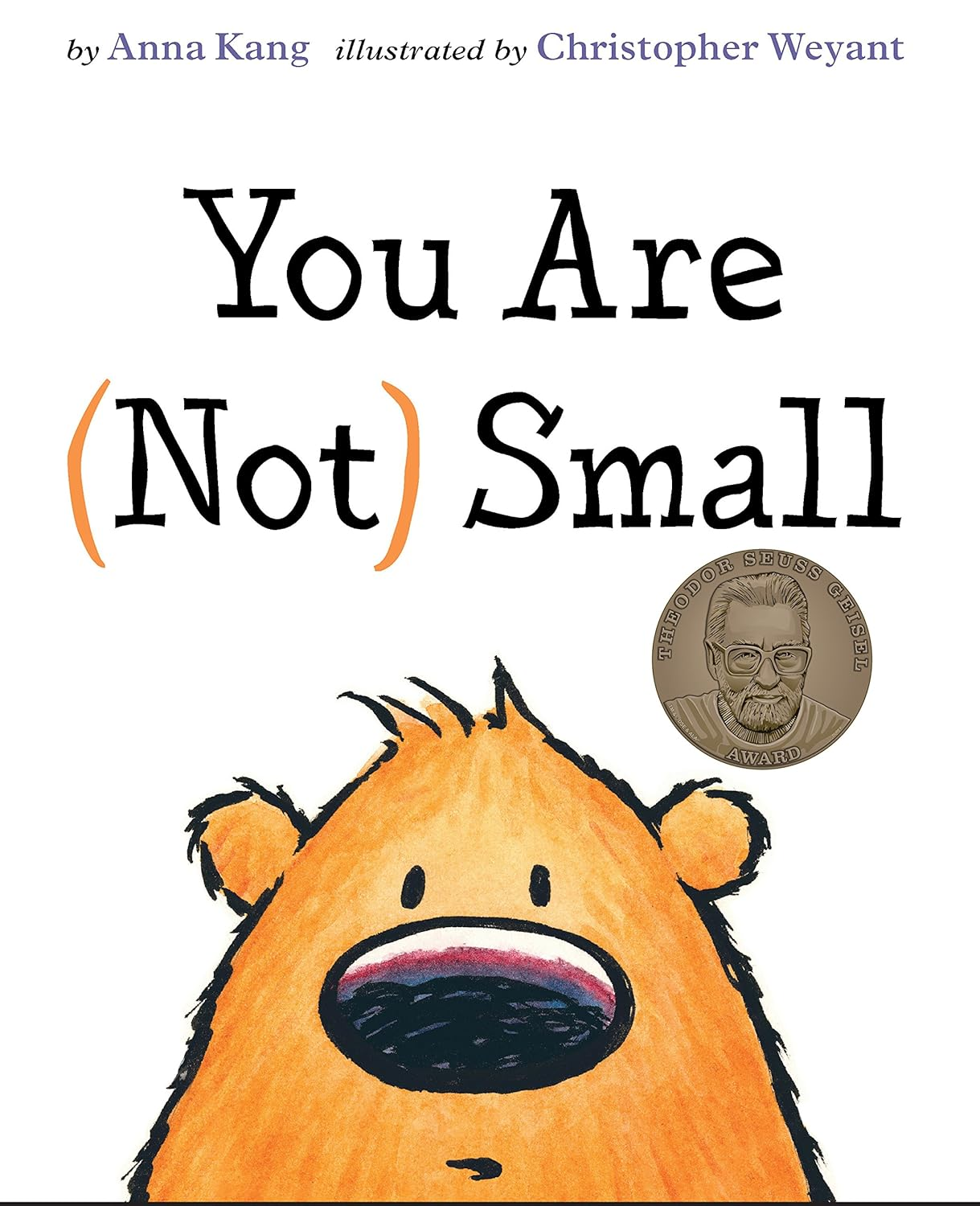
You Are (Not) Small by Anna Kang; illustrated by Christopher Weyant

This one doesn’t have the word BIG in the title, but it shows up several times in the text. Two bears argue over whether they are each “big” or “small,” until the arrival of much bigger and smaller bears make it clear that size is relative. The kids really enjoyed the illustrations.

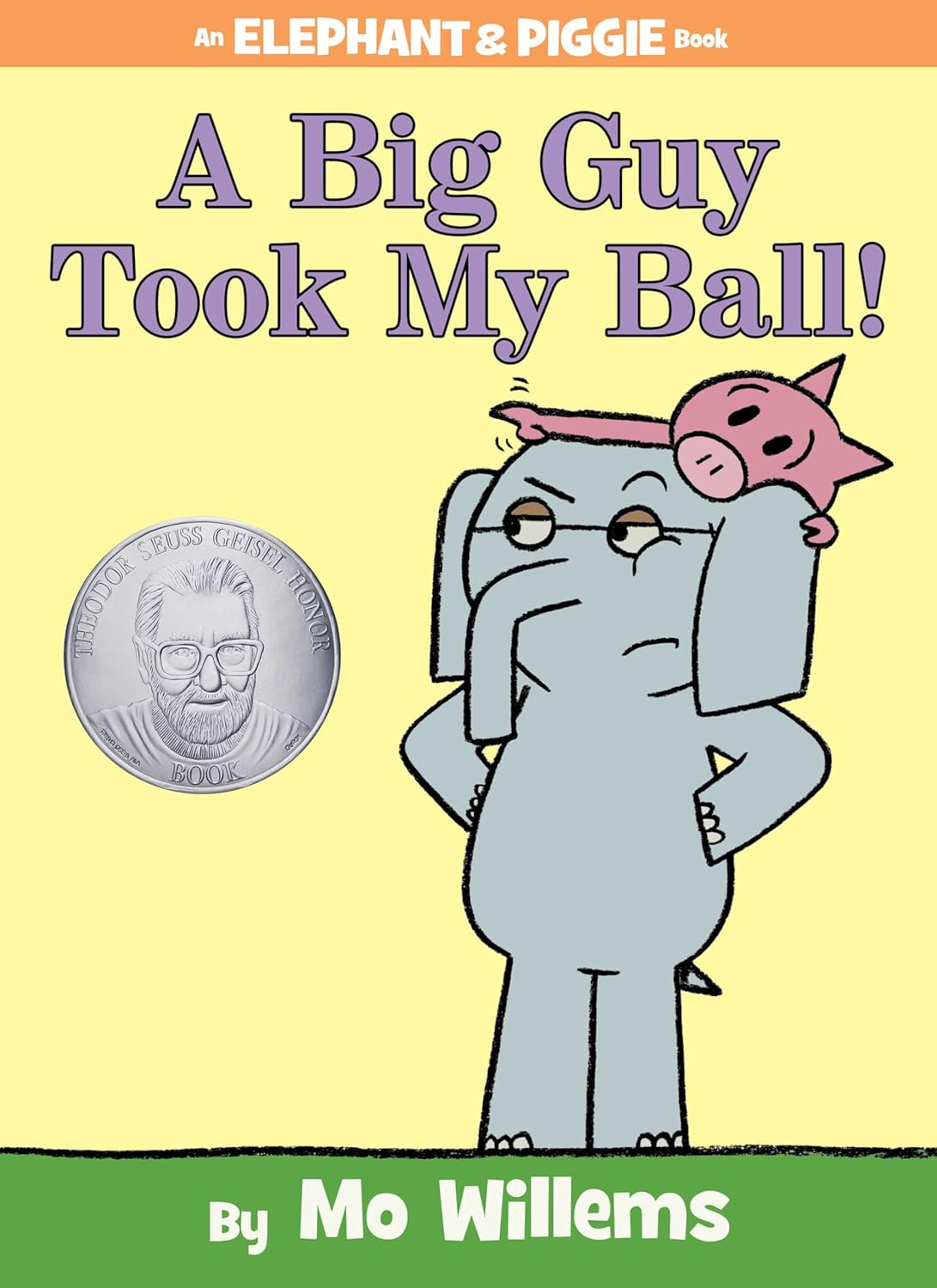
A Big Guy Took My Ball by Mo Willems

One of my favorite Elephant and Piggie books! Just before I read this one for Family Storytime, our town mayor happened by. She’s a school librarian and we used to do storytime together, so I asked her to read this one with me (she read Gerald’s parts and I read Piggie’s). The kids were surprised to find themselves being read to by the mayor, and it made me think that I should bring in more guest readers. Anyway, in the book, Piggie complains to Gerald that a “big guy” has taken the big ball that she found. When Gerald promises to get the ball back, he finds that the big guy is a whale, who is grateful that they found his “little ball.” The part where Gerald talks about how big the “big guy” always gets a laugh.

Songs:

B-I-N-G-O

I sang this to go along with Clifford, the Big Red Dog. This is an old standby, but here’s a video from Super Simple Songs, just in case you’re not familiar with it. Traditionally, you leave out a letter each time you sing it, and clap instead. To go along with our theme, I had the kids bark the missing letters instead, and alternated between barking like a big dog, and barking like a small one.

[C] There was a farmer [F] had a [C] dog,
And Bingo [G] was his [C] name-o.
[C] B-I- [F] N-G-O
[G] B-I- [C] N-G-O
[Am] B-I- [F] N-G-O
And [G] Bingo was his [C] name-o.

There was a farmer had a dog,
And Bingo was his name-o.
(Clap!)-I-N-G-O!… etc.

Elephants Have Wrinkles

We sang this one at Family Storytime to go with the book A Big Guy Took My Ball. I asked the kids to suggest new places where elephants have wrinkles (on their foreheads, on their neck, etc.) for each verse, and we sang it a little faster each time.

Elephants have (pat legs on each syllable)
Wrinkles, Wrinkles, Wrinkles (clap hands on each syllable)
Elephants have (pat legs on each syllable)
Wrinkles (clap hands on each syllable)
Everywhere! (stomp feet on each syllable)
On their nose! Oh-oh! (touch your nose, and mime a trunk)

Repeat

Elephants have wrinkles…

On their legs! On their nose! Oh-oh!

The Itsy Bitsy Spider

We sang this with the parachute for Outdoor Musical Storytime. The first time through, I put a tiny plastic spider on the parachute and we bounced it up and down, which the kids found quite exciting. The second time through, I put a large plastic spider on the parachute and we sang, “The great big hairy spider” instead.

The itsy bitsy spider went up the water spout.
Down came the rain and washed the spider out!
Out came the sun and dried up all the rain,
And the itsy bitsy spider went up the spout again.

The great big hairy spider went up the water spout…

Baby Shark

We ended with the Pink Fong version of Baby Shark (which features different sizes of shark) as our instrument play-along.

[C] Baby shark, doo doo doo doo doo doo
[F] Baby shark, doo doo doo doo doo doo
[Am] Baby shark, doo doo doo doo doo doo
[G] Baby shark!

Mommy shark, doo doo doo doo doo doo…

Daddy shark…

Grandma shark…

Grandpa shark…

Let’s go hunt…

Run away!…

That’s the end…

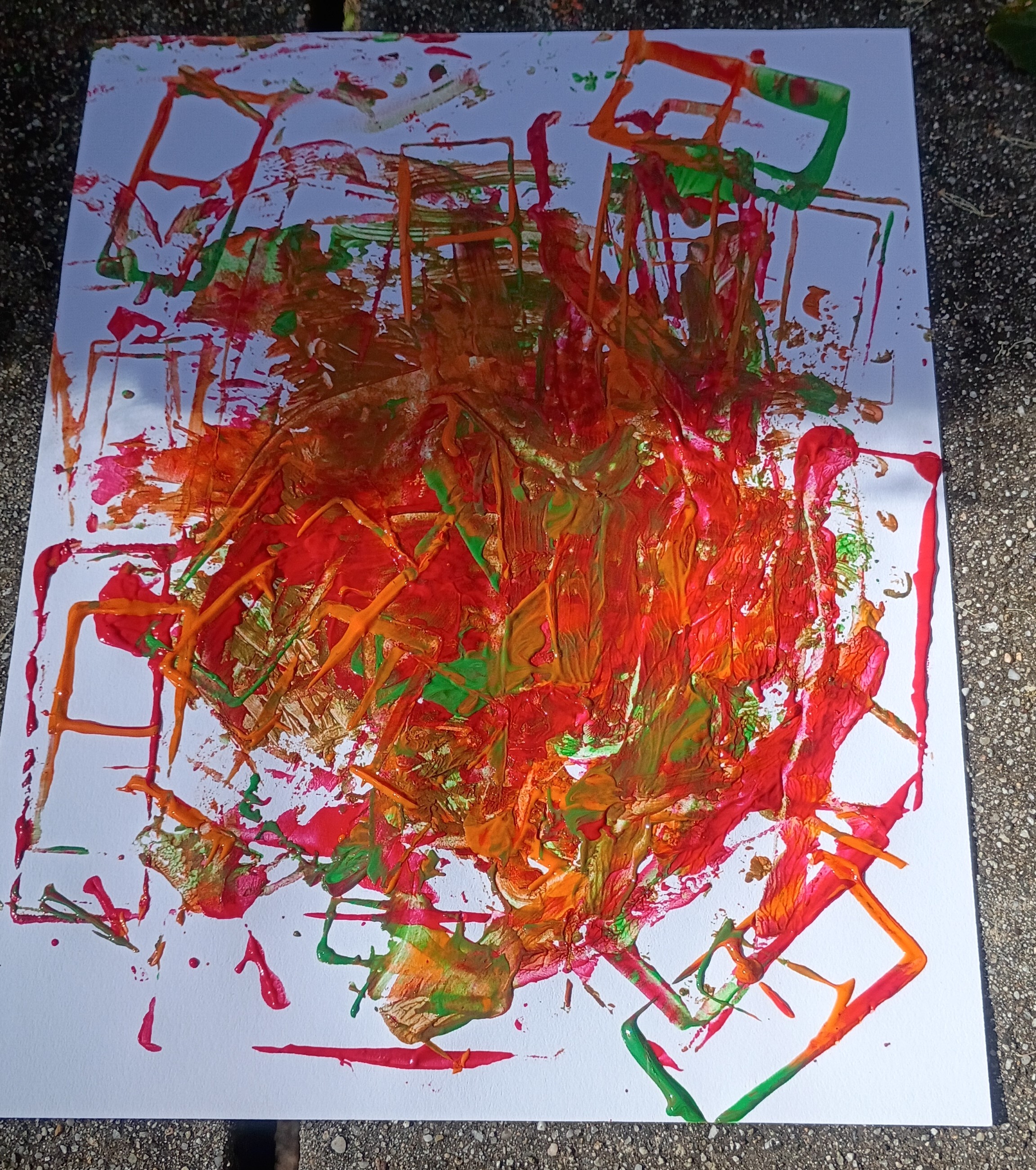
Stay & Play: Pom-Pom Painting

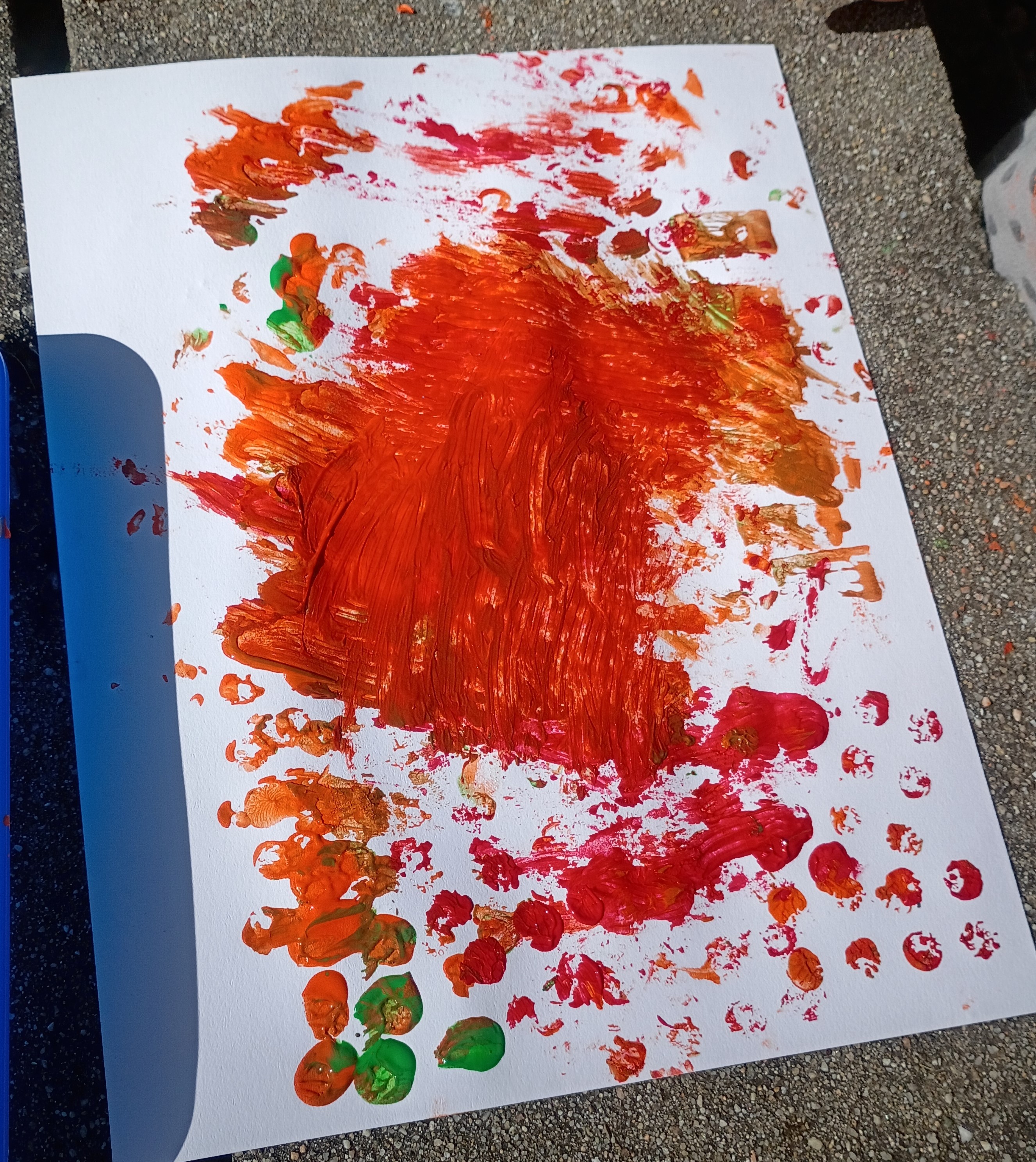
This was a really simple, if messy Stay & Play craft. I just put out white paper, pom-poms of various sizes, and pie tins with different colors of tempera paint. The kids had a great time exploring the colors and imprints of the different pom-poms, and the way they blended together on the page.

Do you have any favorite books or songs featuring the word “Big,” or any favorite literacy tips you like to share? Please let me know in the comments.

Music to My Ears: A Storytime About Songs

I’ve been trying to incorporate more early literacy tips into my storytimes lately, so I thought I would try to actually build each of my storytimes around a literacy tip. Last week, I focused on the idea of pointing out common sight words that kids are likely to see out in the world, by doing a storytime around the word “STOP!” This week, I decided to talk about the importance of using songs and rhymes to build pre-reading skills.

I started by talking about how sharing songs and rhymes with young children is one of the easiest ways to help them become strong readers later on. And a fun way to incorporate music into daily life is to make up your own versions of popular songs. To demonstrate this idea, I shared books that were all based on traditional rhymes and children’s songs.

Here’s what we did for Outdoor Musical Storytime (I’m also including a book we read in Family Storytime that fit the theme):

Books:

Hush, Little Trucker by Kim Norman; illustrated by Toshiki Nakamura

I love this picture book because it combines a traditional lullaby with construction vehicles. Based on the song Hush, Little Baby, this book features a mother describing how she will search for her son’s lost toy truck using a wide variety of other machines. The kids enjoyed calling out the names of the different vehicles.

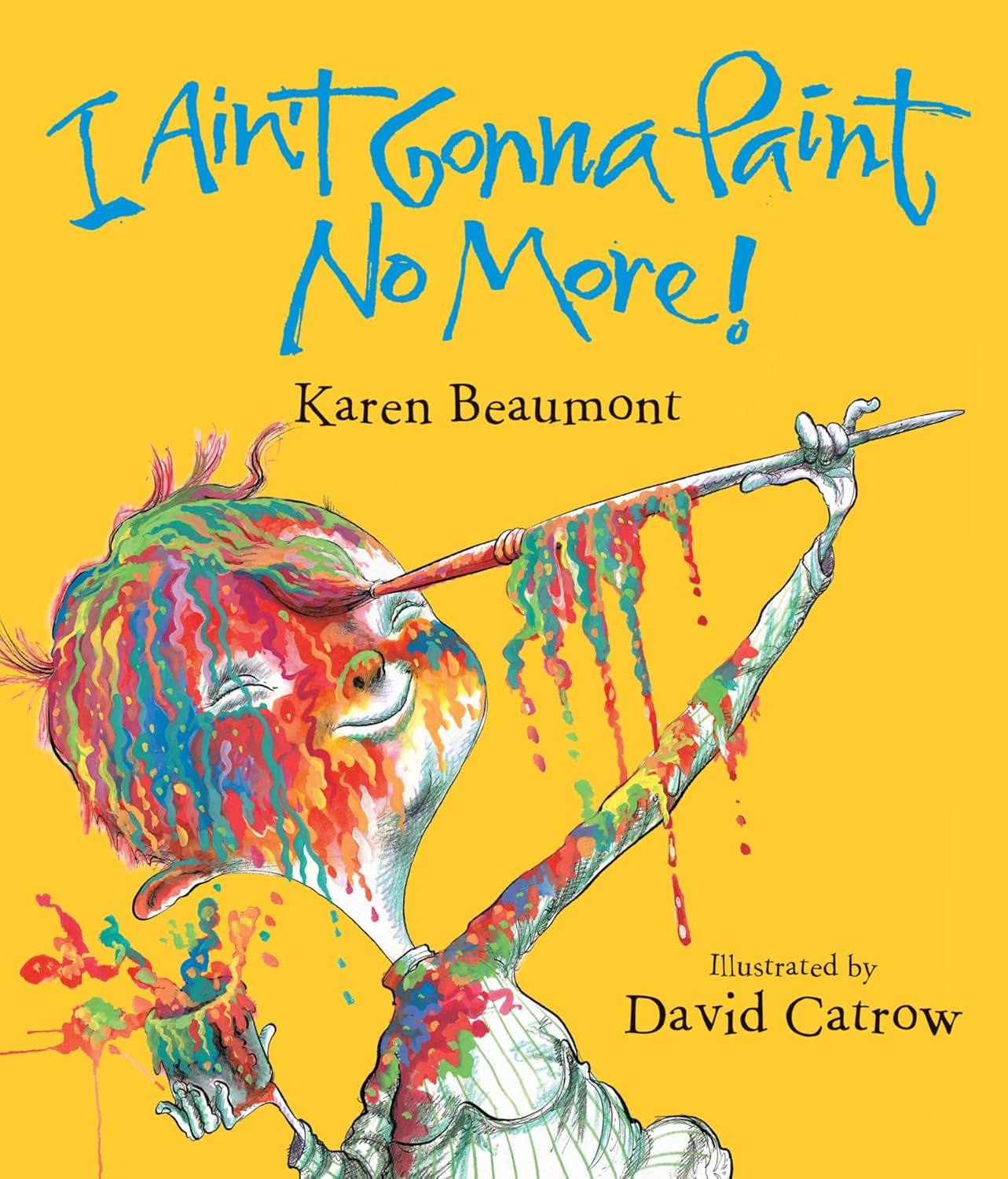
I Ain’t Gonna Paint No More by Karen Beaumont; illustrated by David Catrow

This is one of my all-time favorite storytime books: a parody of It Ain’t Gonna’ Rain No More about a little boy who defies his mother by painting different parts of his body. I gave out the play scarves before we read it, and I had the kids pretend they were paintbrushes. They loved trying to guess which body part we were painting next, based on the rhyme.

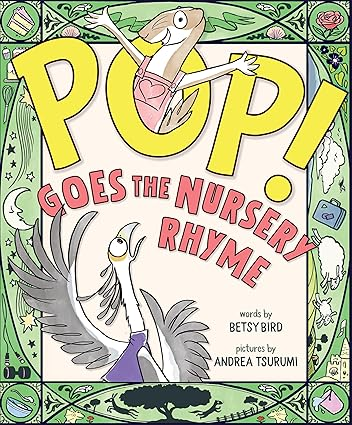
Pop! Goes the Nursery Rhyme by Betsy Bird; illustrated by Andrea Tsurumi

I actually did this book last week for Family Storytime, and I enjoyed it so much that I used it for Outdoor Musical Storytime this week (I also read it to two T/K classes, who both kept singing “Pop, Goes to Weasel” long after I stopped reading). It features several famous nursery rhymes (Jack and Jill, Pat-a-Cake, Twinkle, Twinkle) that all get interrupted by a weasel popping out to sing, “Pop! Goes the Weasel.” The kids still had the play scarves from the previous book, so I had them throw their scarves in the air every time we got to the word, “Pop!”

Here We Go Digging for Dinosaur Bones by Susan Lendroth; illustrated Bob Kolar

Cute, informative picture book based on the song Here We Go Round the Mulberry Bush, all about excavating dinosaur bones. I had the kids act out the motions: digging the bones, brushing them off, wrapping them up, and assembling them. Each page has additional facts about paleontology.

Songs:

We Are Scary Ghosts

I was originally going to do The Wheels on the Bus to go with the book Hush, Little Trucker (I love to have the kids suggest animals, Pokemon, or superheroes to go on the bus, like “The Pikachu on the bus goes, “Pika! Pika!”). But since we had the play scarves, and it was close to Halloween, I decided to do one of my favorite Halloween storytime songs instead. I had the kids put the scarves on their heads, and pull them off on the “BOO!”

We are scary ghosts floating down the street,
Walking down the street,
Walking down the street.
We are scary ghosts walking down the street,
We’ll scare you…BOO!

Pop, Goes the Weasel

We did this song with the parachute. I put a few small stuffed animals on the parachute so we could make them pop up in the air (I just wish I had a toy weasel!) Here’s a Rock N Learn video with the tune, in case you aren’t familiar with it.

All around the cobbler’s bench,
The monkey chased the weasel.
The monkey thought ’twas all in fun,
“Pop!” Goes the weasel!

Down by the Bay

We did this as our instrument play-along at the end. I had the kids suggest ideas for what the mother says in each verse. We had “Did you ever see bananas wearing pajamas?” and “Did you ever see a cat wearing a hat?”

[C] Down by the bay, where the watermelons [G7] grow,
Back to my home, I dare not [C] go,
For if I [F] do, my mother will [C] say,
“Did you ever see a whale with a polka dot tail
[G7] Down by the [C] bay?”

Stay & Play: Paper Plate Maracas

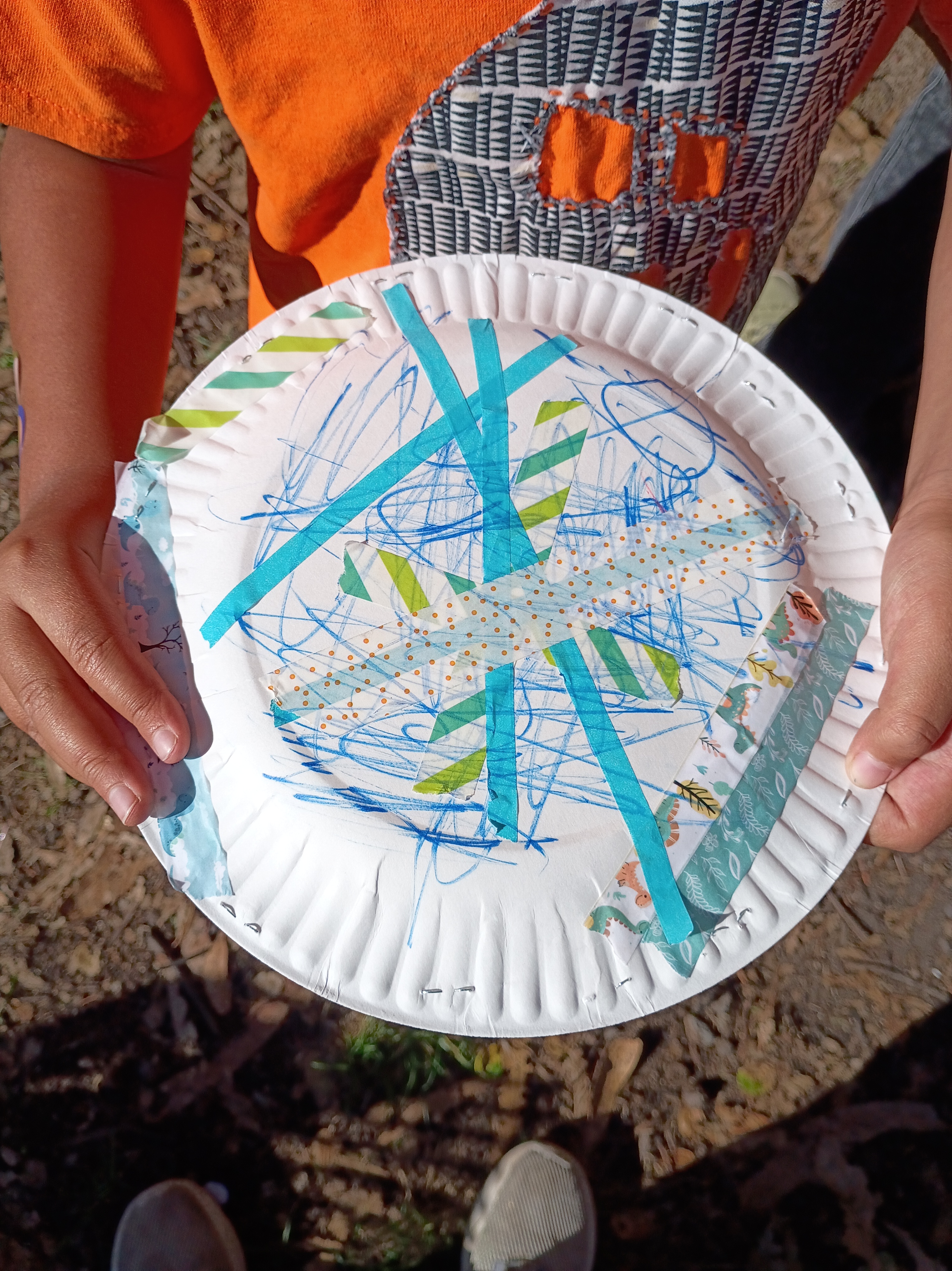
For the Stay & Play, I put out paper plates, markers, & washi tape. Each of the kids decorated the bottoms of two plates. My coworker and I helped them put a small amount of rice on top of one of their plates, then we put the other plate on top and stapled them both together (we did all the stapling). I also showed them how to put washi tape around the outside of the plates to cover any gaps. NOTE: I know using food items as a craft supply can be problematic, but we had an old, open bag of rice in the supply closet, so I made an exception this time. You can also use beads or other small objects.

What are your favorite early literacy tips, or your favorite picture books based on songs? Please share them in the comments below.

Stop and Go: A Storytime

In our library system, we’ve recently been discussing making more of an effort to incorporate literacy tips for caregivers into our storytimes. I’ll admit that I often struggle to find a natural way to include them. So, this week I decided to build my storytime around a common sight word (“Stop”) and encourage families to look for it together out in the world.

I began by holding up a paper stop sign, and talking about how a great way to prepare for learning to read is to look for words that you encounter a lot in your daily life. I then asked the kids what the sign said. A number of the older ones recognized it as a stop sign.

Here’s what I did for the rest of the storytime (a combination of the books I used for both Outdoor Musical Storytime and Family Storytime). For Family Storytime, I also included the words “Go” and “Pop” (see below).

Books:

Go! Go! Go! Stop! by Charise Mericle Harper

This is a great book for modeling pointing out prominent words in a picture book, and getting the kids to call them out. The story is about Little Green, who can only say the word “Go!” At first the construction vehicles find him very helpful, but things quickly become too chaotic. Luckily, Little Red rolls into town and says the word, “Stop!” and the two learn to work together to help the vehicles finish building the bridge. One of the toddlers in my Family Storytime kept pointing to the different construction vehicles on each page and expounding at length on each one. I had no idea what he was trying to say, but he was VERY excited!

Go Away, Big Green Monster! by Ed Emberley

I had to include this one for Family Storytime, both because of the word “Go” and because it’s close to Halloween. I love how kids of all ages are mesmerized by the way the parts of the monster’s face disappear on each page. I usually have them make a “whoosh” noise and waive their hands after each “Go Away” page. I once saw a children’s performer use this book to teach the words for the parts of the face in Mandarin, which I thought was clever, although it was funny that the main Mandarin phrase the kids came away with was “Go away!”

Stop That Mop! by Jonathan Fenske

This rhyming easy reader feels like a Dr. Seuss version of The Gingerbread Man. A mop gets tired of mopping up a pig’s glop and slop, so he runs away. He is chased by a bunny, a horse, and is finally confronted by a Stop sign, who tries to save him from falling off of cliff (luckily he lands on top of a bird). A cute, simple story with fun illustrations.

Stop Snoring, Bernard! by Zachariah Ohora

Simple story about an otter who can’t find a place to sleep where his snoring won’t bother any of the other animals. But eventually his otter friends and families tell him that they miss him. Lots of fun opportunities for the kids to snore and yell, “Stop snoring, Bernard!”

Pop! Goes the Nursery Rhyme by Betsy Bird; illustrated by Andrea Tsurumi

I read this at Family Storytime, even though it doesn’t include the word “Stop” at all. But it did provide an opportunity to talk about rhyming words. This is a really fun book featuring a series of popular nursery rhymes that all get interrupted by a weasel yelling, “Pop! Goes the Weasel.” I gave out the play scarves before we read it, and had the kids throw their scarves in the air each time we yelled “Pop!” I also read this at a preschool the next day, and one boy begged me to read it again.

Songs & Activities

Stop & Go

For this activity, I held up a paper Stop Sign and a paper Go sign. We all did different actions together (clapping, stomping, running in place, etc.) while I was holding up the Go sign, and then stopped when I held up the Stop sign.

Head and Shoulders, Knees & Toes

We sang this after reading Go Away, Big Green Monster in Family Storytime. I always start by having the kids point to the different body parts before we sing (I always say, “Did you bring your head today?”). But midway through this process, one little girl shouted, “Elbow!” So, the second time we sang it, I sang “elbow” instead of “nose.” They thought it was hilarious! I used this trick again yesterday at a couple of preschools, and threw in “eyebrow” instead of “nose” the third time we sang it. It’s so much fun to catch kids by surprise.

Head and shoulders, knees and toes, knees and toes.
And eyes and ears, and mouth and nose.
Head and shoulders, knees and toes, knees and toes.

We Bounce and We Bounce and We Stop

This is similar to the Stop & Go activity above, but in song form. It’s one of my all-time favorite storytime songs, because it’s so versatile. For Outdoor Musical Storytime, we sang it with the parachute as “We shake and we shake and we stop!”

[C] We bounce and we bounce and we stop!
[C] We bounce and we bounce and we stop!
[C] We bounce and we bounce and we bounce and we bounce,
[C] And we bounce and [G7] we bounce and we [C} stop!

Dance Like You’ve Got Ants in Your Pants by Eric Herman

We did this as our instrument play-along at the end. It’s such a fun song. Each time we spray our imaginary spray, I usually say, “And the ants (bees, bears) say, ‘Ewww! Ewww! Ewww!” and run away!

[C] Dance like you’ve got [G7] ants in your pants.
[F] Dance like you’ve got [G7] ants in your pants.
[C] Dance like you’ve got [G7] ants in your pants,
Now [F] STOP! And spray some ant spray!

[C] Dance like you’ve got [G7] bees on your knees.
[F] Dance like you’ve got [G7] bees on your knees.
[C] Dance like you’ve got [G7] bees on your knees,
Now [F] STOP! And spray some bee spray!

[C] Dance like you’ve got a [G7] bear in your hair.
[F] Dance like you’ve got a [G7] bear in your hair.
[C] Dance like you’ve got a [G7] bear in your hair,
Now [F] STOP! And spray some bear spray!

[G7] Bop! Bop! Bop! [F] Until you [C] drop!
[G7] Hula, Hula, Hula! [F] Until you [C] drool-a!
[C] Jump like you got [G7] bumped on your rump.
[F] Jump like you got [G7] bumped on your rump.

[C] Jump like you got [G7] bumped on your rump,
Now [F] STOP!
[G7] Dance anyway, [F] Dance any [C] how,
[G7] Dance any night and day.

[F] Keep on dancing [C] now.
[G7] Dance any way you want to.
[F] Dance any way you [C] can.
[G7] Dance like you got ants [F] in your pants a- [C] gain!

[C] Dance like you’ve got [G7] ants in your pants.
[F] Dance like you’ve got [G7] ants in your pants.
[C] Dance like you’ve got [G7] bees on your knees.
[F] Dance like you’ve got [G7] bees on your knees.

[C] Dance like you’ve got a [G7] bear in your hair.
[F] Dance like you’ve got a [G7] bear in your hair.
[C] Jump like you got [G7] bumped on your rump.
[F] Jump like you got [G7] bumped on your rump.

[G7] Bop! Bop! Bop! [F] Until you [C]drop!
[G7] Dance, Dance, Dance, [F] don’t ever [C] STOP!

Stay & Play: Stop Sign Collages

Before storytime, I printed and cut out paper stop sign templates. I also cut red tissue paper and origami paper into small pieces. For the Stay & Play, I gave the kids the template, along with glue sticks, red washi tape with different patterns, a variety of colored sequins, the paper pieces, popsicle sticks and tape. Some of them got really into decorating their stop signs, and they all loved being able to hold them up and yell, “Stop!” when they were done.

What are your favorite literacy tips to share with families and caregivers, and how do you incorporate them into your programs? Please share in the comments below.

Going Out on a Limb: A Storytime About Trees

Last week, we enjoyed celebrating trees in both Outdoor Musical Storytime and Family Storytime.

Here’s what we did:

Books:
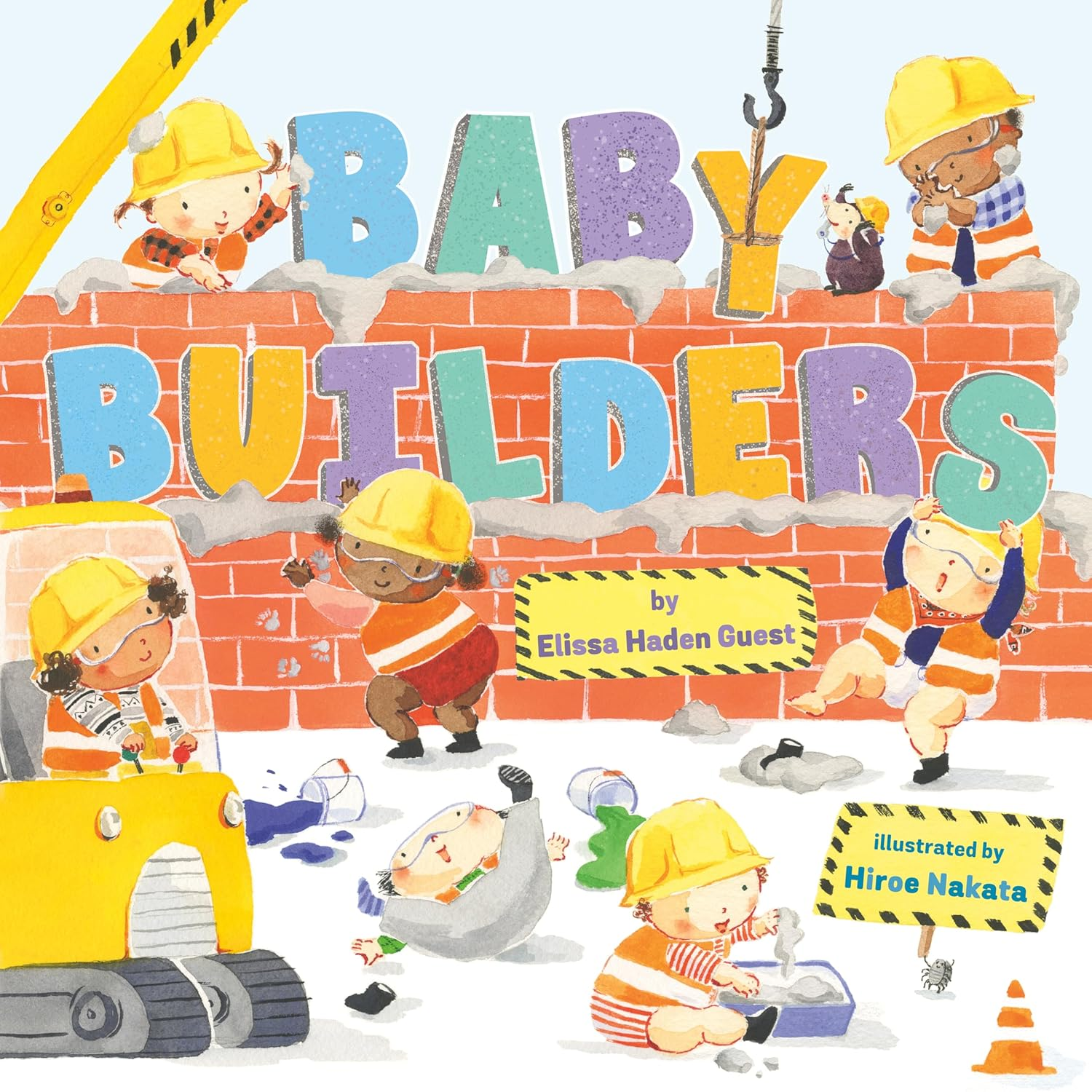
Stuck by Oliver Jeffers

Hilariously over-the-top story about a boy whose kite gets stuck in a tree, so he tries to get it down by throwing increasingly large objects at it: his shoes, a ladder, a firetruck, the house across the street, etc. This one always gets laughs.

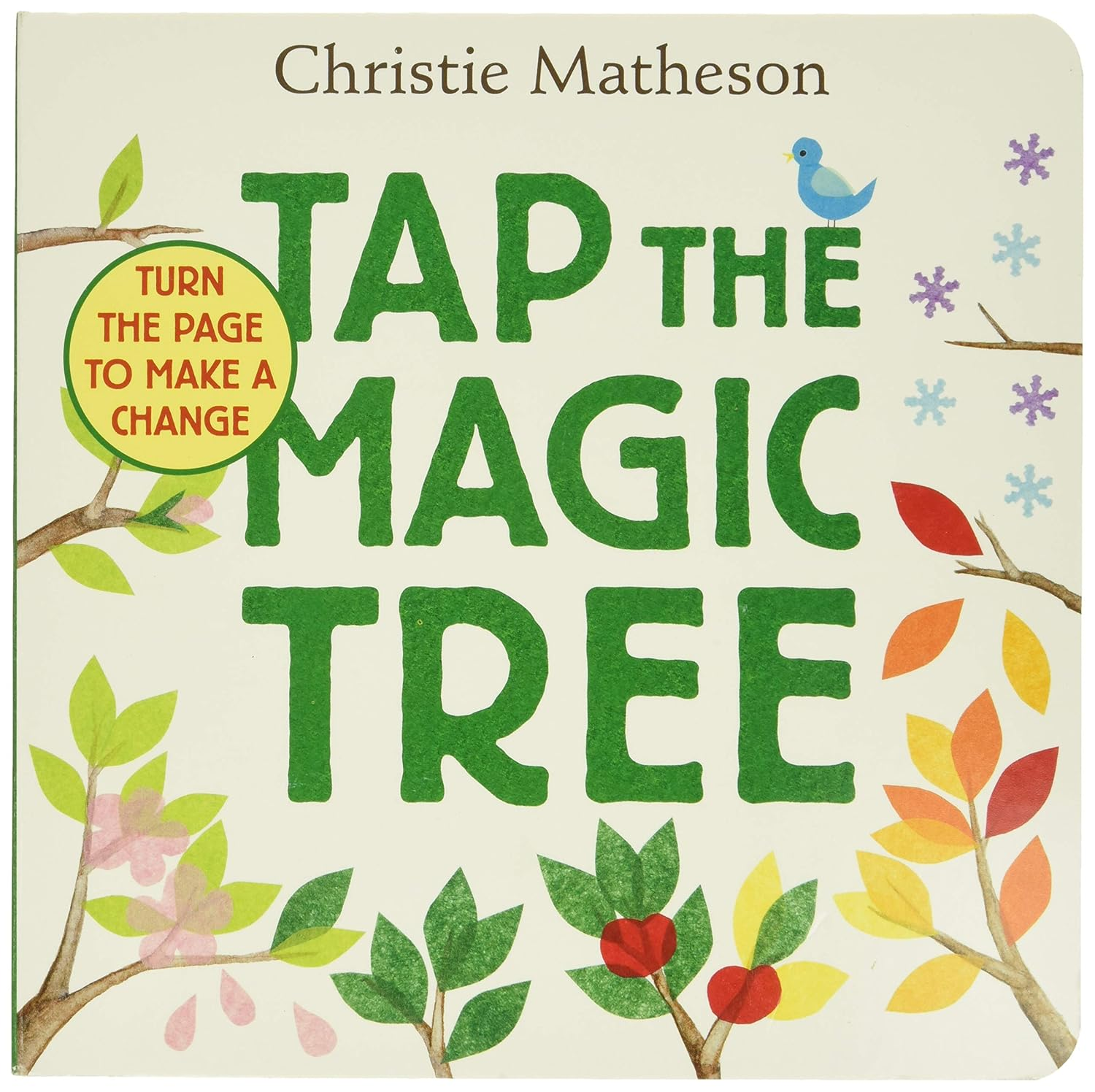
Tap the Magic Tree by Christie Matheson

One of my favorite interactive picture books, which asks readers to tap an apple tree to make leaves appear, rub the leaves to make buds, etc., as it follows the cycle of growth throughout the course of a year. With my larger groups, I have the kids tap an imaginary tree in the air, but with smaller ones, I bring the book around and let each child interact with a page.

Ol’ Mama Squirrel by David Ezra Stein

Ol’ Mama Squirrel guards her babies fiercely by chanting “Chook! Chook! Chook!” at any potential predators. But when a big bear threatens her family, she gathers all of the Mama squirrels in the park to scare him away. The kids enjoyed joining in on the “Chook, Chook! Chooks!”

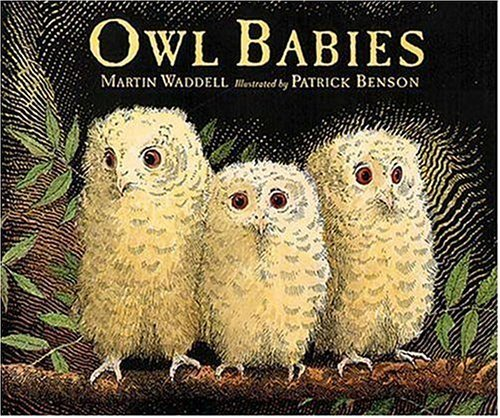
Owl Babies by Martin Waddell; illustrated by Patrick Benson

This is one of my all-time favorite picture books: the story of three baby owls waiting for their mother to return to the nest. It’s such a sweet, relatable story, and the part where the mother owl returns always gets big smiles from both kids and grown-ups.

The Starry Giraffe by Andy Bergmann

The hungry Starry Giraffe picks apples from a tree, but ends up giving each one to a hungrier animal, until they are all gone. I love the twist at the end.

Songs & Rhymes:

I Bought Me a Rooster

I love this traditional cumulative song, because it gives the kids a chance to suggest their favorite animals for each verse.

[C] I bought me a rooster and the rooster pleased me
I fed my rooster on the [G7] bayberry tree
[C] My little rooster goes, [F] “Cock-a-doodle doo!
Dee [C] Doodle, Dee [F] Doodle, Dee [G7] Doodle, Dee [C] Doo!”

[C] I bought me a dog and the dog pleased me
I fed my dog on the [G7] bayberry tree
[C] My little dog goes, [F] “Ruff! Ruff! Ruff!”
[C] My little rooster goes, [F] “Cock-a-doodle doo!
Dee [C] Doodle, Dee [F] Doodle, Dee [G7] Doodle, Dee [C] Doo!”

I bought me a cow and the cow pleased me…etc.

I’m a Wide Eyed Owl

You can sing this to the tune of Turkey in the Straw, or just chant it as a rhyme:


I’m a wide-eyed owl (make circles with your fingers to look like eyes)
With a pointed nose (make a V with your index fingers and hold it up to your nose),
I have pointed tufts (hold your index fingers up on either side of your head),
And claws for toes (wiggle your fingers like claws).
I live in a tree,
And I’m looking at you (point your finger).
When I flap my wings (flap arms),
I say, “Whoooo! Whooo!”

Way Up High in the Apple Tree

We did this rhyme with the parachute for Outdoor Musical Storytime. I put two apple-shaker instruments on the parachute, and we lifted it up and down. For Family Storytime, I gave each child two play scarves to bundle up in their hands like apples. Then I asked them to suggest other foods they would like to pick from a tree. They suggested mangos, oranges, and sandwiches.

Way up high in the apple tree,
Two little apples smiled at me.
I shook that tree as hard as I could!
Down came the apples.
Mmmm! They were good!

Under a Shady Tree

We sang this as our instrument play-along at the end of both storytimes.

[C] Under a shady tree, you and me.
Under a [G7] shady tree you and [C] me.
Under a shady tree you and me.
Lying under a [G7] shady tree you and [C] me.

Can you [G7] feel the breeze blow by?
Can you [C] feel it on your face?
This is our [F] special [G7] place.

[C] Under a shady tree, you and me.
Under a [G7] shady tree you and [C] me.
Under a shady tree you and me.
Lying under a [G7] shady tree you and [C] me.

Can you [G7] feel the soft cool grass?
Can you [C] feel it with your toes?
We can [F] sit here while it [G7] grows.

[C] Under a shady tree, you and me.
Under a [G7] shady tree you and [C] me.
Under a shady tree you and me.
Lying under a [G7] shady tree you and [C] me.

If you want to [G7] close your eyes,
And [C] sleep beneath the tree,
You can [F] rest your head on [G7] me.

[C] Under a shady tree, you and me.
Under a [G7] shady tree you and [C] me.
Under a shady tree you and me.
Lying under a [G7] shady tree you and [C] me.

Stay & Play: Mixed Media Trees

This was a really simple Stay & Play. Before storytime, I printed out tree templates from CraftsOnSea, and picked a variety of leaves from trees and plants. For the Stay & Play, I put out the templates, leaves, glue sticks and markers. The kids really enjoyed gluing the leaves on their tree, and decorating it with the markers.

Do you have any favorite books or songs about trees? Please share them in the comments below.

Reaching Out: Library Outreach and Satellite Libraries

Thumbprint/Dot Marker Picture from One of Our Aftercare Sites

This past year, my coworkers and I have been making an effort to connect with kids and families who aren’t usually able to attend our regular library storytimes and programs. We were already offering an evening Family Storytime once a week, as well as a Saturday one, and for many years we have been providing monthly storytimes at local preschools, but most of our in-library activities and special programs were still mostly scheduled during regular work hours, and tended to attract most of the same people.

At the beginning of last year, my coworker Rachel Evans suggested that we visit local aftercare programs, where kids go after school until their parents can pick them up. She reached out to each of them to schedule a time for us to visit once a month, and bring a simple staff-led activity. There turned out to be a LOT of programs, far more than one or two people could manage. In the end, most of our staff ended up signing up to cover a location, and we’ve even brought in some volunteers to help with the larger sites.

I’ve been surprised to see how many kids are in each of the aftercare programs. Some of them have over a hundred students. It’s been a lot of fun to get to know the kids at each location, and they are always excited for the change of routine, and a chance to be creative.

We’ve also created satellite library collections for each location. These are bins of 30 to 40 library books (we usually pull duplicate copies from our shelves to fill them) that are checked out to a library card created for that site. We tell the aftercare providers that they don’t have to worry about keeping track of the books, and that the kids are welcome to bring them home. We exchange the books for new ones at each visit. Yesterday I brought a bin to an aftercare program for the first time, and the kids were literally begging to look at the books. They were also eager to tell me what types of books they would like me to bring next time.

Here are some of the activities we have done with the aftercare sites so far:

  • Decorate a bandana: We brought white bandanas and fabric markers, as well as pictures of different ways to use bandanas (neckerchiefs, head-scarves, headbands, hair ties, pirate-style, etc.).
  • Beading: We brought pipe cleaners and a wide variety of pony beads, including alphabet beads. The kids loved making bracelets for themselves, as well as for their friends and family.
  • Thumbprint art: We brought stamp pads, white paper, markers, and lots of baby wipes, along with examples of different animals and objects made from thumbprints, including Ed Emberley’s Thumbprint Art book. We also brought dot markers, for kids who didn’t want to get their fingers inky. Some of the kids enjoyed making artwork just with those.
  • Button making: We brought our button maker, along with precut paper circles, markers, mylar circles, and pinback button supplies. The kids LOVE designing their own buttons, although operating the button machine can be a bit staff intensive.
  • Bookmark decorating: We brought precut cardstock bookmarks, markers, and yarn to make tassels. The kids made lots of bookmarks for family and friends.
  • Lego Drop Challenge: We brought bins of Legos and challenged the kids to make something with 20 pieces that could survive being dropped from a height of seven feet (we marked the feet on a wall). This was a HUGE hit at all of our sites.

A few tips that we’ve learned along the way:

  • Keep the projects open-ended: Most of the day cares cater to a wide range of grade levels, so it’s better to provide activities that kids can participate in regardless of their age, reading abilities, etc. Also, because the groups tend to be large, with a lot of in-and-out, it’s best to avoid anything that requires a lot of instruction.
  • Stick to generic supplies: We’ve found that it’s best to stick to projects where the supplies don’t have special designs, like stickers where there might be only a few of a particular kind.
  • It helps to provide some pictures or samples of different ways to do the activity: With the bandana decorating, some of the kids weren’t interested until they saw all of the different ways they could wear the bandana. Then suddenly we had several excited groups of bandits, pirates, and cowboys, along with several headbands and hair ties.
  • Encourage kids to make the activity their own: I always tell the kids that they don’t have to do the project the way I did it. Often they will take the materials in a whole new direction. One day, I brought pipe cleaners to an aftercare so that they could make animal sculptures, and one of the girls made a pipe cleaner pumpkin instead. Soon they all wanted to learn how to do that. She taught me how to do it, and I ended up making it part of a Halloween program at the library a few weeks later. The same girl used the yarn from our bookmark decorating activity to do some finger knitting, and soon all the kids wanted to try that too. It’s always so much fun to see them finding inspiration from each other.

Overall, the outreach has been incredibly successful. I’ve even been seeing some of the aftercare kids visiting the library with their parents. It’s always really gratifying to hear them say, “You came to my daycare!”

Do you have any activities that have been successful at aftercare sites or other locations? Please share them in the comments below.
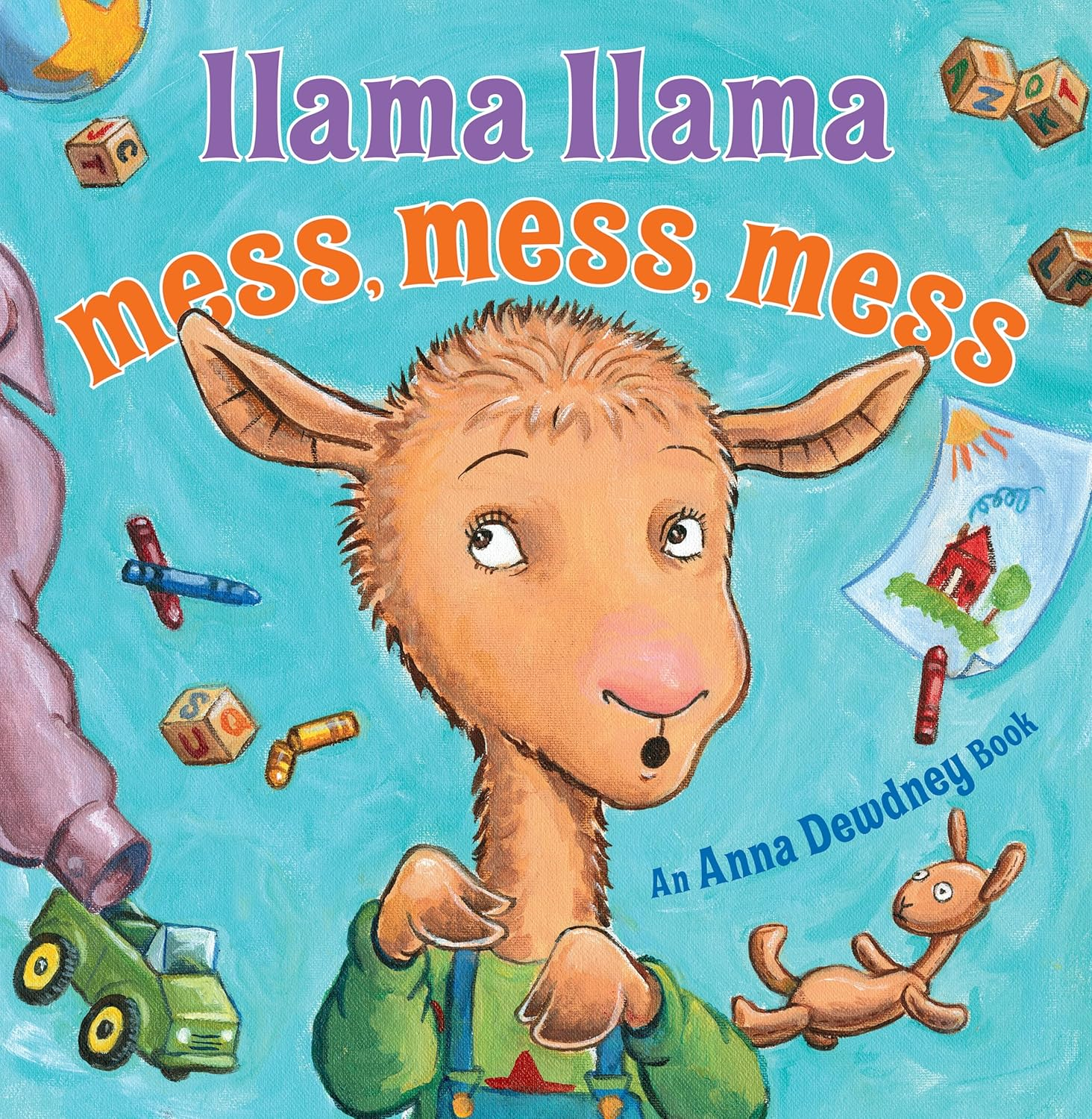
Page Turners: A Storytime for Picture Book Month

November is Picture Book Month, so I thought it would be fun to celebrate some of the classic picture books that have stood the test of time. Please share your favorites in the comments below.

Books:

Caps for Sale by Esphyr Slobodkina

This is such a fun book to read aloud, and is one of the earliest examples of a story that seems designed for audience participation. A cap seller wakes from a nap to discover that all of his caps have been stolen by monkeys, who copy everything he does. The kids loved pretending to be the monkeys and making, “Tsz! Tsz! Tsz!” noises.

Corduroy by Don Freeman

This was one of my very favorite childhood stories, about a bear searching for his lost button, after the mother of a little girl who wants to buy him points out that it is missing. I did preface the book by explaining that mattresses always used to have buttons sewn on the top, since a lot of modern mattresses aren’t made that way, but the kids clearly understood the humor of Corduroy mistaking an escalator for a mountain, and a department store for a palace. The ending got lots of “Awww’s!”

Madeline by Ludwig Bemelmans

I still have a copy of this book that my grandmother gave me. She suffered from Parkinson’s disease for most of her life, causing her to lose the use of her right hand, so the message she inscribed to me on the title page is written in her shaky handwriting. Sharing it at storytime this week brought back a lot of memories of her, and it was gratifying when several of the kids asked if there were other books about Madeline, which they eagerly checked out before they went home. I think the book is kind of amazing for the way it manages to pack so much into a concise, but memorable little poem: a unique character, an emergency trip to the hospital, and the humor of a whole school full of girls envying the attention their classmate receives after what would ordinarily be seen as a traumatic event.

Where the Wild Things Are by Maurice Sendak

I love reading this book aloud because the kids are always absolutely mesmerized by the magical story of Max, and his journey to the land of Wild Things. They also enjoyed pretending to be Wild Things: roaring and gnashing their teeth.

Songs:

Monkey See & Monkey Do

I don’t remember where I learned this song, but it’s one of my favorites, and it was the perfect follow-up to Caps for Sale.

When you clap, clap, clap your hands,
The monkey clap, clap, claps his hands,
Monkey see, and monkey do,
The monkey does the same as you!

Repeat with other motions: when you jump up and down; make a funny face; turn yourself around; and sit back on the ground.

When the Bears Go Marching In

Fun variation of When The Saints Go Marching In. We sang it with the parachute at Outdoor Musical Storytime, and I threw different stuffed animals onto the parachute for each verse. The kids loved watching them fly up and down.

[C] Oh, when the bears go bouncing in,
Oh, when the bears go bouncing [G7] in,
Oh, [C7] how I want to be in that [F] number,
When the [C] bears go [G7] bouncing [C] in!


Repeat with other actions, like:
Oh, when the bears go clapping in…
Oh, when the bears go stomping in… etc.

You Sing a Song by Ella Jenkins

Ella Jenkins just died at the age of 100, so it seemed appropriate to share this song as a tribute to her. We did it as our instrument play-along for Outdoor Musical Storytime, and with the play scarves for Family Storytime. I adapted the verses accordingly, doing “You shake them fast!” for the egg shakers, and “You throw a scarf” for the play scarves.

[C] You’ll sing a song, and [Am] I’ll sing a song,
And [C] we’ll sing a [Dm] song toge-[G]ther.
[C] You’ll sing a song, and [Am] I’ll sing a song,
In [G] warm or [C] wintry [G] wea-[C]ther.

You’ll wave a scarf, and I’ll wave a scarf, and we’ll wave our scarves together…

You’ll peek-a-boo, and I’ll peek-a-boo… (put the scarf over your face, then pull it away)

You’ll throw a scarf, and I’ll throw a scarf…

Home Again

I wrote this song a while back as a tribute to Maurice Sendak, who wrote a lot of my favorite childhood books. We did it as our instrument play-along for Family Storytime.

[F] Darling, when you [C] feel afraid,
For [Bb] you can plainly [F] see,
The world is full of [C] monsters
Who look [Bb] just like you and [F] me.
Just [F] jump aboard your [C] tiny boat
Fol-[Bb]low the falling [F] star.
You’ll sail away through [C] night and day,
To [Bb] where the wild things [F] are.

And you will dance and [C] then
Let the [Bb] wild rumpus be-[F]gin.
But I will love you [C] best of all
When [Bb] you come home [F] again.

And darling, when the goblins come,
And no one seems to care,
Climb out your bedroom window
Into outside over there.
Bring your horn, and play a jig,
And charm them with a song.
They’ll set you free, and you will soon be
Home where you belong.

And you will dance and then,
Let the wild rumpus begin.
But I will love you best of all,
When you come home again.

[C] And if you fall into the [F] Night Kitchen,
[C] Just fly your plane up to the [F] Milky Way.
[C] Our world is full of dark and [F] strange visions,
But I [C] know that you will find a [A] way.

And when the moon is in a fit,
And you are in the dumps,
Lost in the rye with one black eye,
And diamonds are all trumps.
I will come and buy you bread,
One loaf or maybe two.
And I will bring you up
Cause happy endings can come true.

And we will dance and then,
Let the wild rumpus begin.
And I will love you best of all
Until the very end.

Stay & Play: Homemade Books

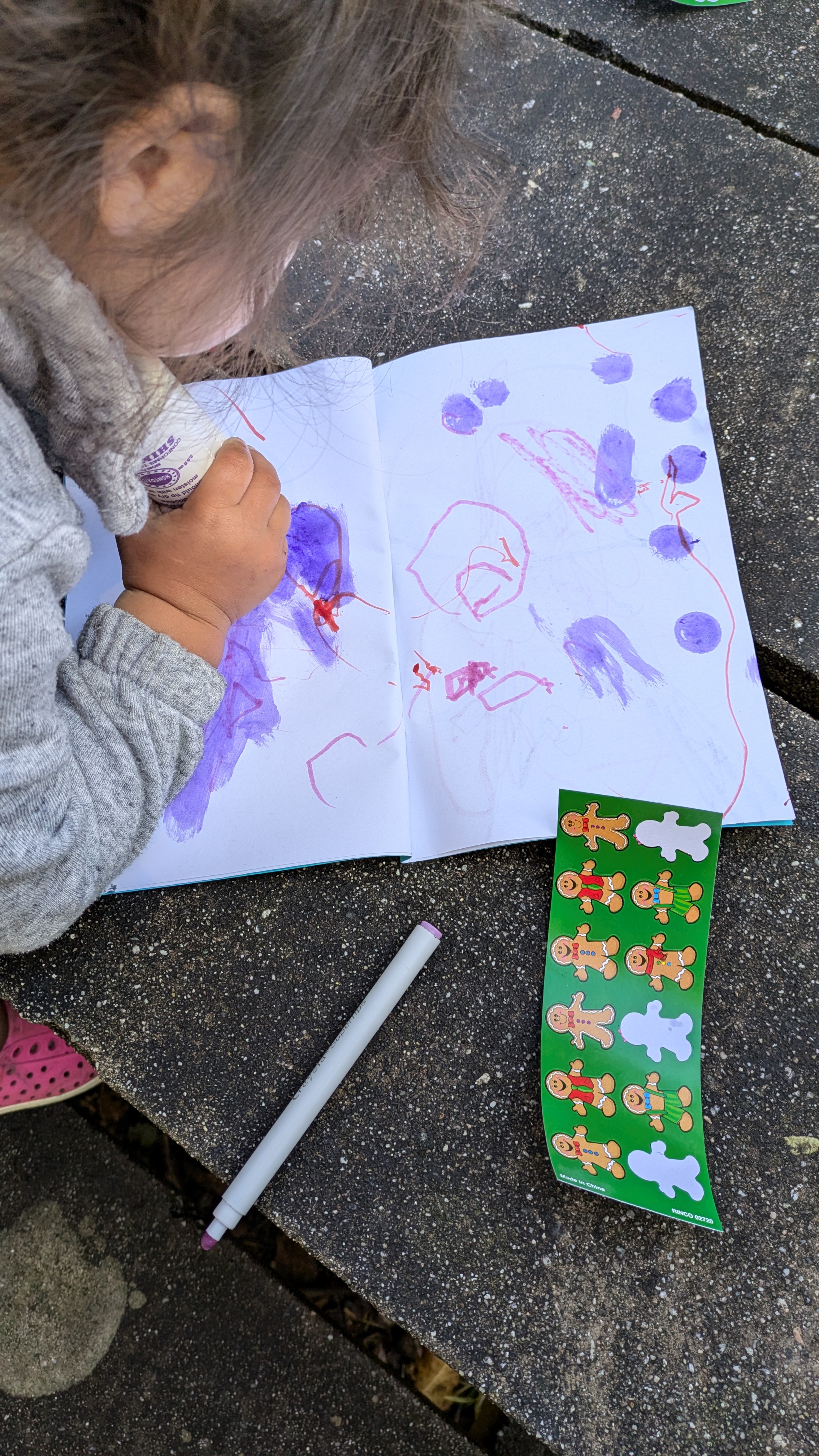
Super simple Stay & Play. Before storytime, I assembled the books by folding three pieces of white paper in half and stapling a folded piece of colored paper around them to make a cover. For the Stay & Play, we put out markers, stickers, and dot markers for the kids to create their own books.

What are your favorite classic picture books? Please share them in the comments below.
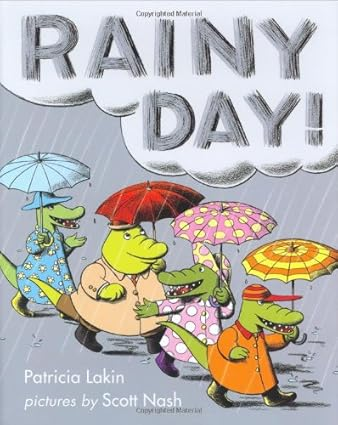
Going Batty: A Storytime for Bat Appreciation Month

October is Bat Appreciation Month, so I was excited to devote a couple of storytimes to celebrating bats.

I started by sharing photos of three different kinds of bats: two that are common in the Bay Area (the Mexican free-tailed bat and the large brown bat), and one that families can visit at the Oakland Zoo (the Malayan flying fox, a large fruit bat). I talked a little bit about how bats eat a lot of the bugs that we don’t like, including lots of mosquitoes, but that some of them eat fruit, and some even drink blood (although they are small, and rarely target people).

Here’s what we did:

Books:

Superbat by Matt Carr

Funny story about a bat who makes himself a costume in order to become Superbat. The problem is that all of the superpowers he has (amazing hearing, the ability to fly, and echolocation) are things that all of his other bat friends can do too. He is about to give up his dream, when his bravery helps him save a family of mice. The kids enjoyed yelling, “Superbat!”

Mr. Bat Wants a Hat by Kitty Black; illustrated by Laura Wood

A cute, colorful picture book about a bat who decides he would like a hat. He takes an especially nice one from a baby, who gets understandably upset. Eventually he feels bad and returns the hat, and is thrilled to receive a pair of socks in return. I had the kids make “Wah!” sounds along with the baby.

I Am Bat by Morag Hood

This is such a simple book, but I really enjoy reading it aloud in my super squeaky “bat voice.” Bat talks about his love for cherries, and is greatly upset when some of them disappear. Luckily, a pear appears in their place. The kids enjoyed naming the different types of animals who are stealing the cherries.

Kit and Caboodle by Anna Pignataro

Sweet story about a witch named Kit, who rescues an injured bat named Caboodle. Her attempts to fix his wing with magic don’t work out, but she cares for him until he recovers, and eventually he ends up rescuing her in return.

Fiona, the Fruit Bat by Dan Riskin; illustrated by Rachel Quiqi

Full disclosure: I was planning to read this one for Family Storytime, but we ran out of time. I think it’s a great book for describing how echolocation works, through a simple story about a young bat flying alone in the dark for the first time.

Trick or Treat, Bugs to Eat by Tracy C. Gold, illustrated by Nancy Leschnikoff

Adorable rhyming Halloween book full of facts about bats. The kids enjoyed making “Eww!” sounds whenever the book described all the yummy bugs the bat is excited to eat.

Songs:

I’m A Bitty Bitty Bat by Stephanie Leavell

I really like this bat-themed movement song, and the kids enjoyed flying around like bats as we sang it. You can add in your own motions.

I’m a [Am] bitty, bitty bat,
A [Dm] bitty, bitty [Am] bat.
[Dm] Flying a-[Am]round,
I’m a [E7] bitty, bitty [Am] bat.

I’m a [Am] great big bat,
A [Dm] great big [Am] bat.
[Dm] Flying a-[Am]round,
I’m a [E7] great big [Am] bat.

Chorus:

I’m [Dm] flying, I’m [Am] flying.
I’m a [E7] bitty, bitty, bitty, bitty bat.
I’m [Dm] flying, I’m [Am] flying.
I’m a [E7] bitty, bitty, bitty, bitty [Am] bat.

I’m a balancing bat,
A balancing bat.
Flying around,
I’m a balancing bat.

Chorus:

I’m flying, I’m flying.
I’m a bitty, bitty, bitty, bitty bat.
I’m flying, I’m flying.
I’m a bitty, bitty, bitty, bitty bat.

I’m a bouncing bat…

The Bats in the Sky

We sang the first verse (below) with the parachute for Outdoor Musical Storytime, raising it up and down as we sang. For Family Storytime, I extended it into a longer song about Halloween, and asked the kids to suggest different things they might see on Halloween. It’s to the tune of The Wheels on the Bus.

The bats in the sky fly up and down,
Up and down, Up and down.
The bats in the sky fly up and down,
All night long.

Halloween version:

The [C] bats in the sky fly up and down,
[G7] Up and down, [C] Up and down.
The [C] bats in the sky fly [G7] up and down,
On Hallo-[C]ween.

The witches in the house go, “Hee, hee, hee!
Hee, hee, hee! Hee, hee, hee!”
The witches in the house go, “Hee, hee, hee!”
On Halloween.

The ghosts in the house go, “Boo! Boo! Boo!”…

The children at the door say, “Trick or Treat!”…

Soooky Bats

We sang this variation of Scary Skeletons with the play scarves for Family Storytime. I had the kids take two scarves each, and wave them like bat wings.

We are spooky bats
Flying down the street,
Flying down the street.
We are spooky bats
Flying down the street.
We’ll scare you…BOO!

Apples and Bananas

We sang this as our instrument play-along, after reading I Am Bat. It’s a silly traditional camp song, but the kids love it, and it’s a great way to focus on the different vowel sounds. I usually change all of the vowels in each line (including the “I like to eat” part), which is different from the way they sing it in this Super Simple Songs video:

I like to [C] eat, eat, eat, apples and ba-[G]nanas.
I like to eat, eat, eat, apples and ba-[C]nanas.
I like to [C] eat, eat, eat, apples and ba-[G]nanas.
I like to eat, eat, eat, apples and ba-[C]nanas.

Ay lake to ate, ate, ate, ayples and baynaynays…

Ee leek to eat, eat, eat, eeples and beeneenees…

I like to īte, īte, īte, īpples, and bīnīnīs… (the ī symbol is for the long “i” sound, which sounds like “eye”)

Oh, loke to oh-te, oh-te, ohte, oh-pples and boh-noh-nohs…

 Ū lūk to ūte, ūte, ūte, ūpples and būnūnūs… (the ū symbol is for the long “u” sound, which sounds like “ooh)

Stay & Play: Sponge Painted Bat Pictures

I based this one on a craft from Tiny Teaching Shack. This was messy, but a fun way to give the kids a chance to try relief art, which is always a bit magical.

Before storytime, I printed lots of bat templates on white cardstock and cut them out (there’s a great collection of them here on OneLittleProject.com). For the Stay & Play, I put out black construction paper, the bat templates, removable restickable glue sticks, paper bowls with different colors of tempera paint, and sponge brushes. I showed the kids how to glue a bat or two onto their black paper ,and then paint the whole paper (including the bat) with the sponge brushes. They loved peeling the bat off at the end to see the shape appear in black in the middle of their painting.

Do you have favorite books or songs about bats? Please share them in the comments below.
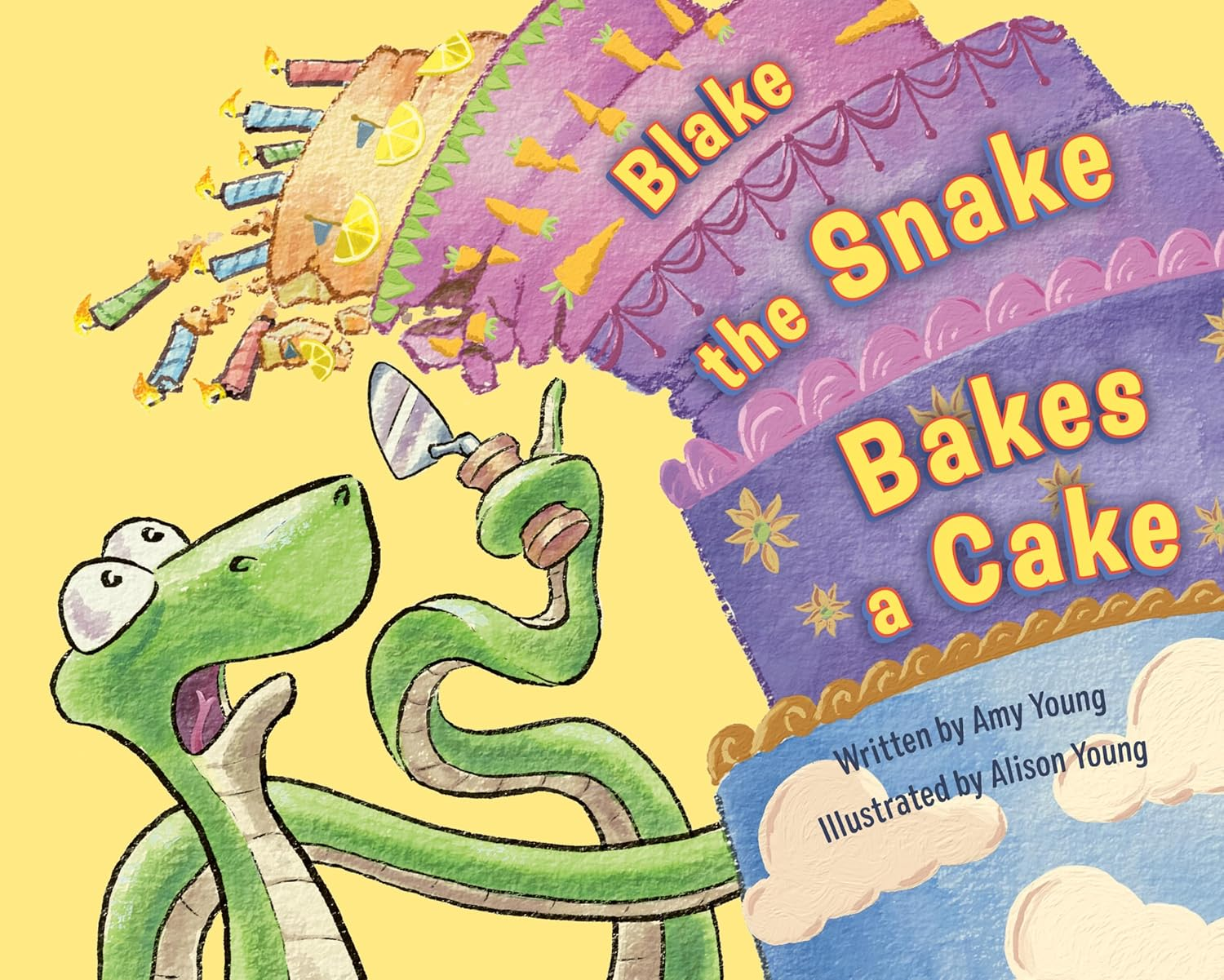
My Summer Adventure: A Storytime About Summer

This year, our library system decided to revamp our annual summer program. For the past several years, we called our program Summer Learning, and gave out reading logs that asked kids to fill in little bubbles each time they read for 20 minutes. This summer, we called our program My Summer Adventure instead. We gave out paper journals with five blank squares for participants to draw or write about different activities they tried over the summer: reading a new book, travelling to a new place, practicing a new skill, attending a library program, etc. The journal entries can be shared with library staff in person, or entered online (the kids get to keep the actual journal as a memento of what they did over the summer). Participants aged 0-18 who share their journal entries can earn up to three raffle tickets for a chance to win a $1,000 college scholarship or a County Parks pass. They can earn an additional raffle ticket by checking something out from the library on their own library card.

So far, the feedback on the new program has been positive, and it’s been nice having kids come in to describe their summer adventures. It has been a bit more challenging to explain the logistics of the program though, so my coworker Claire suggested that we have our storytime families work on their journal entries as one of our Stay & Play activities. So, this week, I decided to a do a storytime about different types of summer adventures, which mostly revolved around traveling. Here’s what we did.

Books:

Bearplane by Deborah Underwood; illustrated by Sam Wedelich

This adorable rhyming book describes a little bear’s flight to a family reunion, covering all of the elements of the trip: packing, going to the airport, waiting in line, going through the metal detector, buying snacks, boarding the plane, sitting for a long time (without kicking the seat in front of you!), etc.

Rattletrap Car by Phyllis Root; illustrated by Jill Barton

This is an older title, but I love it for the humor and all of the wonderful sound effects. On a hot summer day, a family tries to drive to the lake in their rattletrap car, but first they have a flat tire, and then pieces of the car fall off. Luckily, they have a solution for every problem, usually involving chocolate marshmallow fudge delight, which is apparently better than super glue!

Row, Row, Row Your Boat by Jane Cabrera

I love this extended version of Row, Row, Row Your Boat, which features lots of different animals and their sound effects. This book works well for a wide range of ages, and the kids love shouted out the names of each animal. We handed out egg shakers before we read it.

Songs:

The Airplane Song by Laurie Berkner

This is a really fun song, where the kids get to pretend to be airplanes flying and landing, with other actions in between. I asked the kids to suggest different places they’d like to go for each verse.

[C] Get in your airplanes, and [F] off we [G] go.
[C] Going to the park is [F] first, you [G] know.
[C] Now slow it [C7] down and [F] land on the [Fm] ground,
And when you [G] get out,
You’re gonna jump all [C] around.

Get back in your airplanes and off we go.
Going to the California is next, you know.
Now slow it down and land on the ground,
And when you get out,
You’re gonna spin all around.

Get back in your airplanes and off we go.
Going to the New York City is next, you know.
Now slow it down and land on the ground,
And when you get out,
You’re gonna gallop all around.

Get back in your airplanes and off we go.
Going to the playground is next, you know.
Now slow it down and land on the ground,
And when you get out,
You’re gonna dance all around.

Get back in your airplanes, it’s time to go home,
Your family and friends are waiting you know.
Now slow it down and land on the ground,
And come sit down in your own hometown.

Bumping Up and Down in My Little Red Wagon

We sang this with the parachute for Outdoor Musical Storytime, and put some stuffed animals on top, so the kids could make them bounce up and down.

Bumping up and down in my little red wagon.
Won’t you be my darling?

Zoom, Zoom, Zoom, We’re Going to the Moon

We sang this with the play scarves in Family Storytime (I always do it with the parachute for Outdoor Musical Storytime). The kids loved throwing them in the air.

Zoom, Zoom, Zoom,
We’re going to the Moon.
Zoom, Zoom, Zoom,
We’re going to the Moon.
If you want to take a trip,
Climb aboard my rocket ship.
Zoom, Zoom, Zoom,
We’re going to the Moon.
10-9-8-7-6-5-4-3-2-1
Blast-off!

Freight Train

This is one of my all-time favorite songs, and it has an incredible back-story. The original version by Elizabeth Cotten is beautiful, but sad, so I use this kid-friendly version by Elizabeth Mitchell. I ask the kids for different destinations for each verse.

[C] Freight train, Freight train [G7] going so fast.
[G7] Freight train, Freight train, [C] going so fast.
[E7] Please don’t tell what [F] plane I’m on,
So they [C] won’t know [G7] where I’ve [C] gone.

Going to Hawaii, going so fast!
Please don’t tell what train I’m on,
So they won’t know where I’ve gone.

Stay & Play: My Summer Adventure Journals

For our Stay & Play activity, we handed out My Summer Adventure journals to each family, along with crayons and markers. We explained that they could draw or write about things they had done over the summer, including coming to storytime! Since the kids were mostly toddlers and preschoolers, the caregivers usually wrote descriptions and the kids drew or just colored in the box. I gave each family who completed a journal entry a raffle ticket to be entered into our end-of-summer raffle for a $1,000 college scholarship or a County park pass.

Happy end of summer! Does your library offer a summer program? Please tell me about it in the comments below.

Let the Games Begin: A Storytime About the Olympics

The Opening Ceremony for the 2024 Summer Olympic Games was held today in Paris, so this week for Outdoor Musical Storytime and Family Storytime, I focused on the Olympics and some of its featured sports.

I started out by describing the Olympics and some of the sports the kids might see if they watched it on TV: gymnastics, swimming, diving, cycling, running, etc.

Here are the books and songs that I did:

Books:

Curious George and the Summer Games based on the books by Margret & H.A. Rey

Cute story where George sees kids practicing various sports for an upcoming competition, and tries to join in. Although as usual, he gets in a bit of trouble, he ends up saving the day for a friend who gets stage fright during her gymnastics routine. A good overview of a variety of events like hurdles, the relay race, the long jump, and volleyball. I don’t usually read Curious George books because they tend to be too long for toddlers and preschoolers, but the older kids in my Family Storytime were excited that I was reading one.

Koala Lou by Mem Fox; illustrated by Pamela Lofts

Sweet story about a koala whose mother is too busy to remember to say “Koala Lou, I do love you!” the way she used to, so she decides to compete in and win the climbing competition in the Bush Olympics. She practices and practices, but comes in second instead of first. She is devastated, until her mother finds her and says she loves her and she always will. The kids loved joining in during the parts where the crowd cheers. I always get choked up at the end (an embarrassing occupational hazard!).

Dino Swimming by Lisa Wheeler

Cute, rhyming story about a dinosaur swimming competition. The kids enjoyed pointing out the different types of dinosaurs.

Bike On, Bear! by Cynthea Liu; illustrated by Kristyna Litten

Bear can do absolutely anything, except ride a bicycle. Finally, his mother sends him to the library, where he finds a book that describes the steps involved in learning to ride. He still struggles to get the hang of it until he sees a baby goat in need of a quick rescue, and finds he can ride after all. I love the shameless plug for the library. One of the parents remarked afterwards that you really can learn anything there.

Jubari Jumps by Gaia Cornwall

This is such a sweet father and son story, and perfect for storytime because of its large illustrations. Jubari thinks he is ready to try the high dive at the pool, but keeps finding reasons not to climb the ladder. His Dad tells him that sometimes when he is afraid, he takes a deep breath, and finds that the fear turns into a feeling of surprise. Jubari is thrilled to find that it works! Several of the kids had read the book before, but they all seemed to enjoy it.

Songs:

Monkey See, and Monkey Do

We sang this after reading Curious George and the Summer Games. I had a volunteer who mimed the motions with a monkey puppet, and we asked the kids to suggest other motions for the monkey to do.

When you clap, clap, clap your hands,
The monkey clap, clap, claps his hands,
Monkey see, and monkey do,
The monkey does the same as you!

Repeat with other motions: jumping up and down; making a funny face; turning yourself around, etc. I usually end with “When you sit back on the ground…”

Skidamarink A Dink A Dink

We sang this after reading Koala Lou.  I went over the sign language for “I Love You” before we sang the song together. Here’s a link to a YouTube video from Super Simple Songs with the tune:

Skidamarink a-dink, a-dink
Skidamarink a-doo
I love you.
Skidamarink a-dink, a-dink
Skidamarink a-doo
I love you.
I love you in the morning
And in the afternoon.
I love you in the evening
And underneath the moon.
Oh, skidamarink a-dink, a-dink
Skidamarink a-doo
I love you.

We Are the Dinosaurs by Laurie Berkner

We sang this after reading Dino-Swimming. It’s always a hit!

[Dm] We are the dinosaurs [C] marching, marching.
[Dm] We are the dinosaurs. [A] Whaddaya think of that?
[Dm] We are the dinosaurs [C] marching, marching.
[Dm] We are the [A] dinosaurs. [Dm] We make the [C] earth [Dm] flat.
We make the [C] earth [Dm] flat.

[F] We stop and eat our [C] food, [F] when we’re in the [C] mood.
[F] Stop and eat our [C] food on the [Dm] ground.
[F] We stop and eat our [C] food, [F] when we’re in the [C] mood.
[F] Stop and eat our [C] food, and [Dm] then we march [A] around.

[Dm] We are the dinosaurs [C] marching, marching.
[Dm] We are the dinosaurs. [A] Whaddaya think of that?
[Dm] We are the dinosaurs [C] marching, marching.
[Dm] We are the [A] dinosaurs. [Dm] We make the [C] earth [Dm] flat.
We make the [C] earth [Dm] flat.

[F] We stop and take a [C] rest, [F] over in our [C] nest.
[F] Stop and take a [C] rest at the end of the [Dm] day.
[F] We stop and take a [C] rest, [F] over in our [C] nest.
[F] Stop and take a [C] rest, and [Dm] then you’ll hear us [A] say…

[Dm] We are the dinosaurs [C] marching, marching.
[Dm] We are the dinosaurs. [A] Whaddaya think of that?
[Dm] We are the dinosaurs [C] marching, marching.
[Dm] We are the [A] dinosaurs. [Dm] We make the [C] earth [Dm] flat.
We make the [C] earth [Dm] flat.

[A] And then we RO-AR-OAR!
[A] Because [Dm] we [C] are the [Dm]dino-[D]saurs!

The Bears Are Jumping Up and Down

We did this with the parachute at Outdoor Musical Storytime. I put little plastic bear counters on the parachute. The kids loved watching them fly around. I was a little worried in retrospect that they might hurt if they hit someone though, so I think if I do it again, I will use teddy bears instead.

The bears are jumping up and down,
Up and down, up and down.
The bears are jumping up and down,
At the Olympics today.

The bears are running all around,
All around, all around.
The bears are running all around,
At the Olympics today.

Jump Up by Dan Zanes

This is such a happy song! Years ago, my old manager, Thom Ball, and two volunteers and I recorded an album of Musical Storytime songs that we gave away to our storytime families, and Dan Zane kindly gave us permission to include this one. For my storytimes this week, we did it as our instrument play-along at the end. The kids loved jumping up and down as we sang.

[C] Jump up day is breaking
[G7] Jump up let’s get shaking
[C] I know you’re lying down
[F] Jump up and we’ll dance a-[C]round

Jump up bells are ringing
And i hear friends are singing
Oh yea, it’s a crazy sound
Jump up and we’ll dance around

Jump up stand on your tip toes
Reach out grab a rainbow
Turn it upside down
Jump up and we’ll dance it around

Jump up clouds are passing
Look up the sky is laughing
I know we’ll be laughing too
Jump up I want to dance with you

Jump up you know i love you
That’s right i love love love you
A new day is shining down
Jump up and we’ll dance around

Stay & Play: Paper Gold Medals

This was a quick and easy Stay & Play activity. Before storytime, I cut circles out of yellow paper and punched a hole in each one. I also cut pieces of red nylon cord roughly 24″ long.

For the Stay & Play, I put out the circles, cut pieces of cord, and markers. I told the kids they could make themselves a medal for whatever activity they would like to win a medal in: running, eating ice cream, etc.

Do you have any favorite books about the Olympics or Olympic sports? Please share them in the comments below.